

You just received a text with SYFM in it and now you are here, equal parts confused and slightly concerned. That is a completely fair reaction. SYFM meaning in texts is not something most people know off the top of their head, and the full phrase is not exactly gentle. SYFM stands for “Shut Your F*ing Mouth”** — a blunt, aggressive expression used to tell someone to stop talking, usually sent in frustration, anger, or occasionally as very edgy humor between close friends.
What Does SYFM Mean in a Text Message?
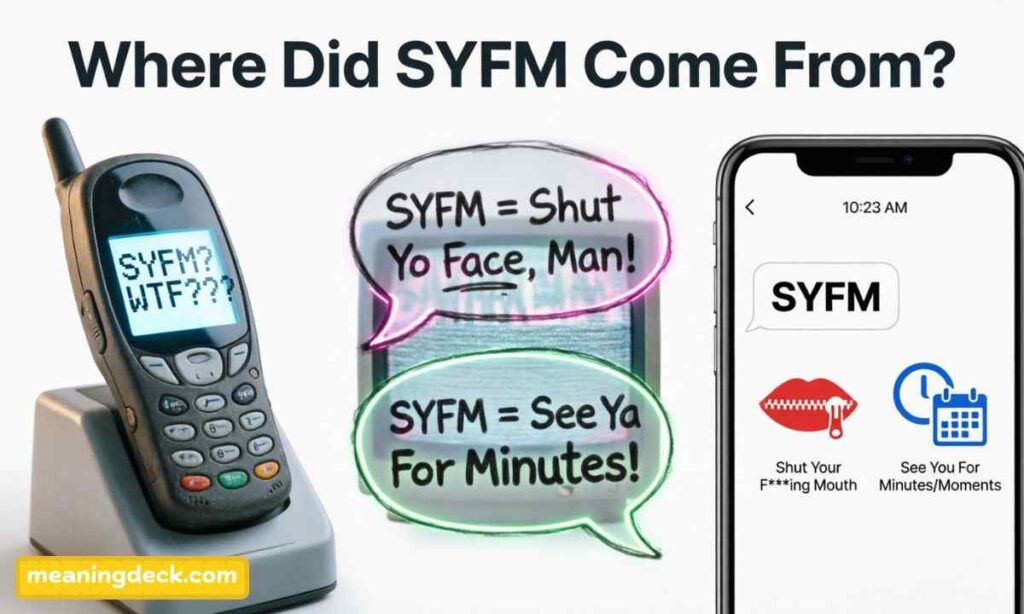
SYFM means “Shut Your F*ing Mouth.”**
It is a strongly worded way of telling someone to be quiet or stop what they are saying. The tone is almost always charged with emotion, whether that is real anger, overwhelming frustration, or the kind of over-the-top reaction close friends sometimes throw at each other when joking around.
There is no soft version of this phrase. It does not have a gentle reading. The moment someone sends SYFM, the conversation has moved into intense territory, and the person on the receiving end is going to feel it.
The Emotional Range Behind SYFM: It Is Not Always What You Think
Here is something most articles skip entirely: SYFM does not always signal genuine hostility.
The meaning shifts dramatically depending on who sends it and why. Understanding that range saves a lot of unnecessary panic.
SYFM as real anger: This is the version that means exactly what it says. Someone has heard enough, they are genuinely upset, and they want the conversation to stop immediately. No humor, no softness, just a hard stop.
SYFM as extreme frustration: Sometimes people are not angry at the person they are texting. They are overwhelmed by a situation and venting hard. SYFM in this context is emotional release more than a direct attack.
SYFM as dramatic humor: Between very close friends with that kind of relationship, SYFM can function almost like an eye roll in text form. It means “stop it, you are being ridiculous” rather than “I am genuinely furious.” This version usually comes with context that makes the joke obvious.
SYFM as shock or disbelief: When someone shares something absolutely unbelievable, a friend might respond with SYFM the same way someone would say “no way” or “stop it.” It expresses that the information is too wild to process.
Reading which version you received requires looking at everything around it, not just the abbreviation itself.
Where Did SYFM Come From?
Read This: DPMO Meaning: The Simple, Clear Answer You Actually Need
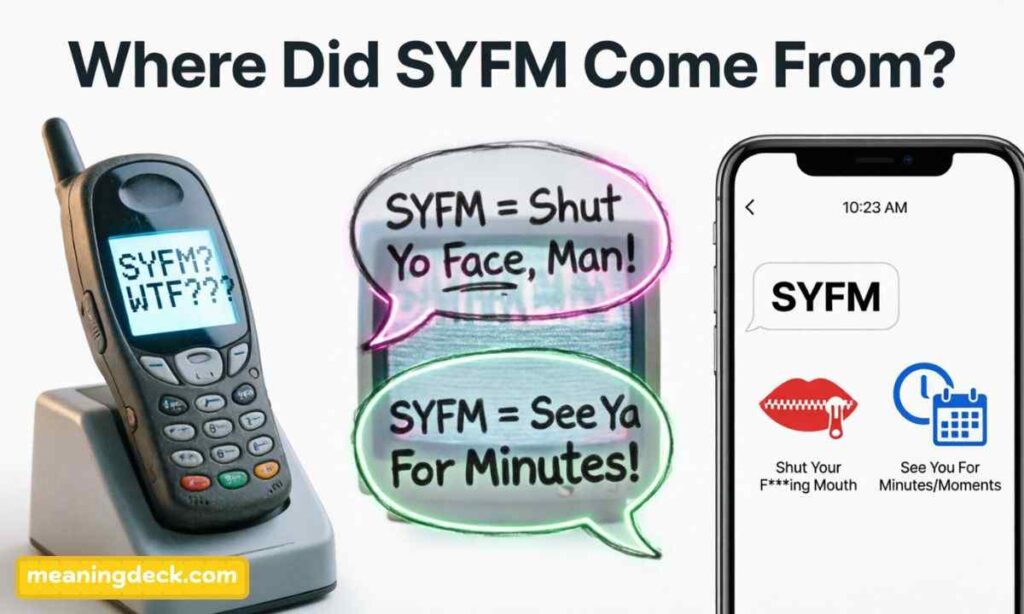
SYFM belongs to a long tradition of abbreviated profanity in digital communication.
The phrase “shut your mouth” itself is centuries old. It has always been a sharp way to silence someone, used in arguments, confrontations, and dramatic moments across cultures and generations. Adding the intensifying word in the middle simply amplified the phrase to match stronger emotions.
When text messaging became mainstream in the late 1990s and early 2000s, people began compressing emotional expressions aggressively. Typing a full sentence while angry felt counterproductive. Short, punchy abbreviations let people communicate intensity without slowing down. WTF, STFU, and LMFAO all emerged from this same era and the same need.
SYFM grew from that same environment. It is specifically a more extreme version of STFU (Shut The F* Up)**, with the word “mouth” replacing “up” to make the image more direct and physical. By the mid-2000s, it was established in online forums, gaming chats, and eventually migrated into mainstream texting culture.
Historical and Cultural Roots of Commanding Silence
The act of commanding someone to stop speaking goes much deeper than internet slang.
In ancient Greek culture, orators and philosophers placed enormous importance on knowing when to speak and when to stay silent. Silence was considered wisdom. Telling someone to be quiet was not just an insult, it was a judgment on their lack of wisdom. The Stoic philosopher Epictetus wrote that we have two ears and one mouth for a reason, a concept that has echoed through philosophy for centuries.
In Biblical tradition, the value of guarding one’s speech appears throughout Proverbs. Proverbs 17:28 states that even a fool appears wise when they keep silent. Commanding silence, in that framework, carries moral weight beyond simple argument.
In Medieval royal courts, speaking out of turn in front of a monarch could be a punishable offense. “Hold your tongue” was not just a social request; it carried real consequences. The command to silence someone has always carried power, authority, and emotion in human interaction.
SYFM is the 21st century text message version of that same ancient impulse, just with considerably less ceremony and considerably more abbreviation.
SYFM vs. Similar Aggressive Abbreviations: A Quick Comparison
Knowing how SYFM sits among related expressions makes it much easier to understand the difference in intensity.
| Abbreviation | Full Phrase | Intensity Level | Typical Context |
| SYFM | Shut Your F***ing Mouth | Very High | Anger, frustration, or intense humor |
| STFU | Shut The F*** Up | High | Frustration, arguments, gaming chats |
| STF | Shut The F*** | Moderate to High | Abbreviated frustration |
| SMH | Shaking My Head | Low to Moderate | Mild disapproval or disbelief |
| WTF | What The F*** | Moderate to High | Shock, confusion, or frustration |
| FFS | For F***’s Sake | Moderate | Exasperated frustration |
| NVM | Never Mind | Low | Dismissal without anger |
As the table shows, SYFM sits at or near the top of the intensity scale. It is more targeted than WTF and more physically direct than STFU. Using it carries more emotional weight than most other abbreviations in this category.
Real Life Examples of SYFM Used in Text Conversations
Reading it in context makes the range of usage completely clear.
Example 1 (Genuine Anger): Person A: “I told you not to tell anyone and you told literally everyone.” Person B: “I only told two people, it is not that serious.” Person A: “SYFM right now, I am done with this conversation.” Meaning: Real anger, real boundary, conversation is closing fast.
Example 2 (Venting Frustration): Friend: “My boss just gave me three extra projects five minutes before I was leaving. SYFM with this job.” Meaning: Not directed at the friend at all. Pure emotional venting about a situation.
Example 3 (Dramatic Humor Between Close Friends): Friend A: “I just accidentally called my teacher ‘mom’ in front of the whole class.” Friend B: “SYFM that did not happen.” Meaning: Disbelief and humor. This is closer to “stop it, no way” than genuine hostility.
Example 4 (Shock Response): Friend A: “She showed up to the wedding in white.” Friend B: “SYFM.” Meaning: The information is so outrageous that the response is pure shock compression.
How Tone and Relationship Completely Change SYFM?
This is the detail that saves the most misunderstandings.
SYFM from a stranger or acquaintance almost always reads as genuinely aggressive or hostile. There is no established relationship to soften the phrase, so the full weight of the words lands directly.
SYFM from a close friend can mean almost the opposite depending on your dynamic. Some friendships run on sarcasm, sharp humor, and deliberately exaggerated reactions. In those relationships, SYFM functions more like a dramatic “stop it” than an actual attack.
SYFM in an argument is a serious escalation. If a conversation was already tense and someone drops SYFM, that is a signal that things have moved from a disagreement to something more heated. Responding carefully at that point matters.
SYFM in a casual reaction to news or a story usually signals surprise and disbelief more than anger. Reading the full conversation will tell you which one you are dealing with.
The phrase itself never changes. The relationship and context around it change everything.
Common Mistakes People Make With SYFM in Texts
A few patterns show up repeatedly when people misjudge this abbreviation.
Mistake 1: Sending it as humor to someone who will not take it that way. What feels like playful exaggeration to you might feel like a genuine attack to someone who does not share your communication style. Know your audience before sending SYFM as a joke.
Mistake 2: Assuming it is always a joke. The opposite mistake is equally common. Receiving SYFM from someone who is actually angry and brushing it off as “they are just being dramatic” misses the signal completely. Pay attention to the full tone of the conversation.
Mistake 3: Using it in any professional or semi-professional context. There is no world in which SYFM belongs in a work group chat, a school-related message thread, or any setting with authority figures or professional relationships. This is strictly personal, casual communication territory.
Mistake 4: Responding to SYFM with more escalation. If someone sends you SYFM and they mean it genuinely, matching that energy usually makes things worse. Sometimes the smartest reply is no reply at all, at least until the temperature drops.
Should You Use SYFM in Your Texts?
This depends entirely on who you are texting and what kind of relationship you share.
Use SYFM only when:
- You are texting someone who knows your humor and communication style deeply
- The context makes the emotional intent completely clear
- The conversation is casual, personal, and between people with an established dynamic
- You are venting about a situation and both parties understand that clearly
Avoid SYFM when:
- You are texting someone you do not know well
- The conversation is already tense and you do not want to escalate it further
- You are in any kind of professional or authority-adjacent relationship
- There is any chance the other person might take it literally and feel genuinely attacked
If you want to express strong frustration without the full intensity of SYFM, consider “I need a break from this conversation,” “please stop,” or even STFU if you need something stronger than words but softer than SYFM. The goal is always communication, not collateral damage.
What to Do If Someone Sends You SYFM
Receiving SYFM can feel jarring if you are not expecting it. Here is how to handle it without making things worse.
Step 1: Read the context first. Before reacting, look at the full conversation. Is this person genuinely angry? Are they venting? Is this their usual humor? The answer changes your response completely.
Step 2: Do not match aggression with aggression. If they mean it seriously, escalating will extend the conflict. Give it space before replying.
Step 3: Ask for clarity if needed. If you genuinely cannot tell whether SYFM was a joke or a real reaction, it is completely fair to ask. “Are you actually upset with me or was that a joke?” is a reasonable response that shows you are paying attention.
Step 4: Set your own boundary if the message felt genuinely aggressive. You do not have to absorb hostility in silence. Calmly naming what you experienced, “that felt really harsh,” is a fair and grounded response to an aggressive message.
Read This: D1 Meaning: The Complete Guide to What D1 Really Stands For
SYFM and the Broader Culture of Aggressive Online Slang
SYFM is not an isolated phrase. It belongs to a broader category of internet slang that compresses strong emotion into short, sharp abbreviations.
This style of communication reflects something real about digital conversation: text removes tone, facial expression, and body language. When those tools disappear, people reach for intensity through word choice. Profanity-laced abbreviations became a way to communicate emotional weight that plain words in a text message could not always carry.
Researchers who study computer-mediated communication have noted that online environments often produce more extreme language precisely because the natural regulators of face-to-face conversation are absent. Nobody can see you blush, hesitate, or soften your expression before speaking. So the words do all the work.
SYFM exists because sometimes people need a text-sized container for a very large emotion. Whether that emotion is genuine anger or dramatic humor, the abbreviation delivers it instantly.
Frequently Asked Questions
Is SYFM always meant as an insult?
Not always. Between close friends with compatible humor, it can function as a dramatic reaction to surprising news rather than a genuine attack. However, in most contexts outside of tight friendships, it carries aggressive intent. Reading the relationship and the surrounding conversation is essential.
How is SYFM different from STFU?
Both are aggressive commands to stop talking, but SYFM is considered slightly more direct and intense because it references the mouth specifically, making the image more physical and pointed. STFU is more widely used and slightly more recognized; SYFM tends to carry an extra edge.
What should I do if a stranger texts me SYFM?
That is a clear signal of hostility from someone you do not know. You are completely entitled to disengage, block, or report depending on the platform. There is no obligation to respond to aggressive messages from strangers.
Final Thoughts
SYFM packs an enormous amount of emotion into four letters. It can mean genuine anger, frustrated venting, or the kind of dramatic humor only certain friendships support. The phrase itself never changes; the relationship and context around it define everything.
Now that you know exactly what it means, where it comes from, and how it functions across different situations, you will never misread it again. And if you choose to use it yourself, you will do so with a clear understanding of exactly what you are sending and to whom.

Welcome to MeaningDeck! I’m Alex, an AI-Powered SEO, and Content Writer with 2 years of experience.
I help websites rank higher, grow traffic, and look amazing. My goal is to make SEO and web design simple and effective for everyone.
Let’s achieve more together!