

You searched for RLS meaning and ended up with a pile of confusing abbreviations, half-explained answers, and medical jargon that made your head spin. Sound familiar? You are not alone. RLS is one of those short terms that can mean wildly different things depending on where you encounter it. This article clears all of that up, fast. By the time you finish reading, you will know exactly what RLS means, where it comes from, and how to use it correctly in any context.
What Does RLS Mean?
RLS stands for Restless Legs Syndrome in the medical world. It is a neurological condition where a person feels an uncontrollable urge to move their legs, usually triggered by discomfort, tingling, or a crawling sensation, especially at night or while resting.
But hold on. If you are in a tech or database environment, RLS means something completely different: Row Level Security. And in some legal or finance circles, it can even refer to Regulatory Licensing Standards.
So the short answer is: RLS meaning depends entirely on context. The good news is that once you understand each version, it becomes very easy to tell them apart.
RLS in Medicine: Restless Legs Syndrome Explained Simply
Imagine lying in bed, finally ready to sleep, and your legs suddenly feel like they have ants marching through them. You move your legs for relief, the feeling goes away for a moment, and then it comes back. That is the daily reality for people with Restless Legs Syndrome.
RLS is classified as a neurological sensorimotor disorder. It affects the nervous system and interferes with the body’s ability to stay still. The urge to move is not a choice. It is a symptom driven by internal signals that the brain sends incorrectly.
Key facts about medical RLS:
- It often gets worse in the evening or nighttime
- Movement temporarily relieves the discomfort
- It can seriously disrupt sleep and daily quality of life
- It affects roughly 5 to 10 percent of adults worldwide
- Women are more likely to experience it than men
Read This: Gyatt Meaning: What It Means, Where It Came From & How to Use It (2026)
Where Did the Term RLS Come From? A Brief History
The condition was not just named randomly by a bored doctor on a slow Tuesday. Restless Legs Syndrome was first formally described by Swedish neurologist Karl-Axel Ekbom in 1945. Because of this, it is sometimes also called Ekbom Syndrome in older medical literature.
Ekbom documented patients who described uncomfortable sensations in their legs that improved only with movement. He recognized it as a distinct neurological condition rather than just anxiety or general discomfort.
Interestingly, descriptions that match RLS symptoms appear in historical texts going back centuries. Some medical historians believe Thomas Willis, a 17th century English physician, described something very similar in 1672, making it possibly one of the oldest documented neurological complaints in history.
Not bad for a condition that many people still think is just “being fidgety.”
RLS in Technology: Row Level Security
Now let us switch lanes completely. If you are a developer, database administrator, or working with tools like PostgreSQL, SQL Server, or Salesforce, then RLS means something entirely different to you.
Row Level Security (RLS) is a database feature that controls which rows of a table a specific user can access. Instead of showing every user everything in a database, RLS filters the data based on the user’s identity, role, or permissions.
Think of it like a restaurant menu that shows different options depending on who you are. A regular customer sees the standard menu. A VIP customer sees additional items. The kitchen has everything, but not everyone sees the same thing.
Why RLS matters in databases:
- It protects sensitive data by restricting row-level access
- It simplifies security policies without needing complex code
- It works invisibly in the background, so users only see what they are allowed to see
- It is especially important in multi-tenant applications where different companies share the same database but should never see each other’s data
Quick Comparison Table: RLS Meanings at a Glance
| Context | RLS Stands For | Where You See It |
| Medicine / Health | Restless Legs Syndrome | Hospitals, clinics, sleep studies |
| Technology / Databases | Row Level Security | PostgreSQL, SQL Server, Salesforce |
| Legal / Finance | Regulatory Licensing Standards | Compliance documents, audits |
| Aviation (rare) | Runway Lighting System | Airport operations manuals |
The table above shows you at a glance why context is everything when interpreting RLS.
Real Life Usage Examples of RLS
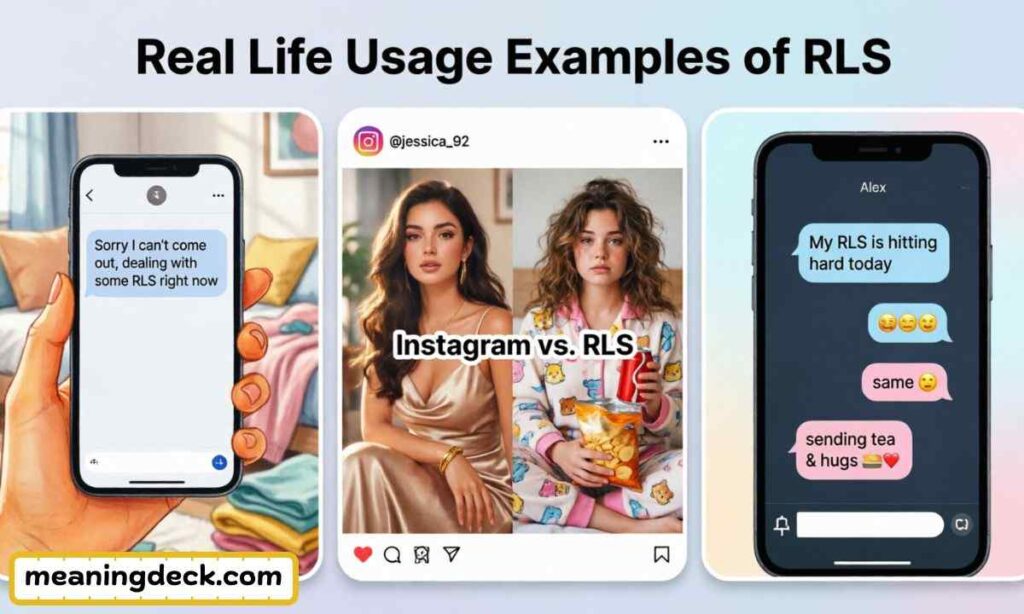
Sometimes seeing a term used in an actual sentence makes everything click. Here are clear, real-world examples for each major RLS meaning:
Medical RLS: “My doctor diagnosed me with RLS after I kept waking up at night with that uncomfortable tingling in my legs.”
“Restless Legs Syndrome is often underdiagnosed because many people assume it is just stress or poor circulation.”
Technology RLS: “We implemented Row Level Security in our PostgreSQL database so that each client only sees their own records.”
“Without RLS, any user with database access could potentially view confidential data from other accounts.”
Legal / Compliance: “The firm had to meet all Regulatory Licensing Standards before launching operations in the new market.”
Each of these examples shows how the same three letters carry completely different weight depending on the conversation happening around them.
Common Mistakes People Make With RLS
Here is where things get a little embarrassing for a lot of people. These are the most common RLS mistakes worth avoiding.
Mistake 1: Assuming it always means the medical condition. If a developer says “we need to set up RLS,” they almost certainly mean Row Level Security, not legs. Context matters more than the abbreviation itself.
Mistake 2: Confusing symptoms with a different condition. People often mistake RLS for general leg pain, muscle cramps, or even anxiety. The defining feature of Restless Legs Syndrome is the irresistible urge to move, combined with relief upon movement. That distinguishes it clearly.
Mistake 3: Thinking RLS in databases is optional. Some developers skip Row Level Security thinking other security layers are enough. In multi-user or multi-client environments, that is a serious risk. RLS is not decoration. It is essential.
Mistake 4: Using the full term only once and then abbreviating without explanation. When writing about RLS, always define it fully on first use. Never assume your reader already knows which version you mean.
How RLS Is Diagnosed and Treated (Medical Focus)
Since Restless Legs Syndrome is the most commonly searched version of RLS, it is worth going a little deeper here.
There is no blood test or scan that definitively diagnoses RLS. Doctors rely on a set of four core criteria established by the International Restless Legs Syndrome Study Group:
- An urge to move the legs, usually with uncomfortable sensations
- The urge begins or gets worse during periods of rest or inactivity
- The urge is partially or completely relieved by movement
- The urge is worse in the evening or at night
Treatment options vary based on severity. Mild cases often improve with lifestyle changes like regular exercise, reducing caffeine, and improving sleep habits. More severe cases may require medication, including dopamine agonists or iron supplementation if low iron levels are a contributing factor.
The connection to iron is particularly interesting. Research has shown that low iron levels in the brain, not necessarily in the blood, can trigger or worsen RLS symptoms. This is why some patients show normal blood iron levels but still benefit from iron therapy.
How Row Level Security Actually Works (Tech Focus)
For the tech readers, here is a cleaner picture of how RLS functions in a real database setup.
When you enable Row Level Security on a table in PostgreSQL, for example, you then create policies that define who can see or modify which rows. Without a policy, no user (except the table owner) can access any rows at all.
A simple policy might say: “Users can only see rows where the user ID column matches their own ID.” The database enforces this automatically every time a query runs. The application code does not need to add special filters. The security lives at the database level.
This is powerful because it means even if someone makes a coding mistake in the application, the database itself still protects the data. RLS acts as a safety net that sits below everything else.
Which RLS Meaning Should You Use?
This is the practical question. Here is a clear guide:
Use “Restless Legs Syndrome” when:
- You are in a medical, clinical, or health-related conversation
- You are discussing sleep disorders, neurology, or chronic conditions
- Someone describes uncomfortable leg sensations that worsen at rest
Use “Row Level Security” when:
- You are working in software development, databases, or data engineering
- You are discussing user permissions, data access, or security architecture
- You hear it in the context of PostgreSQL, Snowflake, SQL Server, or Salesforce
Use “Regulatory Licensing Standards” when:
- You are in a legal, compliance, or financial context
- You are dealing with industry certifications, audits, or government regulations
When in doubt, ask for context. A three-letter abbreviation never tells the whole story on its own.
Read This: OTW Meaning: What It Really Means and How to Use It Right
Related Terms Worth Knowing
As you learn more about RLS, a few related terms will keep appearing. Here is what they mean:
PLMD (Periodic Limb Movement Disorder): Often confused with Restless Legs Syndrome, PLMD involves involuntary limb movements during sleep. The difference is that RLS happens while awake, while PLMD happens during sleep and the person is usually unaware of it.
Dopamine: A brain chemical closely linked to RLS. Problems with dopamine signaling in the brain are believed to be a major cause of Restless Legs Syndrome.
Multi-tenant Architecture: A database design where multiple clients share the same database. This is the most common environment where Row Level Security becomes critical and non-negotiable.
Ekbom Syndrome: The older, clinical name for Restless Legs Syndrome, named after the doctor who formally identified it.
Frequently Asked Questions
Can RLS go away on its own?
In some cases, yes. RLS linked to pregnancy often resolves after delivery. RLS caused by iron deficiency may improve significantly after iron levels are corrected. However, primary Restless Legs Syndrome is typically a long-term condition that requires ongoing management rather than a one-time cure.
Is Row Level Security the same as Column Level Security?
No, and this is a common point of confusion in databases. Row Level Security (RLS) controls which rows a user can see. Column Level Security controls which columns a user can access. Both can be used together for comprehensive data protection, but they operate at different levels of the table.
How common is RLS (Restless Legs Syndrome) really?
More common than most people realize. Studies suggest that between 5 and 15 percent of the general population experiences some form of RLS, with symptoms ranging from mild and occasional to severe and nightly. Many cases go undiagnosed because people dismiss the symptoms as normal tiredness or stress.
Final Thoughts
RLS is a small abbreviation carrying big meaning. In the medical world, it describes Restless Legs Syndrome, a neurological condition that disrupts sleep and daily comfort for millions of people. In the tech world, it describes Row Level Security, an essential database feature that protects sensitive data at the row level.
The key to using RLS correctly is always starting with context. Know your audience, know your field, and define the term clearly on first use. That single habit eliminates almost every confusion around this abbreviation instantly.
Now you know more about RLS than most people who have been using the term for years. And you did not even have to sit still uncomfortably to learn it.

Welcome to MeaningDeck! I’m Alex, an AI-Powered SEO, and Content Writer with 2 years of experience.
I help websites rank higher, grow traffic, and look amazing. My goal is to make SEO and web design simple and effective for everyone.
Let’s achieve more together!