

You heard someone say “she’s been MIA lately” and nodded like you totally understood. But deep down, a small voice whispered, “Wait, what does MIA actually mean?” You are not alone. This phrase pops up in texts, news headlines, military reports, and even casual office conversations. So let’s settle this once and for all. MIA means “Missing In Action.” It describes someone or something that has disappeared, cannot be located, or is absent without explanation.
What Does MIA Mean in Simple Words?
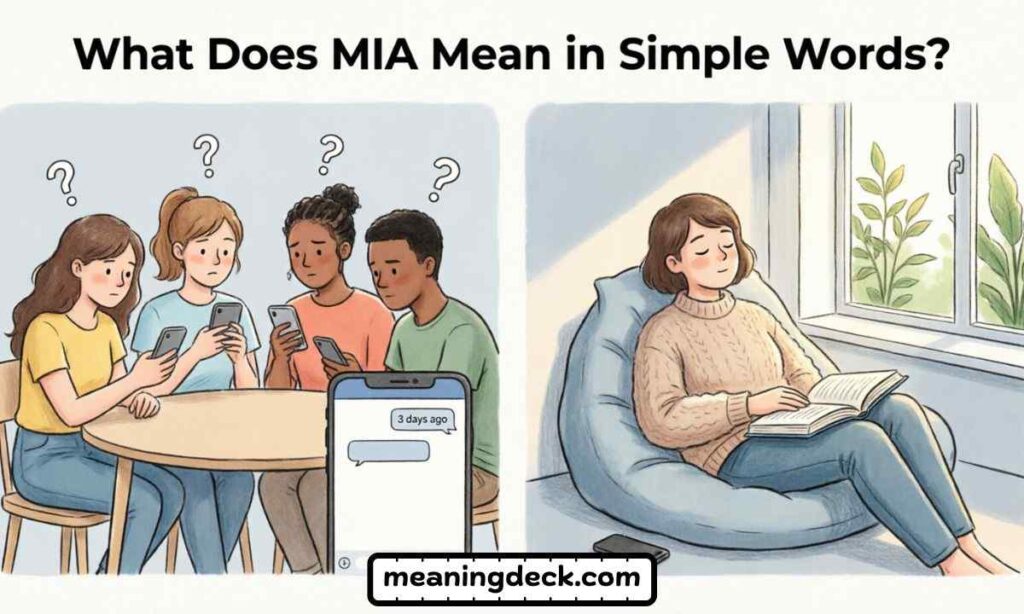
MIA stands for Missing In Action. In its most basic sense, it refers to a person who has disappeared and whose whereabouts are completely unknown.
Originally, this term was used strictly in military contexts. When a soldier could not be found after a battle and was neither confirmed dead nor taken prisoner, they were officially classified as MIA.
Today, people use it far beyond the battlefield. If your friend vanishes from group chats for two weeks, congratulations, they are now “MIA.”
The Military Origin of MIA
The term Missing In Action became widely recognized during World War II and grew even more prominent during the Vietnam War in the 1960s and 1970s.
Thousands of American soldiers were listed as MIA during Vietnam, and their families spent years, sometimes decades, waiting for answers. It became one of the most emotionally painful military classifications a family could receive.
The U.S. Department of Defense still maintains an official list of MIA personnel from past conflicts. It is a deeply serious term with real human stories behind it.
So yes, when someone uses it casually about a missing pizza delivery guy, there is a bit of historical weight being borrowed there.
MIA in Everyday Language: How It Evolved
Language does not stay in one box. Over time, MIA jumped from military files into everyday speech, and it fits surprisingly well.
People now use MIA to describe:
- A friend who has not replied to texts in days
- An employee who skipped work without notice
- A product that went out of stock with no warning
- A celebrity who disappeared from social media
The beauty of this term is that it captures the exact feeling of something being gone without explanation. No goodbye. No warning. Just gone.
Read This: FOMO Meaning: What It Is, Why You Feel It & Where It Came From (2026)
MIA Meaning in Texting and Social Media
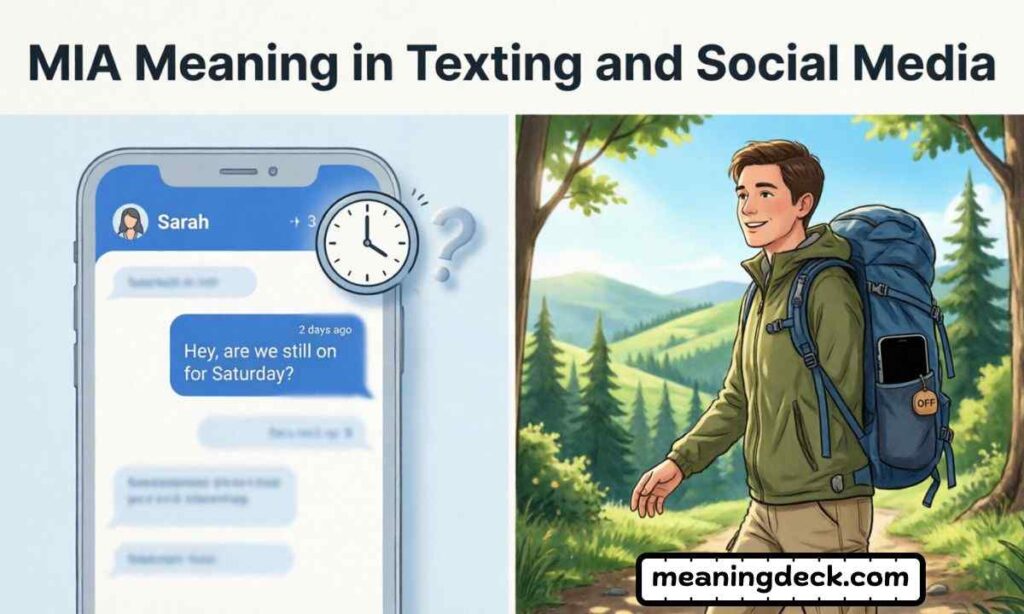
In modern texting and online culture, MIA is used casually and constantly. It does not carry any military weight in these conversations. It simply means someone has been unreachable, quiet, or absent.
Here are a few real-life texting examples:
- “Sorry I’ve been MIA, work has been crazy.”
- “Where have you been? You’ve been MIA all week.”
- “He ghosted the whole group chat. Total MIA behavior.”
On social media, people also say things like “Going MIA for a few days” when they plan to take a digital detox. It is basically the polished way of saying “I am disappearing and I will not be answering your memes.”
MIA Meaning in Different Fields: A Quick Comparison
The same three letters carry different weight depending on where you see them. Here is a clear breakdown:
| Context | What MIA Means | Tone |
| Military | Missing In Action (soldier unaccounted for) | Serious, official |
| Everyday speech | Person who has disappeared or gone quiet | Casual, informal |
| Workplace | Employee absent without explanation | Neutral to serious |
| Social media | Someone taking a break or going offline | Light, informal |
| News and media | Public figure who has vanished from spotlight | Descriptive |
As you can see, the core meaning stays the same across all contexts. Someone or something is simply not where it is supposed to be.
Is There a Biblical or Historical Reference to MIA?
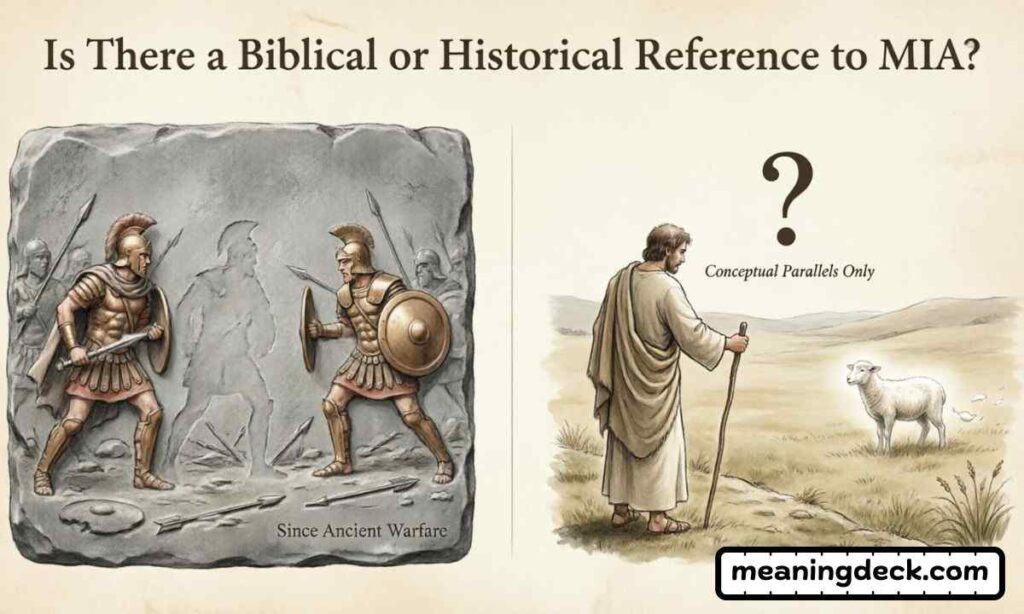
While the exact acronym MIA is modern, the concept behind it is ancient.
In the Bible, the story of the Prodigal Son (Luke 15:11–32) tells of a son who leaves home, disappears from his family’s life, and then returns. His father says the famous line: “This my son was dead, and is alive again; he was lost, and is found.” That is essentially the MIA story, just told in a tunic instead of a text message.
Throughout ancient warfare, soldiers who vanished in battle were mourned without certainty. Families of Roman, Greek, and Persian soldiers also lived with the painful uncertainty of not knowing what happened to their loved ones.
MIA as a human experience is thousands of years old. The acronym is just a modern shortcut for a timeless feeling.
Common Mistakes People Make When Using MIA
Even short phrases get misused. Here are the most common errors to avoid:
Mistake 1: Treating MIA as always military Many people assume MIA only belongs in war discussions. Not true. It is perfectly correct in casual settings.
Mistake 2: Writing it as “M.I.A.” with periods In modern usage, MIA without periods is the standard. Adding periods makes it look dated and overly formal.
Mistake 3: Confusing MIA with KIA KIA means Killed In Action. These are two very different classifications. MIA means the person’s fate is unknown. KIA means the person has died in combat. Using them interchangeably is a serious error.
Mistake 4: Using MIA for someone you simply disagree with If someone blocks you, they are not MIA. They know exactly where they are. They just do not want you knowing where that is.
MIA vs. AWOL: What Is the Difference?
This is a question that trips up a lot of people, so let’s clear it up quickly.
| Term | Full Form | Meaning |
| MIA | Missing In Action | Whereabouts completely unknown, often in combat |
| AWOL | Absent Without Official Leave | Person left intentionally without permission |
The key difference is intent and knowledge. An MIA person cannot be found and may not have chosen to disappear. An AWOL person made a deliberate choice to leave without authorization.
In casual speech, people sometimes use both interchangeably, but technically they describe very different situations.
How to Use MIA Correctly in a Sentence?
Using MIA in writing or conversation is simple once you understand its meaning. Here are examples across different situations:
Casual: “My gym motivation has been completely MIA since January.”
Workplace: “Three team members were MIA during the Monday call, and nobody sent an email.”
Serious: “He was listed as MIA after the battalion lost contact during the operation.”
Humorous: “My willpower to avoid dessert? Absolutely MIA. Has been since 2019.”
Notice how the tone changes based on context, but the core usage stays consistent. Someone or something is absent and unaccounted for.
Read This: Rabe Meaning Slang: Definition, Origin & Usage Guide
Which Version Should You Use?
If you are writing for a formal or professional audience, spell it out at first mention: Missing In Action (MIA). After that, MIA alone is fine.
If you are texting or posting casually, just use MIA directly. No explanation needed. Your audience already gets it.
If you are writing about a military topic, be careful and respectful. The term carries real emotional significance for many families who have lived through it.
When in doubt, ask yourself: does the context make the meaning clear? If yes, use MIA freely. If there is any chance of confusion, add a brief clarification.
Related Terms You Should Know
While exploring MIA, it helps to know a few related terms that often appear nearby:
POW (Prisoner of War): A soldier captured and held by the enemy. Different from MIA because their location is known.
KIA (Killed In Action): A soldier confirmed to have died during military operations.
Ghost: In modern slang, to ghost someone means to suddenly cut off all contact. Essentially going MIA on purpose.
Off the grid: Choosing to disconnect completely from technology and communication. A voluntary MIA.
These terms often travel together, especially in military writing and modern slang conversations.
Frequently Asked Questions
Can MIA be used for objects, not just people?
Absolutely. You can say “my motivation has been MIA” or “the office stapler is MIA.” The term works for anything that has disappeared without explanation.
Is MIA a negative term?
Not always. In military contexts, it carries serious and often painful weight. In casual speech, it is neutral or even lighthearted. “I’ve been MIA” said by a friend usually just means they were busy, not that anything bad happened.
Is there a difference between MIA and “missing person”?
Yes. A missing person is a legal or official classification, usually reported to authorities. MIA is a descriptive term, originally military, now used broadly in speech and writing. A missing person case is formal. Calling your friend MIA is just a conversation.
Final Thoughts
MIA is one of those rare terms that crossed from war rooms into text messages without losing its meaning. Whether you see it in a history book about Vietnam or in a friend’s apology text after two weeks of silence, the message is the same: someone was gone, and now we are talking about it.
Use it correctly, understand its origins, and respect the weight it carries in serious contexts. And if you have been MIA from something important lately, well, now you at least have the perfect word to describe your situation when you finally come back.

Welcome to MeaningDeck! I’m Alex, an AI-Powered SEO, and Content Writer with 2 years of experience.
I help websites rank higher, grow traffic, and look amazing. My goal is to make SEO and web design simple and effective for everyone.
Let’s achieve more together!