

You scroll through Instagram and see your friends at a rooftop party you were never invited to. Your stomach drops. Your brain whispers, “You should have been there.” That feeling has a name. FOMO, short for Fear Of Missing Out, is the anxious, nagging sense that others are living better, doing more, and experiencing things you are not. And yes, it is very real, very common, and very annoying.
What Does FOMO Mean Exactly?
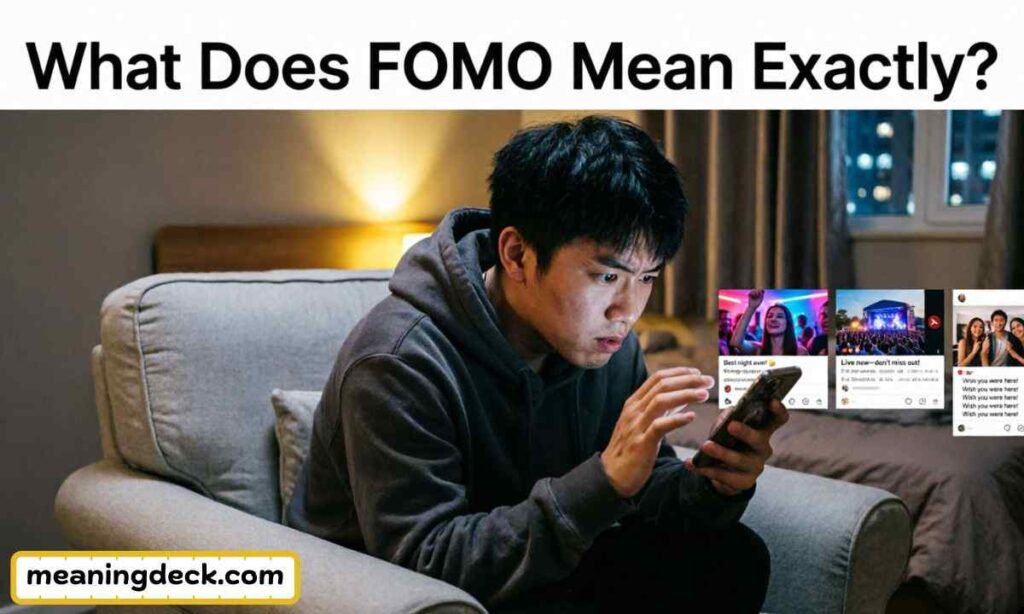
FOMO stands for Fear Of Missing Out. It means a feeling of anxiety or unease that comes when you believe other people are having rewarding experiences that you are not part of.
It is not just about parties. FOMO shows up when you skip a sale and later see others bragging about their deals. It shows up when you leave a conversation early and spend the next hour wondering what you missed. At its core, FOMO is the brain’s way of saying, “Hey, what if something better is happening without you?”
Simple answer? FOMO = the fear that you are missing something good.
Where Did the Word FOMO Come From?
Read This: SYFM Meaning in Text: What It Means & When to Use It
This is where it gets interesting. Most people think FOMO is a social media invention, but the feeling itself is ancient.
Patrick McGinnis, a Harvard Business School student, officially coined the term FOMO in 2004 in an article for The Harbus, the school’s student newspaper. He was writing about the social anxiety he and his classmates felt around missing out on social opportunities. The term caught on fast because, well, everyone already knew the feeling.
Before McGinnis gave it a name, humans were experiencing FOMO for centuries. The Bible even hints at it. In the story of Esau and Jacob, Esau sold his birthright for a bowl of soup because he could not stand the idea of missing out on immediate pleasure. That impulsive trade, made out of fear of loss, is textbook FOMO thinking.
The ancient philosopher Epicurus also wrote about how people cause their own suffering by constantly comparing their lives to what others seem to have. The man was basically diagnosing FOMO two thousand years before smartphones existed.
FOMO vs. JOMO vs. FOBO: What Is the Difference?
Since acronyms love company, FOMO has a few relatives worth knowing.
| Acronym | Full Form | Core Feeling |
| FOMO | Fear Of Missing Out | Anxiety about missing experiences others are having |
| JOMO | Joy Of Missing Out | Contentment and relief in choosing to stay in |
| FOBO | Fear Of Better Options | Inability to commit because something better might exist |
| MOMO | Mystery Of Missing Out | Not knowing what you missed, which feels worse |
FOMO pushes you to say yes to everything. JOMO gives you permission to say no guilt-free. FOBO keeps you stuck deciding. If you have ever spent forty minutes choosing a restaurant and still felt bad about your choice, that was FOBO waving hello.
How Does FOMO Actually Feel in Real Life?
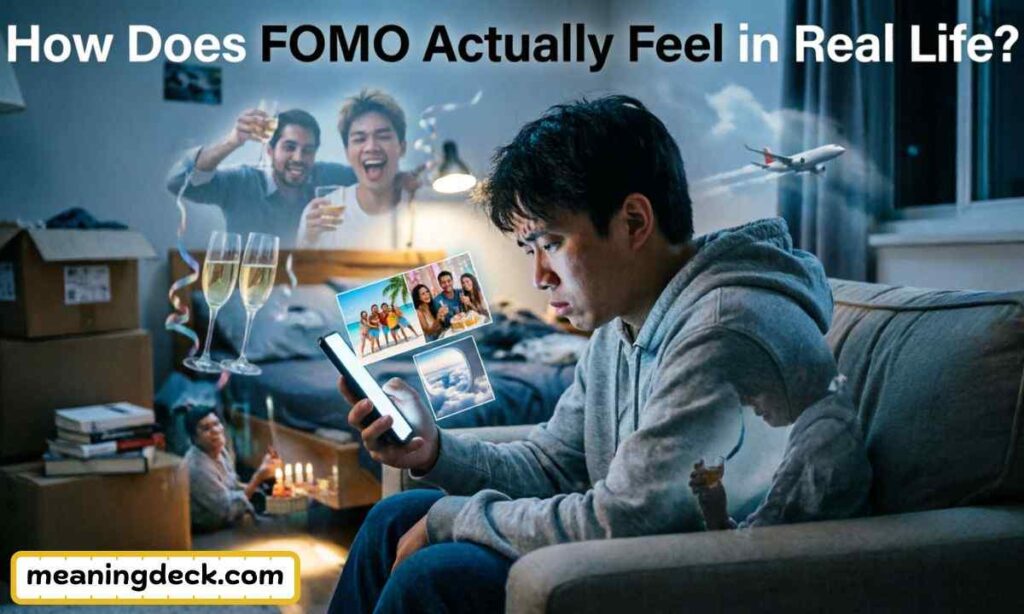
FOMO is not just a vague concept. It shows up in very specific, painfully relatable moments.
You open your phone and see a group photo from a dinner you were not at. You feel a small sting. You tell yourself it is fine. It is not fine. That is FOMO.
Your colleague mentions an email chain you were left out of. Suddenly that meeting feels more important than it probably was. FOMO again.
You are watching Netflix, perfectly comfortable, but you keep checking Instagram because what if something is happening right now? Classic FOMO behavior.
The key signs include:
- Constant phone checking, especially after social events
- Saying yes to things you do not actually want to do
- Feeling dissatisfied even when your own situation is objectively fine
- Comparing your life to curated highlight reels online
- Regret after declining invitations, even reasonable ones
Why Does FOMO Happen? The Psychology Behind It
FOMO is not weakness. It is wiring.
Human beings are social creatures. For most of human history, being excluded from the group meant real danger. If the tribe moved on without you, survival became much harder. So the brain evolved to treat social exclusion as a threat.
FOMO activates the same brain regions linked to physical pain. That twinge you feel when you see a party you missed? Neuroscientists say it registers similarly to actual hurt. You are not being dramatic. Your brain is just doing its ancient job in a modern world where the threat is a brunch you skipped.
Social media amplifies FOMO dramatically because platforms are designed to show you the best moments of everyone else’s life. Nobody posts a photo of themselves eating cereal alone on a Tuesday night. Everyone posts the vacation, the promotion, the party. So your brain receives a constant stream of evidence that the world is exciting without you. Spoiler: it is not. They are just better at filtering.
FOMO in the Digital Age: Social Media’s Role
FOMO existed before the internet, but social media gave it a megaphone, a camera, and a global audience.
Platforms like Instagram, TikTok, and Snapchat are essentially FOMO engines. Every story, every reel, every highlight is a tiny reminder of an experience you did not have. The infinite scroll was not designed to relax you. It was designed to keep you looking for something better, something you might be missing.
Studies show that heavy social media users report significantly higher levels of FOMO than people who limit their usage. The connection is not subtle. More scrolling equals more comparison, and more comparison equals more anxiety.
FOMO also drives real purchasing behavior. Flash sales, limited-time offers, and “only 3 left in stock” alerts are all marketing tools designed to trigger FOMO. Brands know that fear of missing a deal often pushes people to buy things they did not plan to buy. If you have ever panic-bought something during a sale and then quietly returned it, you were FOMO’s loyal customer.
FOMO in Everyday Language: How People Use It
The word FOMO has fully crossed over from internet slang into everyday conversation. People use it seriously, sarcastically, and humorously.
Common usage examples:
“I have serious FOMO about that concert. Everyone keeps posting clips.”
“She agreed to three events in one night because of pure FOMO. She survived none of them.”
“I am feeling major FOMO watching the travel posts. Time to book something.”
“His FOMO is so bad he shows up to events he was not even invited to.” (We all know this person.)
You will also see FOMO used as an adjective in casual speech: “That was such a FOMO moment.” Or as a verb: “I totally FOMO’d my way into agreeing to that trip.”
Common Mistakes People Make About FOMO
A few misconceptions float around about FOMO that are worth clearing up.
Mistake 1: FOMO is only about social events. Wrong. FOMO applies to career opportunities, investment trends, relationships, streaming shows everyone is watching, and even food trends. If people around you seem to be experiencing something desirable and you are not, FOMO can show up.
Mistake 2: Only young people feel FOMO. Also wrong. Research shows FOMO affects people across age groups. Parents feel it about vacations. Professionals feel it about networking events. Retirees feel it about not being in the loop. Age does not cancel FOMO.
Mistake 3: FOMO means you are insecure. Not necessarily. Even confident, self-aware people feel FOMO occasionally. It becomes a problem only when it consistently drives poor decisions or chronic anxiety. Occasional FOMO is just being human.
Mistake 4: Avoiding social media eliminates FOMO. It helps, but FOMO can exist without a single app. Word-of-mouth, overheard conversations, and office gossip create FOMO just fine without Wi-Fi.
How to Handle FOMO Without Losing Your Mind
The goal is not to eliminate FOMO entirely. That is neither realistic nor necessary. The goal is to stop letting it make your decisions for you.
Practical steps that actually work:
Recognize it when it starts. The moment you feel that pull of anxiety about something others are doing, name it. Saying “that is FOMO talking” immediately creates a small but useful distance between the feeling and your next choice.
Ask if you actually want it. Before saying yes to something driven by FOMO, ask yourself: Would I want this if no one else was talking about it? Honest answer? Often no.
Limit passive scrolling. There is a difference between actively connecting with people online and passively consuming other people’s highlight reels. One builds connection. The other quietly convinces your brain that your life is inadequate.
Practice intentional gratitude. Not the cliché kind where you list five things every morning. The active kind where you pause and genuinely notice what is going right in your current moment. FOMO lives in comparison. Gratitude lives in presence. They cannot occupy the same space at the same time.
Embrace JOMO occasionally. Choosing to stay in, rest, or simply opt out of something is not failure. It is wisdom. The ability to say no without guilt is one of the most underrated life skills available.
Which Should You Choose: FOMO or JOMO?
Neither FOMO nor JOMO is a permanent personality setting. They are responses, and the healthy move is knowing when each one serves you.
Choose FOMO thinking when:
- A genuine, rare opportunity presents itself
- You are in the habit of isolating and need a push
- The experience will meaningfully grow your relationships or skills
Choose JOMO thinking when:
- You are saying yes out of guilt, not genuine desire
- You are already stretched thin and need recovery
- The event will drain more than it gives
The real skill is telling the difference between the two in real time, before you have already exhausted yourself saying yes to everything and wondering why life feels like a treadmill.
Read This: MK Meaning in Text: What It Really Means and How to Use It Correctly
A Quick Look at FOMO Around the World
FOMO is not an exclusively Western experience. The feeling is universal, but how cultures frame it differs.
In Japan, a related concept called “Kodawari” describes an obsessive commitment to one thing rather than spreading attention across everything. It is almost the cultural antidote to FOMO.
In Arabic, the phrase “Hasad” describes envy of others’ blessings, which overlaps emotionally with FOMO though it carries different moral weight in Islamic tradition.
In South Asian cultures, social comparison is deeply embedded in family and community structures. The pressure to attend every wedding, festival, and family gathering because “what will people think?” is essentially culturally institutionalized FOMO.
The feeling is human. Only the vocabulary changes.
Frequently Asked Questions
Is FOMO a mental health condition?
No, FOMO is not a clinical diagnosis. It is a psychological experience that can contribute to anxiety and depression when chronic, but by itself it is a normal human response. If FOMO is significantly affecting your daily life or mental health, speaking with a professional is always a smart step.
Can FOMO be positive?
Yes, in small doses. FOMO can motivate you to step outside your comfort zone, try new things, or reconnect with people you have been avoiding. The problem starts when it becomes the default driver of your decisions rather than an occasional nudge.
How is FOMO different from jealousy? Jealousy
usually involves a specific person and a specific thing you want that they have. FOMO is broader and more generalized. It is less about wanting what one specific person has and more about a vague fear that the world is moving on without you. You can feel FOMO without knowing exactly what you are afraid of missing.
The Final Word
FOMO means Fear Of Missing Out, and it is that restless, anxious feeling that others are having experiences, opportunities, or moments that you are not part of.
It is ancient, it is human, and in the age of social media it is louder than ever. But it does not have to be in charge.
Understanding FOMO is the first step to defusing it. Once you can see it clearly, name it accurately, and question whether it is actually telling you something useful, you take back the steering wheel. Your life does not need to be documented, compared, or validated by what everyone else is doing.
Sometimes the best thing happening right now is exactly where you already are.

Welcome to MeaningDeck! I’m Alex, an AI-Powered SEO, and Content Writer with 2 years of experience.
I help websites rank higher, grow traffic, and look amazing. My goal is to make SEO and web design simple and effective for everyone.
Let’s achieve more together!