

You searched DSL meaning slang and landed here, which already tells you this is not about your internet connection. You are right to be curious. DSL in slang refers to “D* Sucking Lips”** — a crude, sexually suggestive term used to describe full, prominent lips. It is used online, in comment sections, in texting, and occasionally in spoken conversation, mostly as a compliment in certain contexts, though it is never exactly subtle or polite company-appropriate.
What Does DSL Mean in Slang?
In slang, DSL stands for “D* Sucking Lips.”**
The term describes someone who has notably full, plump, or prominent lips. It originated as crude humor and sexual commentary, and it has stayed in that territory ever since. There is no softened version of this phrase. It means exactly what it spells out.
It is worth knowing upfront that DSL is considered vulgar and inappropriate in most formal, professional, or mixed-audience settings. Understanding it does not mean endorsing it. But if you saw it in a comment, a text, or an online thread, now you know precisely what was being said.
The Other Meanings of DSL You Should Also Know
Before going deeper into the slang side, it is important to acknowledge that DSL carries completely different meanings in other contexts, and mixing them up creates genuine confusion.
DSL as Digital Subscriber Line: This is the technical meaning most adults grew up knowing. DSL is a type of broadband internet connection that transmits data through traditional telephone lines. In the 1990s and 2000s, it was one of the most common ways households connected to the internet.
DSL as Domain-Specific Language: In software development and programming, a DSL is a specialized coding language built for a particular task or domain rather than general use. SQL is one of the most famous examples of a domain-specific language.
DSL as the slang term: This is the version that brought you here. Depending on where you see DSL used, the context will almost always make the meaning clear. A tech forum discussing internet speeds is not talking about lips. A social media comment under someone’s photo almost certainly is.
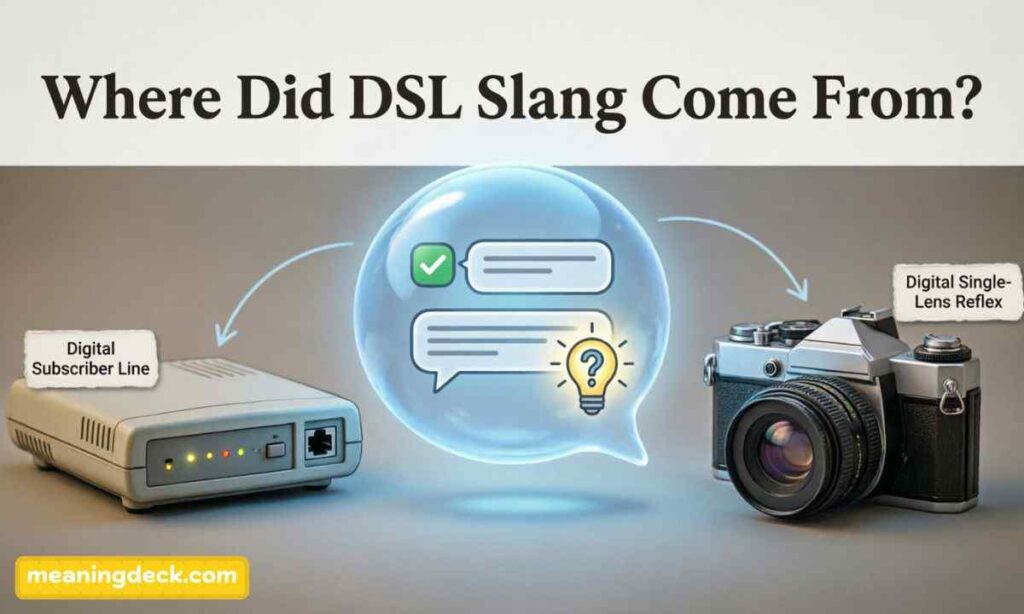
Where Did DSL Slang Come From? The Origin of This Term
Read This: SYFM Meaning in Text: What It Means & When to Use It
DSL as slang emerged from internet culture in the late 1990s and early 2000s, the same era when broadband DSL internet was at its absolute peak of cultural relevance.
The wordplay was intentional and deliberately crude. Internet users, especially in early forums like Something Awful, 4chan, and early Reddit communities, built an entire vocabulary around repurposing technical and everyday acronyms into sexual or offensive jokes. DSL was a perfect target because the abbreviation was so widely recognized from the internet context that the contrast made the joke land harder.
The humor came from the collision of something completely mundane (your home internet connection) with something sexually explicit. That kind of linguistic misdirection became a staple of early internet humor, and DSL stuck around long after many similar jokes faded.
By the mid-2000s, DSL as slang had migrated out of forums and into broader online conversation, comment sections, music lyrics, and eventually everyday texting among younger generations. The internet origin story got forgotten along the way, and the slang took on a life of its own.
Historical and Cultural Context: Lips as a Symbol Through the Ages
The cultural obsession with lips, specifically full and prominent lips, is genuinely ancient.
In ancient Egypt, full lips were associated with beauty, sensuality, and divine femininity. Egyptian art consistently depicted gods and idealized humans with defined, prominent features including full lips. Cleopatra was famously celebrated for her physical presence, and representations of her consistently emphasized her lips as part of her power and appeal.
In classical Greek and Roman sculpture, lips were carefully carved to communicate character and status. Full lips on a figure often signaled vitality, youth, and desirability. The precision artists brought to this single feature reflects how much cultural meaning was attached to it.
In Song of Solomon in the Bible, one of the most openly poetic books of the Hebrew scriptures, lips are referenced directly as a symbol of attraction and intimacy. Song of Solomon 4:3 compares the lips of the beloved to a scarlet thread, emphasizing their beauty as part of a broader celebration of physical attraction within a committed relationship.
The point is that humans have always assigned meaning, beauty, and cultural weight to lips. DSL slang is the bluntest possible modern expression of something that has been part of human conversation for thousands of years, just without the poetry.
DSL Slang vs. Other Appearance-Based Internet Slang: A Quick Comparison
Seeing DSL alongside similar terms shows exactly where it sits in the landscape of online commentary about physical appearance.
| Slang Term | What It Describes | Tone | Appropriate Setting |
| DSL | Full, prominent lips | Vulgar, sexual | Never formal; only very casual |
| Snatched | Perfectly styled or attractive look | Positive, energetic | Casual social media |
| Thicc | Full figure, curvy body type | Casual compliment | Informal only |
| Glow up | Significant improvement in appearance | Positive, celebratory | Broad casual use |
| Model vibes | Someone with striking, model-like looks | Flattering, light | Casual compliment |
| Baddie | Someone who is very attractive and confident | Positive, strong | Casual and social media |
As the table makes clear, DSL sits at the most explicit end of this spectrum. Most appearance-based slang has at least some degree of social acceptability across casual settings. DSL does not. It is specifically and permanently in the crude category, which means context and audience awareness matter enormously before using it.
Real Life Examples of DSL Used Online and in Texts
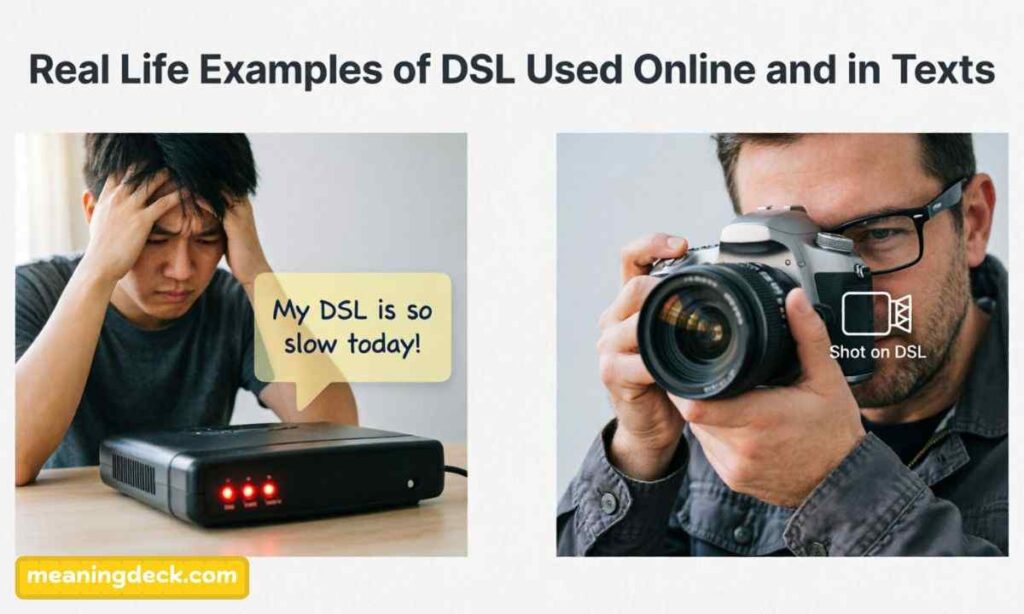
Seeing the term used in actual context removes any remaining ambiguity.
Example 1 (Social Media Comment): Someone posts a close-up photo with bold lipstick. Comment: “DSL energy fr” Meaning: A crude reference to the person’s full lips, framed as a compliment in that particular comment culture.
Example 2 (Text Between Friends): “Did you see his new profile pic? DSL and knows it.” Meaning: Commenting on someone’s prominent lips in a casual, crude way with an implied compliment.
Example 3 (Internet Forum Discussion): “Celebrities spend thousands on lip fillers chasing natural DSL.” Meaning: Using the term to describe naturally full lips as a physical trait that others try to recreate cosmetically.
Example 4 (Music and Pop Culture Reference): Several hip-hop and R&B artists have referenced DSL in lyrics as slang for attractive, full lips. The term appears in song contexts where the crude humor is treated as straightforward description rather than insult.
In every case, the term is being used in explicitly casual, adult-oriented spaces. It does not appear in professional writing, journalism, or academic contexts for obvious reasons.
Why DSL Slang? Spread So Far Beyond Its Internet Origins
The fact that DSL traveled from niche internet forums to mainstream slang is genuinely interesting and worth understanding.
A few specific factors explain its staying power.
The original wordplay was memorable. Hijacking an acronym that millions of people already knew and giving it a completely different meaning created a cognitive hook. Once you hear the DSL joke, it is genuinely hard to forget.
Lips became a major beauty focal point. As cosmetic lip treatments, lip fillers, and bold lip makeup became dominant trends in beauty culture through the 2010s, commentary about lips naturally increased everywhere. DSL slang rode that cultural wave without being part of it intentionally.
Crude humor travels fast online. Content moderation has caught up significantly, but in the early years of social media, explicit and crude humor spread widely. DSL was compact enough to slip through filters while still communicating its meaning clearly to those who knew it.
Music and pop culture kept it alive. Once slang enters song lyrics and viral content, it achieves a kind of permanence that pure forum humor rarely does. DSL made that jump and stayed.
Common Mistakes People Make With DSL Slang
A few predictable errors come up repeatedly when people encounter or use this term.
Mistake 1: Assuming it is tech-related in a social context. If someone comments DSL on a photo and you respond asking about their internet speed, you are going to create an extremely awkward moment. Context reading is essential with multi-meaning abbreviations.
Mistake 2: Using it as a general compliment without understanding the full meaning. Some people pick up slang from context without knowing exactly what it means. Using DSL as a comment on someone’s appearance without realizing how explicitly sexual the full phrase is can cause real offense, especially if the recipient knows the meaning and you clearly did not.
Mistake 3: Using it in any professional or public-facing setting. This applies to work Slack channels, professional social media profiles, public comments on brand pages, school-related communication, and any setting where a reasonable person would be offended by explicitly sexual language.
Mistake 4: Using it toward someone who has not consented to that kind of commentary. Even in casual settings, directing sexually explicit commentary at someone who has not indicated they welcome it crosses a clear line. What might feel like a compliment to the sender often does not feel that way to the recipient.
Should You Use DSL Slang? An Honest Assessment
This is where a straight answer matters more than hedging.
You probably should not use it in most situations.
The term is explicitly sexual in its full form, and even when used as a compliment, it reduces a person to a single physical feature through a vulgar lens. Most people who receive it, especially those who know exactly what it means, do not experience it as flattering.
If you want to compliment someone’s appearance, there are dozens of slang terms that carry warmth and enthusiasm without the explicit edge. “Stunning,” “snatched,” “gorgeous,” or “model vibes” all communicate genuine admiration without the baggage.
Use DSL only if:
- You are discussing internet or tech topics where DSL means Digital Subscriber Line
- You are explaining the slang term in an educational or informational context
- You are writing about internet culture history or slang etymology
Avoid DSL slang when:
- You are commenting on a real person’s appearance
- You are in any setting that is not explicitly adult and casual
- There is any chance the other person would find sexually explicit commentary unwelcome
The honest truth is that knowing what DSL means is useful. Using it is almost always unnecessary.
Read This: MK Meaning in Text: What It Really Means and How to Use It Correctly
How DSL Fits Into the Broader? World of Repurposed Acronym Slang
DSL is part of a fascinating and very specific category of internet slang: terms that started as legitimate abbreviations and got hijacked for completely different meanings.
This pattern shows up constantly in internet language history.
CD in some communities means something very different from compact disc. WD can mean well done in one context and something crude in another. BJ has a polite meaning as initials and an obvious crude one. The internet has always been exceptionally creative, and occasionally creative in directions that polite society would prefer it had not gone.
What makes DSL particularly interesting as a case study is that the original technical meaning was so mainstream and family-friendly. The gap between “internet connection type your parents discussed at dinner” and the slang version is enormous, and that gap was entirely the point when the joke was first made.
Understanding this pattern helps you navigate online language more confidently. When you see a familiar abbreviation used in an unfamiliar context, the safest move is always to check before assuming.
Frequently Asked Questions
Is DSL always used as a slang term for lips?
Not at all. DSL has three distinct meanings: Digital Subscriber Line in technology, Domain-Specific Language in programming, and the vulgar slang term about lips. Which one is being used depends entirely on context. A tech conversation is never using the slang version. A social media comment on a photo almost certainly is.
Is DSL used as a compliment or an insult?
It depends on who is using it and toward whom. In some online spaces and friend groups, it is intended as a crude compliment about physical attractiveness. In other contexts, it can feel objectifying or demeaning. The person receiving the comment gets to decide how it lands, not the person sending it.
Is it safe to use DSL in casual conversation?
Only if you are in a setting where explicitly adult humor is already established and welcome, and only with people who have clearly indicated that kind of communication is comfortable for them. In any other setting, it is safer and smarter to use different language entirely.
Final Thoughts
DSL slang is one of those terms that is worth knowing precisely because it appears in so many online spaces, and misreading it can create real confusion or real offense depending on the direction of the mistake.
At its core, it is a vulgar acronym born from internet wordplay that found a longer life than most people expected. It describes full lips through an explicitly sexual lens, and it carries that weight regardless of whether it is intended as a joke or a compliment.
Now you know exactly what it means, where it came from, how it spread, and why using it carefully matters. You came here for a clear answer and you got the full picture instead.
That is genuinely better value than whatever your old DSL internet connection could have delivered.

Welcome to MeaningDeck! I’m Alex, an AI-Powered SEO, and Content Writer with 2 years of experience.
I help websites rank higher, grow traffic, and look amazing. My goal is to make SEO and web design simple and effective for everyone.
Let’s achieve more together!