
You typed “BTA” somewhere, someone used it on you, or you stumbled across it in a text and stared at it like it owes you money. Fair enough. BTA stands for “Be There At” in most casual digital conversations, but it also carries a completely different meaning in formal or business settings. Understanding which one applies to your situation takes about thirty seconds, and this article covers both clearly, without wasting your time.
What Does BTA Mean?
In everyday texting and online communication, BTA means “Be There At” followed by a time. For example, someone might say “BTA 7” to mean they will be somewhere at 7 o’clock.
In business and finance, BTA stands for “Bilateral Trade Agreement”, referring to a formal economic deal between two countries.
There is also a third meaning used in some online communities: “But Then Again”, which adds a counterpoint or second thought to a statement.
So the meaning of BTA depends almost entirely on the context where you see it. Think of it like the word “bank.” One version holds water, the other holds money. Neither is wrong. You just have to read the room.
Breaking Down Each BTA Meaning One by One
Let us walk through each meaning properly so nothing stays fuzzy.
BTA = Be There At This is the most common version in casual texting. It is used to confirm arrival time quickly. Instead of typing “I will be there at 6:30,” someone writes “BTA 6:30.” It saves time and thumbs.
BTA = But Then Again This version appears in conversations where someone wants to qualify or contradict what they just said. Think of it as a written version of “on the other hand.” Example: “The movie was great. BTA, I cried for an hour, so who knows.”
BTA = Bilateral Trade Agreement This one lives in business news, economics textbooks, and government policy discussions. It refers to a negotiated deal between two nations that defines trade rules, tariffs, and quotas. No texting shorthand here, just serious policy language.
Read This: 4th Hole Slang Meaning
The Business Side: BTA as a Bilateral Trade Agreement
Since this meaning carries serious weight in the professional world, it deserves its own spotlight.
A Bilateral Trade Agreement is a contract between two countries that lays out how they will trade goods and services with each other. These agreements typically reduce or eliminate tariffs, establish fair competition rules, and open up market access for both sides.
Think of it as two neighbors agreeing on ground rules before they start sharing tools and vegetables across the fence. Both sides benefit, both sides make concessions, and a lawyer writes it all down in language that would put anyone else to sleep.
Countries sign BTAs to strengthen economic ties, increase exports, and attract investment. The United States, European Union, and China have all been parties to various bilateral agreements over the decades.
BTA in Texting: Real-Life Usage Examples
Here is how “Be There At” shows up in actual conversations:
- “Pick me up? BTA 5.”
- “Running late. BTA 8:15 at most.”
- “BTA the coffee shop in 10.”
And here is “But Then Again” in action:
- “I should probably study tonight. BTA, the game starts at 8.”
- “She seemed upset. BTA, she always looks like that on Mondays.”
Notice how the tone and surrounding words make the meaning obvious. If there is a number after BTA, it almost always means “Be There At.” If it follows a contrasting statement, it is “But Then Again.”
Quick Comparison: All BTA Meanings at a Glance
| BTA Meaning | Full Form | Where It Appears | Example |
| Be There At | Arrival time confirmation | Texting, casual chat | “BTA 6 PM” |
| But Then Again | Adding a counterpoint | Online conversations, forums | “BTA, I might be wrong” |
| Bilateral Trade Agreement | Formal trade deal between two nations | Business, finance, news | “The BTA reduced tariffs by 20%” |
| British Triathlon Association | Sports governing body | UK sports community | “Registered with the BTA” |
Yes, there is a fourth one. The British Triathlon Association uses BTA as well, though you will only encounter it if you are swimming, cycling, or running competitively in the United Kingdom.
How BTA Compares to Similar Abbreviations
It helps to see BTA alongside its close relatives so you never mix them up.
ETA means “Estimated Time of Arrival.” It is the broader, more formal cousin of BTA. ETA tells you when something is expected. BTA tells you when someone will specifically be somewhere.
FTA means “Free Trade Agreement,” which is similar to BTA in the trade context but involves multiple countries rather than just two.
TBH means “To Be Honest” and sometimes appears near “But Then Again” in the same message, since both add personal reflection to a statement.
The key difference between BTA and ETA is precision. ETA is estimated. BTA is a commitment. When someone says BTA, they are telling you they will show up. ETA has wiggle room built in. BTA does not, at least not socially.
Common Mistakes People Make with BTA
Here is where things go sideways for a lot of people.
Mistake 1: Assuming BTA always means “Be There At” If you are reading a financial article or watching a business news segment and you see BTA, it almost certainly means Bilateral Trade Agreement. Context matters more than memory here.
Mistake 2: Using BTA where ETA fits better “BTA 20 minutes” sounds a little off if you are giving a rough estimate. ETA works better for uncertainty. BTA sounds more like a confirmed time. Use them accordingly.
Mistake 3: Overusing BTA in professional emails Please do not. Nobody wants to decode abbreviations in a work email. Write it out. Your manager will thank you, even if silently.
Mistake 4: Confusing it with ATA ATA means “Actual Time of Arrival,” which is past tense. BTA is about something happening soon. These are two different moments in time wearing similar abbreviation jackets.
Which BTA Meaning Should You Use?
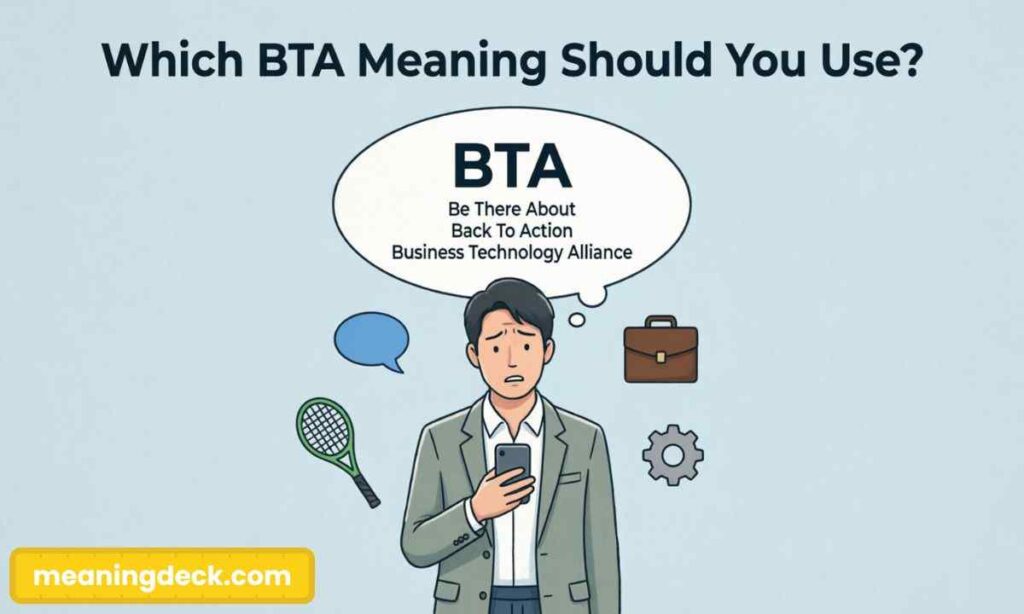
Here is a simple way to decide:
If you are texting a friend about meeting up, use BTA as “Be There At.” It is fast, friendly, and universally understood in casual conversation.
If you are adding a second thought to something you said online, “But Then Again” works perfectly and adds nuance without making your message longer.
If you are writing about international commerce, economics, or trade policy, BTA belongs to the world of Bilateral Trade Agreements.
And if you are running triathlons in Britain, you already know where to look.
The golden rule: when in doubt, write it out. Abbreviations are tools, not rules. If BTA is going to confuse your audience, skip it entirely and use plain language. Nobody ever complained that a message was too easy to understand.
A Brief Look at Where BTA Came From
The texting shorthand version of BTA grew naturally out of the abbreviation culture that exploded in the early 2000s with SMS messaging. When you paid per character or per message, every letter you could cut mattered. Phrases like “be there at” were natural targets for abbreviation because they appeared in conversations constantly.
The trade agreement meaning has a much longer history. Bilateral agreements between nations have existed for centuries, but the acronym BTA became more standardized in trade policy discussions during the post-World War II era when formalized international trade institutions began shaping global economics.
So in a way, BTA has two birthplaces: a teenager saving texts in 2003, and a diplomat negotiating tariffs in a conference room somewhere around 1960. Two very different origins, one shared abbreviation.
Read This: RLS Meaning: What It Really Stands For & Why People Get It Wrong
Why Getting BTA Right Actually Matters?
You might wonder why any of this deserves careful attention. It is just three letters.
But in professional settings, misreading BTA can lead to genuine confusion. Imagine skimming a trade report, seeing BTA, and thinking it refers to arrival time. You would completely misunderstand the document. On the flip side, receiving a text that says “BTA 9” and thinking it means something from a business context would leave you standing alone in a parking lot wondering what just happened.
Getting abbreviations right is part of reading and communicating well. It is not about being a grammar snob. It is about understanding what people actually mean, which is the whole point of communication in the first place.
Frequently Asked Questions
Is BTA used in professional emails?
In formal professional writing, BTA is generally discouraged unless your entire industry uses it consistently and everyone in the conversation understands it. In trade and economics circles, it is acceptable. In standard business emails, write out the full phrase instead.
Can BTA mean something else in gaming or social media?
In certain gaming communities and niche online forums, BTA can take on platform-specific meanings. Always check the context of the community you are in. A quick look at surrounding messages usually makes the intended meaning obvious.
Is “Be There At” or “But Then Again” more common?
In everyday texting and messaging apps, “Be There At” appears far more frequently. “But Then Again” is more common in longer online discussions, comment sections, and forums where people are expressing nuanced opinions rather than coordinating plans.
Final Thoughts
BTA is one of those abbreviations that quietly means three different things depending on who is using it and why. In casual conversation, it saves time when you are confirming plans. In thoughtful discussion, it adds contrast. In global economics, it shapes the movement of goods across borders.
Now that you know all three versions, you will never have to stare blankly at those three letters again. And if someone texts you “BTA 8,” you can confidently assume they are not announcing a new trade policy. They will just be there at 8.

Welcome to MeaningDeck! I’m Alex, an AI-Powered SEO, and Content Writer with 2 years of experience.
I help websites rank higher, grow traffic, and look amazing. My goal is to make SEO and web design simple and effective for everyone.
Let’s achieve more together!