

You are scrolling through comments, minding your business, and then you see it. Someone just typed “SYBAU” at someone else, and now you are sitting there wondering if you missed a memo. You are not alone. This slang term is spreading fast across social media, and if you have no idea what it means, you are about to find out in the clearest way possible.
SYBAU stands for “Shut Your B*tch A** Up.” It is a blunt, informal expression used online to tell someone to stop talking, usually when they are being annoying, overly dramatic, or just plain wrong. Think of it as the internet’s way of saying “enough.”
What Does SYBAU Actually Mean?
At its core, SYBAU is an acronym, and acronyms are just the internet’s way of being rude faster.
The full phrase is “Shut Your B*tch A** Up.” Every word in there is doing a job. “Shut up” is the command. The middle part adds intensity. Together, they form something far more cutting than a simple “be quiet.”
It is not polite. It is not office-appropriate. But in the fast-paced world of internet comment sections, it communicates something very specific: “I am done hearing what you have to say.”
Where Did SYBAU Come From?
Read This: iykyk Meaning: What It Means & How to Use It
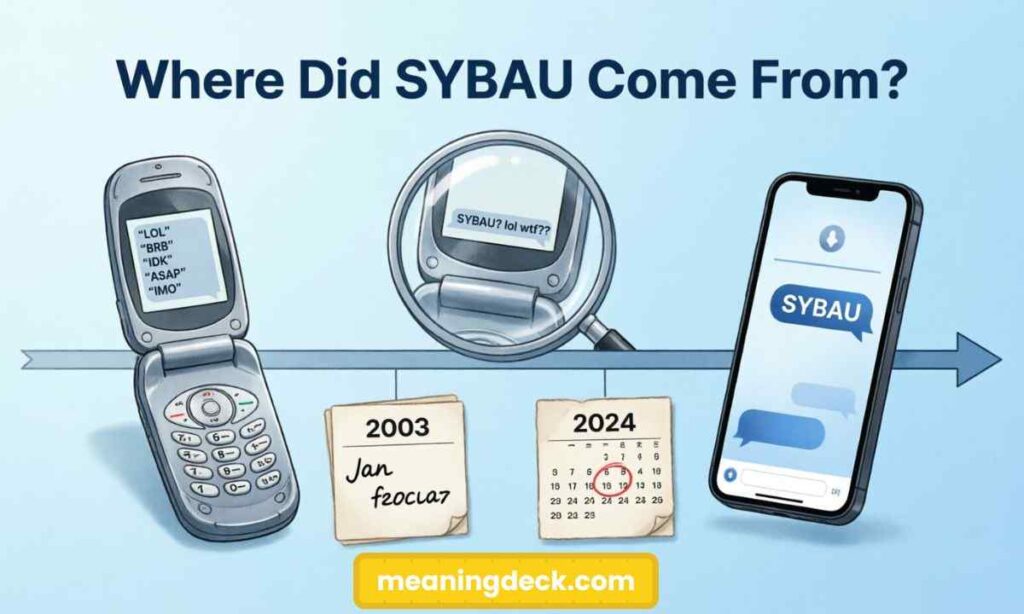
SYBAU did not pop into existence overnight. Like most internet slang, it grew organically out of online culture where typing full sentences felt like too much effort and getting a point across fast was everything.
The term gained significant momentum on platforms like Twitter (now X), TikTok, and Reddit, where comment threads move at lightning speed. When you need to shut down someone’s argument in under a second, a five-letter acronym works perfectly.
It belongs to a long tradition of internet shorthand that goes back to the early days of AIM, MSN Messenger, and online forums. Users in those spaces created terms like LOL, BRB, and WTF. SYBAU follows the same pattern, just with a sharper edge.
Over time it moved from niche internet circles into mainstream Gen Z slang, showing up in memes, reaction videos, and comment sections everywhere.
Is SYBAU Considered Offensive?
Yes, it is. There is no gentle way to say this.
SYBAU is a profanity-laced insult. Even though it is softened by being an acronym, anyone who knows what it stands for understands the full weight of it. Context matters a lot here.
Between close friends who regularly trade sharp-tongued jokes, it can land as playful banter. In that setting, it is less of an attack and more of a “you are being ridiculous” signal.
But in any professional setting, with strangers, or in a heated argument, SYBAU crosses into disrespectful territory quickly. It is the kind of comment that escalates things rather than resolving them.
The safest rule? If you have to wonder whether it is appropriate, it probably is not.
How Is SYBAU Used in Real Life?
Context is everything with this one. Here are a few realistic examples to show you how it shows up online.
Example 1: Playful banter between friends
Person A: “I literally cannot believe you forgot to bring the snacks again.” Person B: “SYBAU, I brought chips last time.”
Example 2: Shutting down an annoying comment
Someone posts a controversial take online. A commenter replies: “SYBAU with that nonsense.”
Example 3: Reaction meme captions
A video of someone overexplaining something obvious gets captioned: “Me when my coworker starts talking about synergy again. SYBAU.”
In each case, the term signals frustration, dismissal, or a playful shutdown. The tone shifts depending on who is using it and why.
SYBAU vs. Similar Slang: A Quick Comparison
There are a few other terms floating around that occupy the same emotional space. Here is how they compare.
| Term | Full Meaning | Tone | Best Used When |
| SYBAU | Shut Your B*tch A** Up | Very blunt, aggressive | Strong frustration or banter |
| STFU | Shut The F**k Up | Blunt, common | General dismissal |
| STHU | Shut The H*ll Up | Slightly milder | Casual shutdown |
| NPC | Non-Playable Character | Mocking, dismissive | When someone says something obvious |
| OK Boomer | Dismissing outdated views | Sarcastic, generational | Responding to out-of-touch opinions |
SYBAU sits at the more intense end of this spectrum. STFU is more universally known, while SYBAU carries an extra punch that makes it feel more personal.
Does SYBAU Have Any Historical or Cultural Roots?

Not in any classical sense. You will not find this one carved into ancient tablets.
But the impulse behind it is timeless. Every culture and every era has had some version of “stop talking.” The Romans had their dismissive phrases. Medieval folks had their own sharp-tongued insults. Shakespeare’s plays are packed with creative ways to tell someone to be quiet. SYBAU is simply the 21st-century digital version of that same human impulse.
What makes internet slang like SYBAU interesting from a cultural standpoint is how fast it travels. A phrase that starts in one corner of the internet can reach millions of people within days. That kind of linguistic speed is entirely new in human history.
From a sociolinguistics perspective, SYBAU is also a good example of how younger generations use coded language to communicate tone, frustration, and identity all at once.
Who Uses SYBAU and Where Does It Show Up Most?
The heaviest users of SYBAU tend to be Gen Z and younger Millennials, particularly those active on platforms like TikTok, Twitter/X, and Discord.
You will most often find it in:
- Comment sections under controversial posts
- Reaction memes where the caption does all the heavy lifting
- Group chats among close friends who are comfortable with casual profanity
- Gaming communities, where trash talk has always had its own dialect
- Podcast and YouTube clip discussions where strong opinions collide
It is notably rare in professional or academic settings, for obvious reasons. Nobody is ending a business email with SYBAU. At least, not successfully.
Common Mistakes People Make with SYBAU
Even with a four-word phrase packed into five letters, people still manage to get it wrong. Here are the most common slip-ups.
Mistake 1: Using it in the wrong setting. This one cannot be stressed enough. Using SYBAU in a professional email, a formal discussion, or with someone you barely know is a fast track to damaging a relationship. Read the room.
Mistake 2: Confusing it with SYAU or STAU. These are not the same thing and they mean different things in different communities. Double-check before you send.
Mistake 3: Using it thinking it is harmless because it is an acronym. The letters soften nothing. Anyone who knows the meaning feels the full force of the phrase. Acronyms are not a politeness filter.
Mistake 4: Overusing it. Any strong expression loses its punch when it shows up every other sentence. Use it sparingly and it lands. Use it constantly and it just becomes noise.
Should You Use SYBAU? Here Is How to Decide
This really comes down to three questions.
Who are you talking to? If it is a close friend who trades sharp banter with you regularly, and the moment calls for it, you are probably fine. If it is a stranger, a coworker, or anyone in a formal space, leave it alone.
What is the emotional temperature of the conversation? Using SYBAU in an already-heated argument is like adding fuel to a fire. If things are already tense, this will not help.
Are you trying to be funny or are you genuinely angry? There is a big difference between a playful “SYBAU, you are being dramatic” and a real dismissal. Know which one you are going for before you hit send.
The short answer: Use it casually with people who already use this kind of language with you. Avoid it everywhere else. Simple as that.
Read This: CTFU Meaning Slang: The Clear, Simple Answer You Were Looking For
Related Slang Terms Worth Knowing
If you are building your internet slang vocabulary, a few related terms will help you understand the full landscape SYBAU lives in.
IYKYK (If You Know You Know): Used when something is inside-knowledge. SYBAU fits this category since not everyone knows what it stands for at first glance.
No Cap: Meaning “no lie” or “seriously.” Often used to emphasize that a blunt opinion, like replying with SYBAU, is completely genuine.
Touch Grass: Telling someone to go outside and skill-reset because they are too invested in something online. A slightly gentler dismissal than SYBAU.
These terms often appear in the same spaces and conversations, so knowing them together gives you a much clearer picture of how internet communication actually works today.
Frequently Asked Questions
What does SYBAU stand for?
SYBAU stands for “Shut Your B*tch A** Up.” It is a blunt internet slang acronym used to dismiss or silence someone, most commonly in online comment sections and casual conversations between friends.
Is SYBAU appropriate to use?
It depends entirely on context. Between close friends who communicate this way, it can be playful. In professional settings, with strangers, or in heated arguments, it is inappropriate and can come across as aggressive or disrespectful. Use it carefully.
Where did SYBAU originate?
SYBAU grew out of online internet culture, particularly on platforms like Twitter, TikTok, and Reddit, where fast and punchy responses are the norm. It is part of a broader tradition of internet acronym slang that dates back to early online chat communities.
Final Thoughts
SYBAU is five letters that carry a lot of weight. Know what it means, know when it fits, and if you are ever unsure whether the moment is right for it, the safest move is to just not use it and say what you actually mean instead.
Words, even short ones, carry real consequences. The internet just sometimes forgets that.

Welcome to MeaningDeck! I’m Alex, an AI-Powered SEO, and Content Writer with 2 years of experience.
I help websites rank higher, grow traffic, and look amazing. My goal is to make SEO and web design simple and effective for everyone.
Let’s achieve more together!