

You are reading a text and someone just replied with a simple “ofc” and you smiled and nodded like you understood completely. Then you opened a new tab and typed the question you were too embarrassed to ask. That is exactly why this article exists. OFC is one of those abbreviations that people throw around like everyone was born knowing it. The good news is the meaning is simple, and by the end of this article, you will never second-guess it again.
What Does OFC Mean?
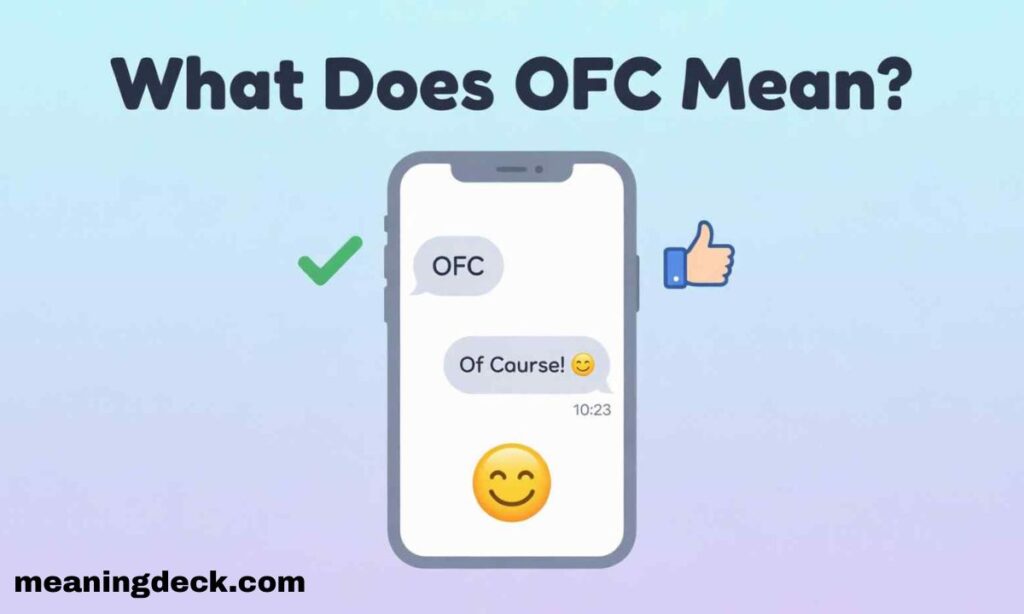
OFC stands for “of course.” That is it. Clean, simple, and nothing complicated hiding underneath.
When someone texts you “ofc” they are expressing agreement, confirmation, or reassurance. It is the digital equivalent of nodding your head enthusiastically and saying yes, obviously, without a doubt.
If your friend asks “Can you come to my party tonight?” and you reply “ofc”, you are saying: yes, absolutely, without question.
The abbreviation is casual by nature. You will find it in text messages, social media comments, online chats, and anywhere conversation moves fast and fingers move faster.
Where Did OFC Come From?
Read This: Ion Meaning Text: The Simple Answer You Need Right Now
To understand ofc, you need to understand the culture that created it.
The phrase “of course” itself has roots in formal English, originally meaning “following the natural or expected path.” The word course here comes from the Latin cursus, meaning a path or direction. Saying something is of course meant it was so obvious it followed the only logical road available.
Fast forward to the rise of instant messaging in the late 1990s and early 2000s. Platforms like AIM, MSN Messenger, and Yahoo Chat created a world where speed mattered more than spelling. Typing “of course” felt slow when you could fire back “ofc” in half a second.
The abbreviation spread naturally from chat rooms into SMS texting, then exploded on social platforms like Twitter, Instagram, Snapchat, and TikTok. Today it is standard vocabulary for anyone under 40 and a mystery to anyone who still signs emails with “Best regards.”
The Historical Roots of “Of Course” Go Deeper Than You Think
Here is something most articles completely skip. The idea behind “of course” has been around far longer than the internet.
In biblical tradition, when God speaks to Abraham and Sarah about bearing a child in old age, Sarah laughs because the idea seems so impossible. The implied response from the divine is essentially: of course it will happen. What seems impossible to humans is the obvious path forward when seen from a higher perspective. The concept of something being of course true even when others doubt it carries deep historical weight.
Ancient Greek philosophers used similar constructs. When Socrates guided students toward a logical conclusion, the student would arrive at the answer and Socrates would essentially respond: naturally, of course. It was a mark of logical inevitability.
So when you type ofc to a friend, you are unknowingly participating in thousands of years of humans expressing obvious agreement. Just with fewer letters.
OFC vs. Other Agreement Abbreviations: A Clear Comparison
People often mix up ofc with other short agreement words. Here is how they all differ:
| Abbreviation | Full Form | Tone | Best Used When |
| ofc | Of course | Casual, warm, reassuring | Confirming something obvious or expected |
| obv | Obviously | Slightly sarcastic or blunt | When something feels self-evident |
| ikr | I know, right | Agreeable, enthusiastic | Relating to someone else’s observation |
| duh | Duh | Sarcastic, playful | When something is almost too obvious |
| sure | Sure | Neutral, sometimes passive | Mild agreement without strong enthusiasm |
| yep/yup | Yes | Casual affirmative | Simple yes with a relaxed tone |
The key difference with ofc is its warmth. It does not carry the mild sarcasm of obv or duh. It feels more like a reassuring yes rather than an eye-roll yes.
Real-Life Examples of OFC in Conversation
Seeing ofc in action makes the meaning stick immediately. Here are natural examples across different situations:
Example 1: Making Plans Friend: “Are you still coming to the game tonight?” You: “ofc, already got my jersey ready.”
Example 2: Asking a Favor Classmate: “Can I borrow your notes from yesterday?” You: “ofc, I will send them right now.”
Example 3: Reassuring Someone Partner: “Do you still love me even when I am being annoying?” You: “ofc I do, that is never even a question.”
Example 4: Social Media Comment Post: “Is this outfit giving main character energy?” Comment: “ofc it is, you look incredible.”
Example 5: Gaming Chat Teammate: “You still want to play ranked tonight?” You: “ofc, I have been waiting all day.”
Notice how ofc always carries a sense of there was never any doubt. That is the emotional core of the word.
OFC Can Also Mean Something Else in Specific Contexts
Here is where things get slightly interesting, and most people do not know this.
In some internet communities and adult content platforms, OFC is also used as an abbreviation for “Only Fans Content” or is loosely associated with subscription-based creator content. This meaning is entirely context-dependent.
In professional settings, OFC can stand for “Office” in older business shorthand, though this usage is rare and almost entirely outdated now.
The important rule is this: when in doubt, look at who is sending it and where. In a text from your friend asking if you can hang out, ofc means of course and nothing else. Context will always be your clearest guide.
How Tone Changes How OFC Lands
This is something competitors never talk about, but it matters more than most people realize.
OFC sounds warm and immediate in text, but the tone shifts depending on what surrounds it.
A plain “ofc” feels natural and friendly.
An “ofc!!!” with multiple exclamation marks feels enthusiastic and excited.
A slow, single “ofc.” with a period can actually feel slightly cold or passive aggressive depending on the relationship. The period in texting culture often signals mild irritation rather than simple punctuation. This is the curious psychology of digital communication.
So if you are genuinely enthusiastic, skip the period. If you want to sound warm, a lowercase “ofc” with no period works best. Punctuation is basically emotional seasoning in texting.
Common Mistakes People Make With OFC
A few errors come up repeatedly, and avoiding them will save you from awkward exchanges.
Mistake 1: Using it in formal or professional writing. Do not write ofc in an email to your boss, a job application, or any professional document. It signals a lack of attention to context. Always write out “of course” in formal settings.
Mistake 2: Assuming everyone knows what it means. Not every generation grew up texting in shorthand. If you are messaging someone older or someone you do not know well, writing “of course” is simply more considerate.
Mistake 3: Confusing OFC with OFB or OFW. These are completely different abbreviations. OFB can refer to Overseas Filipino Business. OFW stands for Overseas Filipino Worker. The letters look similar but the meanings have nothing in common. Always read carefully.
Mistake 4: Typing it in all caps unnecessarily. “OFC” in all caps can read as shouting or extreme emphasis. In casual texting, lowercase “ofc” is almost always the more natural choice.
OFC vs. “Of Course”: Which One Should You Use?
The answer is simple: it depends entirely on the situation.
Use ofc when: You are texting a friend, family member, or close colleague. The conversation is casual and fast-moving. You want to sound natural and relaxed without overthinking it.
Use “of course” when: You are in a professional or semi-formal setting. You are writing an email, message, or comment that represents you professionally. You are speaking to someone who may not be familiar with internet shorthand. You want to add a little more warmth and weight to your agreement.
The two mean exactly the same thing. The only difference is the wrapper they come in. One is jeans and a t-shirt. The other is a clean button-down. Know your audience and dress accordingly.
Why OFC Became So Popular So Fast?
Language always moves toward efficiency, and ofc is a perfect example of that principle.
Humans have been shortening words and phrases for as long as language has existed. Latin scholars used abbreviations in manuscripts. Telegraph operators developed their own shorthand codes. Soldiers in World War II used abbreviations constantly in written communications.
The internet simply accelerated a process that was already happening. When billions of people are communicating in real time, every saved keystroke adds up. “ofc” saves you typing six characters and a space. Multiply that by millions of conversations every day and the appeal becomes obvious.
Beyond efficiency, ofc also carries a social function. Using it signals that you belong to a shared digital culture. It is a small marker of I speak this language. And humans, being the social creatures they are, respond warmly to that kind of belonging.
Read This: 4th Hole Slang Meaning: What It Really Is and Why People Keep Saying It
How OFC Fits Into the Bigger Picture of Internet Slang
OFC belongs to a family of abbreviations that redefined how people communicate online. Related terms like tbh (to be honest), imo (in my opinion), ngl (not gonna lie), and idk (I don’t know) all follow the same pattern: take a common spoken phrase, strip it to its initials, and deploy it at texting speed.
What makes ofc slightly different is its emotional function. Most abbreviations convey information. OFC conveys reassurance. It tells the other person: your question did not even need to be asked, the answer was always yes.
That tiny emotional charge is why it has stayed in regular use even as other abbreviations come and go with trends. Reassurance never goes out of style.
Frequently Asked Questions
Is ofc rude or dismissive to use?
Not at all, when used correctly. In casual conversation it sounds warm and natural. The only time it edges toward dismissive is if someone pairs it with a cold tone or uses it to shut down a conversation. On its own, it is a friendly abbreviation.
Can ofc be used sarcastically?
Yes, and context makes this clear. If someone says something obviously wrong and you reply “ofc” with a laughing emoji, the sarcasm is obvious. The word itself is neutral but the surrounding cues shift the meaning. Think of it like the word sure said with a raised eyebrow.
Is ofc only used in English?
It is primarily an English abbreviation since it stands for an English phrase. However, because English internet culture spreads globally, you will find ofc used by non-native English speakers across many countries, especially in gaming and social media communities where English is the dominant language of interaction.
Final Thoughts
OFC is one of those small words that does a surprisingly large emotional job. It confirms, reassures, and connects people in a single three-letter punch.
Now that you know exactly what it means, where it came from, and how to use it without second-guessing yourself, you can reply with confidence the next time someone sends it your way.
And if someone asks you whether you learned something useful today, you already know the answer. Ofc you did.

Welcome to MeaningDeck! I’m Alex, an AI-Powered SEO, and Content Writer with 2 years of experience.
I help websites rank higher, grow traffic, and look amazing. My goal is to make SEO and web design simple and effective for everyone.
Let’s achieve more together!