

You got a text with the word ion in it and now you are questioning everything you thought you knew about the English language. Same. Ion meaning text slang trips up a lot of people because it looks like a science word that somehow ended up in your group chat. Here is the quick answer: ion means “I don’t” in texting slang. It is a compressed, casual way of saying “I don’t” without the apostrophe or the space. Now let us unpack the whole thing properly.
What Does Ion Mean in Texting?
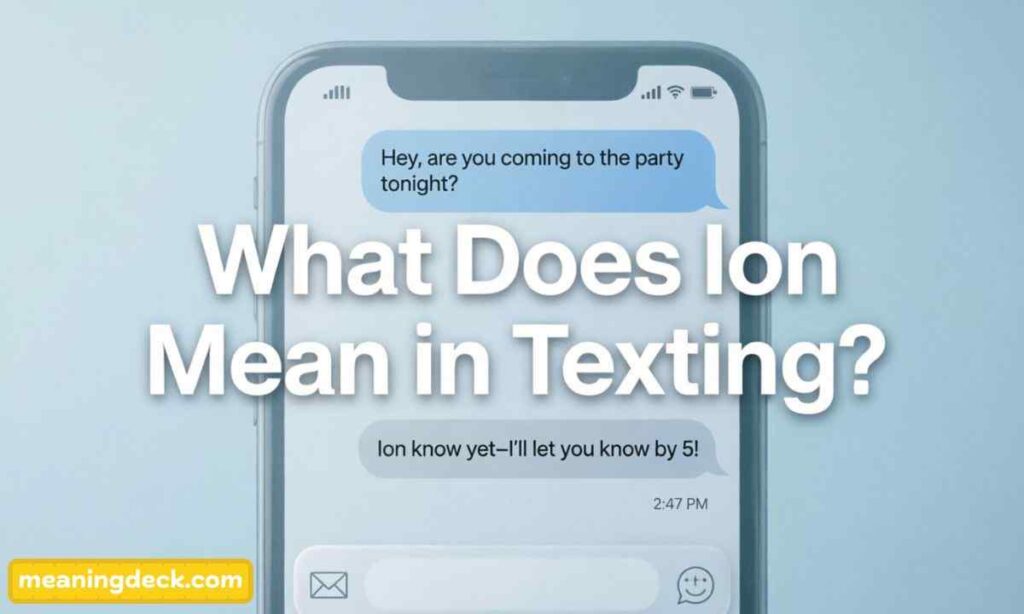
Ion is a slang contraction of “I don’t.” When someone types “ion know” they mean “I don’t know.” When they type “ion want to” they mean “I don’t want to.” Simple as that.
The word works by smashing “I” and “don’t” together so fast that the apostrophe, the space, and the letter “d” all get left behind. What remains is just ion, pronounced exactly like the scientific term but meaning something completely different.
It shows up mostly in text messages, Twitter, TikTok captions, and Snapchat, where speed and informality rule everything.
Where Did Ion Come From? The Real Origin
Ion did not come from a grammar committee. It grew naturally from how people actually speak in casual, fast-paced conversation.
In many regional American dialects, particularly in African American Vernacular English (AAVE), “I don’t” is often spoken in a way that naturally compresses the two words into something closer to “ion” in sound. When texting culture took off in the early 2000s, people started spelling words the way they said them, and ion was a natural result of that shift.
It is not laziness. It is linguistic efficiency. Humans have been compressing language for as long as language has existed. The internet just gave that process a much faster runway.
From AAVE, the term spread into mainstream digital culture through social media platforms, particularly Twitter and later TikTok, where younger users adopted it across all backgrounds and demographics.
Read This: CTFU Meaning Slang: The Clear, Simple Answer You Were Looking For
Is There a Historical or Linguistic Parallel to This?
Actually yes, and this is the part most articles completely ignore.
Language compression is one of the oldest human habits. In Old English, scribes regularly combined and shortened words to save writing space on expensive parchment. Words that seem distinct today were once written as single compressed units. The apostrophe itself was invented as a tool to show where letters had been removed from a word, which is exactly what happens with “I don’t” becoming “ion,” just without the punctuation marker.
Even in Biblical Hebrew and ancient Greek texts, scholars note that spoken language and written language diverged significantly. Common people spoke in compressed, regional forms while formal writing preserved the full versions. This tension between spoken shorthand and written formality has existed for thousands of years.
Ion is simply the modern text-era version of a very ancient human habit: speaking faster than the rules allow.
Ion vs I Don’t vs IDK: How Do They Compare?
People sometimes mix up similar expressions, so here is a clean breakdown.
| Slang / Expression | Full Meaning | Tone | Best Used When |
| ion | I don’t | Casual, informal | Texting close friends |
| idk | I don’t know | Casual, neutral | Any informal conversation |
| idgaf | I don’t give a… | Very casual, strong | Venting, frustration |
| ngl | Not gonna lie | Honest, conversational | Sharing real opinions |
| ion know | I don’t know | Casual, laid back | Same as idk but more stylized |
| iono | I don’t know | Casual, softened | Uncertainty with relaxed tone |
The key difference between ion and idk is that ion is a broader contraction. Idk specifically replaces “I don’t know” while ion can replace “I don’t” before any verb. You can say “ion like that” or “ion think so” but you cannot do that with idk.
Real Life Examples of Ion Used in Texts
Seeing it in a sentence makes everything click. Here are natural examples of how ion actually shows up in real conversations.
Text Message: Friend 1: “You coming to the party tonight?” Friend 2: “Ion know yet, depends on how I feel later”
Twitter/X Post: “Ion understand why people put the milk in before the cereal. That is genuinely alarming behavior.”
TikTok Comment: “Ion even watch that show but this clip has me wanting to start from episode one”
Group Chat: Person 1: “Should we get pizza or burgers?” Person 2: “Ion care either way just pick something”
Snapchat Caption: “Ion feel like doing anything today and I am completely at peace with that”
Notice how naturally ion replaces “I don’t” in every single one of those. The sentence structure stays the same. Only the word changes.
Does Ion Have Any Other Meanings in Texting?
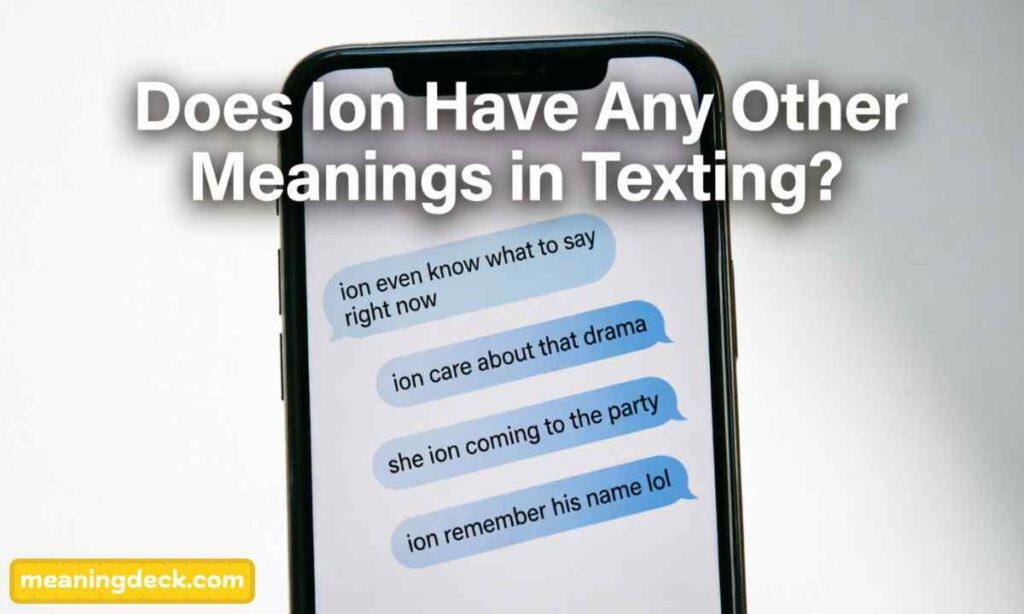
Yes, and this is where things get interesting.
While “I don’t” is the primary and most common meaning, ion occasionally appears with a second slang meaning: “in other news.” This version is much less common but does exist in some online spaces, particularly when someone wants to change the subject mid-conversation.
Example of the second meaning: “Anyway that was a disaster. Ion, I finally finished that book I was reading.”
Here, ion signals a topic shift rather than expressing “I don’t.” Context is everything when you read this one.
A third, far rarer use appears in some niche communities where ion is used as an emphasis filler, similar to how people say “like” or “you know” in spoken sentences. This usage is quite uncommon and mostly regional.
For 95% of text conversations you will encounter, ion means “I don’t.” The other meanings are rare enough that you should only consider them when the “I don’t” interpretation makes no logical sense in context.
How to Tell Which Meaning Ion Has in a Message
Reading context is the actual skill here, and it is easier than it sounds.
If ion is followed by a verb, it almost certainly means “I don’t.” “Ion want to deal with this” = “I don’t want to deal with this.” “Ion think that is right” = “I don’t think that is right.”
If ion appears between two unrelated thoughts or at the start of a new topic, it might mean “in other news.” “That meeting was exhausting. Ion, my weekend was actually great.”
If ion appears mid-sentence with no clear subject link, read the full message again and check the conversation history. Slang meaning almost always becomes clear with two or three lines of context.
The honest truth is that you will rarely need to second guess it. The “I don’t” meaning fits naturally in almost every situation where someone uses ion in a text.
Common Mistakes People Make With Ion
Knowing what ion means is useful. Knowing how people misuse it saves you from making the same errors.
Mistake 1: Thinking It Is a Typo Many people assume ion is a typo for “in” or “on” or just a keyboard slip. It is not. If someone younger sends you “ion know,” they are not making a mistake. They are speaking a dialect you were not taught in school.
Mistake 2: Using Ion in Formal Writing Ion belongs exclusively in casual digital conversation. Putting it in a professional email, a school assignment, or any formal context will read as unprofessional at best and confusing at worst. Keep it in the group chat where it lives naturally.
Mistake 3: Overthinking the Science Connection Yes, an ion is also a charged particle in chemistry. No, the person texting you about weekend plans is not suddenly discussing atomic structure. Context is king. If the conversation is casual, the slang meaning applies.
Mistake 4: Pronouncing It Differently Some people assume the slang ion must be pronounced differently from the science term. It is not. Both are pronounced the same way: “eye-on.” The pronunciation stayed the same even though the meaning changed completely.
Ion in the Context of AAVE and Digital Language Evolution
This section matters because understanding where ion comes from helps you respect and use it correctly.
African American Vernacular English is one of the most linguistically creative and influential dialects in modern American English. It consistently produces expressions that shape how millions of people communicate, both online and off. Ion is one of those contributions.
AAVE has grammatical structures and phonetic patterns that differ from Standard American English in deliberate, rule-following ways. “I don’t” becoming “ion” in spoken AAVE follows consistent phonological rules, the same way contractions in Standard English follow their own consistent patterns.
When internet culture adopted ion, it spread rapidly because digital communication already rewarded compression, speed, and expressiveness. Ion delivered all three.
Recognizing this origin is not just trivia. It is a reminder that slang is not accidental noise. It is structured, creative language with roots in real communities and real communication needs.
Should You Use Ion in Your Own Texts?
This is a fair question, and the honest answer is: it depends on who you are and who you are talking to.
Use ion naturally if:
- You already speak in a casual, expressive texting style
- The people you are texting use it themselves
- The context is informal and relaxed
- It genuinely fits how you communicate
Stick with “I don’t” or “idk” if:
- You are not sure the other person will understand ion
- You are messaging someone from a different generation who may not know internet slang
- The conversation has any level of formality to it
- Using it would feel forced or performative for you personally
The one thing to avoid is adopting slang purely to seem younger or more relatable without it feeling natural. People notice when language does not match the speaker, even in text. Authenticity always reads better than imitation.
If ion fits your voice, use it freely. If it does not, “I don’t” has been working just fine for centuries and will continue to do so.
Read This: DPMO Meaning: The Simple, Clear Answer You Actually Need
How Ion Fits Into the Bigger Picture of Texting Slang
Ion does not exist in isolation. It is part of a whole ecosystem of text slang built on the same principle: compress the words, keep the meaning, move the conversation faster.
Related expressions that follow the same logic include:
- Ima (I am going to)
- Gonna (going to)
- Wanna (want to)
- Kinda (kind of)
- Tryna (trying to)
- Finna (fixing to / about to)
All of these compress multi-word phrases into single spoken-style units. Ion belongs in this same family. It is not random or careless. It is a consistent pattern of how informal spoken English translates into written digital form.
Understanding this pattern means you can often figure out new slang terms on your own just by reading them out loud and listening for what they sound like. That skill comes in very handy when the next unfamiliar word lands in your inbox.
Frequently Asked Questions
Is ion always slang for “I don’t” in texting?
In the vast majority of cases, yes. When you see ion in a casual text conversation followed by a verb, it means “I don’t.” The less common meaning of “in other news” exists but appears rarely and usually in a context where the conversation is clearly shifting topics. If “I don’t” makes sense in the sentence, that is almost certainly the correct reading.
Is using ion considered bad grammar?
In formal writing, yes. In casual texting and social media, no. Grammar rules exist on a spectrum that shifts depending on context. Texting has its own conventions, and within those conventions, ion is perfectly normal and widely understood. The same people who text “ion care” can write a formal essay without a second thought. Code-switching between casual and formal language is a normal human skill.
Where is ion most commonly used?
Ion appears most frequently on TikTok, Twitter/X, Snapchat, and in direct text messages, especially among younger users aged roughly 15 to 30. It is also common in Instagram comments and captions. You will see it less often on LinkedIn or in email, for what should be obvious reasons.
Final Thoughts
Ion meaning text is one of those slang mysteries that feels confusing for about thirty seconds and then makes complete sense forever after. It is just “I don’t” with the letters blurred together by speed and spoken habit.
Once you understand that texting slang often follows the patterns of how people actually speak, a whole vocabulary of internet language starts making sense without needing a translation guide for every single term.
Ion is not replacing the English language. It is not corrupting communication. It is just one more shortcut that millions of people find useful in casual conversation, the same way humans have always found shortcuts in speech.
So the next time someone texts you “ion know what to do,” you know exactly what they mean. And now you also know why they said it that way in the first place.

Welcome to MeaningDeck! I’m Alex, an AI-Powered SEO, and Content Writer with 2 years of experience.
I help websites rank higher, grow traffic, and look amazing. My goal is to make SEO and web design simple and effective for everyone.
Let’s achieve more together!