

You have seen it everywhere. On song titles, in text messages, on social media captions. And yet, nobody ever stopped to explain it properly. “Ft” seems obvious until someone uses it in a way that throws you off. So let us fix that right now, once and for all.
“Ft” means “featuring.” It is a short form used to credit a guest contributor, usually in music, but also in writing, social media, and everyday conversation. That is the core meaning. Everything else is context.
What Does Ft Mean in Simple Terms?

Think of “ft” as a spotlight. When someone is the main act but brings a friend on stage, that friend is “featured.” The abbreviation simply tells you who else is involved without making the sentence clunky.
So when you see “Song Name ft. Artist Name,” it means the second artist appears in the song but is not the lead. The lead artist owns the track. The featured artist is the guest who adds something special.
That one little abbreviation does a surprisingly big job.
Where Did “Ft” Come From? A Quick History
The word “featuring” has been in the English language for centuries, originally tied to the idea of giving something a prominent place. In old newspapers, editors would say a story was “featured” when it was given special attention on the front page.
In music, the use of “ft” as a formal credit started gaining ground in the 1980s and 1990s, especially with the rise of hip-hop and R&B collaborations. Artists like Jay-Z, Diddy, and Mariah Carey popularized the format where a track would carry a guest vocalist or rapper with a clear “ft” credit.
By the 2000s, “ft” had become a universal music industry standard. Streaming platforms, physical albums, and digital downloads all adopted it. Today, it is as natural in a song title as the artist’s own name.
Read This: MIA Meaning: What It Really Means and How to Use It Correctly
Ft vs. Feat: Are They the Same Thing?
Yes, they are. Both “ft” and “feat” are abbreviations for the word “featuring.” They mean exactly the same thing. The choice between them is purely stylistic.
Here is a quick comparison so there is no confusion:
| Term | Full Form | Usage Style | Common In |
| ft | Featuring | Short, casual | Social media, streaming titles |
| feat | Featuring | Slightly formal | Album credits, music databases |
| ft. | Featuring | With a period | Formal writing, song listings |
| feat. | Featuring | With a period | Spotify, Apple Music, credits |
Some platforms prefer “feat.” with a period. Others drop the period entirely. Neither version is wrong. Pick one and stay consistent.
How Is “Ft” Used in Music?
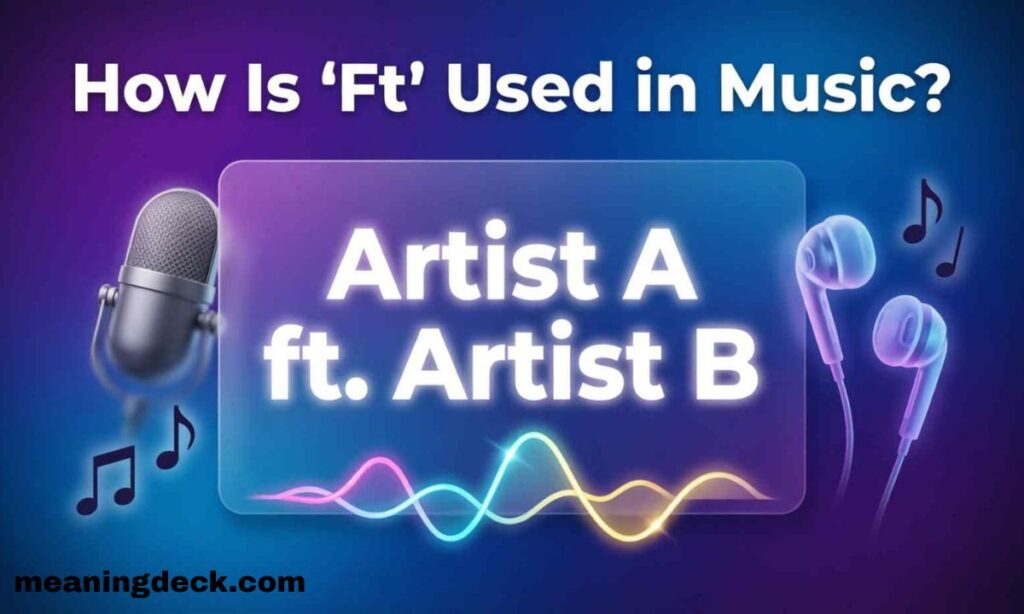
This is where “ft” lives most of its life. In music, the format almost always looks like this:
“Track Title ft. Guest Artist Name”
A few real-world style examples (not referencing specific real songs, just the format):
- “Stay ft. Guest Vocalist” means the main artist made the song and invited a vocalist to contribute.
- “Ride ft. Rapper Name” means a rapper appeared on the track but did not produce or own it.
- “Better Days ft. Two Artists” means two guest artists both appeared on the same track.
The featured artist often sings a hook, performs a rap verse, or adds a musical layer. They are credited because their contribution is significant enough to name publicly.
Ft in Text Messages and Social Media
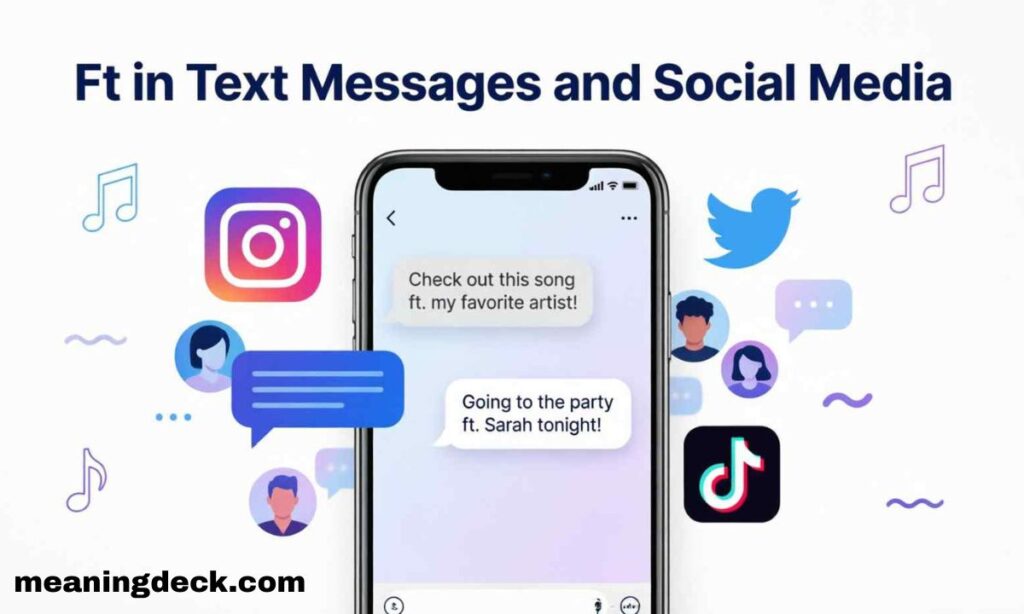
Outside of music, “ft” carries a different meaning entirely. And this is where people often get confused.
In texting and social media, “ft” commonly stands for “FaceTime,” the video calling app by Apple. When someone texts you “ft?” they are asking if you want to video call, not asking you to feature them in a song.
Here is how context changes everything:
- “Ariana ft. Nicki” = Ariana Grande featuring Nicki Minaj (music context)
- “wanna ft tonight?” = Do you want to FaceTime tonight? (texting context)
- “ft me later” = Call me on FaceTime later (casual conversation)
So the same two letters can mean two completely different things. The good news is that context always makes it obvious which one is being used.
Other Meanings of Ft You Should Know
Because English loves keeping things interesting, “ft” also stands for a few other things depending on the field:
- Feet (ft): The unit of measurement. “The room is 12 ft wide.” This is the oldest and most literal use of the abbreviation.
- Full Time (ft): Used in job listings and employment contexts. “This is a ft position.”
- Fort (Ft): Used in place names. “Ft. Worth, Texas” or “Ft. Lauderdale, Florida.”
- Financial Times (FT): The well-known British financial newspaper.
In everyday casual use though, if someone writes “ft” in a creative or social context, they almost always mean “featuring” or “FaceTime.” The other meanings tend to appear in formal or professional writing where the abbreviation is less ambiguous.
Biblical and Historical Context of “Featuring”
While the abbreviation “ft” itself is modern, the concept of featuring someone has ancient roots. In biblical tradition, books and letters were often attributed to their primary author while acknowledging contributors. The book of Psalms, for example, features collections from multiple authors including David, Asaph, and the Sons of Korah.
Ancient scrolls and manuscripts would credit primary authors and note where another voice contributed. In a loose but genuine sense, human collaboration in creative works has always needed a way to credit everyone involved. The modern “ft” is simply the most efficient version of that ancient instinct.
Even Roman and Greek texts often acknowledged co-authors or contributors, recognizing that great work rarely comes from a single voice working in complete isolation.
Common Mistakes People Make with “Ft”
Now that you understand what “ft” means, here are the mistakes that trip people up:
Mistake 1: Using “ft” when you mean “with” If two artists are equal partners on a track, neither should be the “featured” artist. In that case, the credit is usually written as “Artist A & Artist B” or “Artist A x Artist B.” Using “ft” implies one is the guest.
Mistake 2: Confusing ft (feet) with ft (featuring) Measurements and music credits do not mix. In any formal piece of writing, make sure the context is clear so readers do not picture a six-foot-tall rapper named “Guest Vocalist.”
Mistake 3: Adding “ft” to yourself Some creators humorously write “Artist ft. Himself” but in professional contexts, featuring yourself is redundant. You are already credited. Just let it go.
Mistake 4: Misreading “ft” as “ft.” in formal contexts In strict style guides, the period matters. “ft.” with a period is more formal. In casual social media use, the period is usually dropped. Know your audience.
Which One Should You Use: “ft,” “feat,” or “featuring”?
This depends entirely on where you are writing and what impression you want to make.
Use “ft” when you are writing casually, posting on social media, or formatting a song title for a streaming platform that favors short credits.
Use “feat.” when you are submitting music to a database, writing album liner notes, or filling out official credits on platforms like Spotify or Apple Music. It reads slightly more professional.
Use “featuring” in full when you are writing an article, a formal biography, a press release, or any piece of long-form content where abbreviations might feel out of place.
The meaning is the same. The delivery changes based on your context and your audience.
Real-Life Examples of “Ft” Used Correctly
Here are clean, clear examples showing “ft” in action across different contexts:
Music: “The producer released a new single ft. a Grammy-winning vocalist that immediately topped the charts.”
Social Media Caption: “Beach day ft. my best friend and way too much sunscreen.”
Texting: “I have something to tell you, can we ft later?”
Measurements: “The jump was 6 ft off the ground.”
Place Name: “She is currently living in Ft. Collins, Colorado.”
Each example is clear. Each one uses “ft” correctly within its context. Notice how none of them require much explanation because the surrounding words do all the heavy lifting.
Read This: Dayroom Meaning Slang: What It Really Means and Where It Comes From
Why “Ft” Became So Popular in Modern Culture
The internet shortened everything. When character limits and fast scrolling became the norm, long phrases got chopped. “Featuring” became “feat.” which became “ft.” which became “ft” with no period at all.
Social media amplified this. When a song goes viral and thousands of people share it, they are all writing the title quickly. The shorter the credit, the faster it spreads. Efficiency won, and the abbreviation stuck.
Today, “ft” is not just a music term anymore. It has leaked into everyday language to casually acknowledge anyone who made a contribution, even when no music is involved. A birthday post reading “Best night ever ft. my whole crew” is a natural, human way to give credit without a formal sentence structure.
Language evolves. And “ft” evolved fast.
Frequently Asked Questions
Does “ft” always mean featuring in song titles?
In music contexts, yes. When you see a track listed as “Song Name ft. Artist,” it means the second artist appeared in the song as a guest contributor. In texting, the same letters can mean FaceTime, so context is everything.
Is there a difference between “ft” and “feat” in music credits?
No real difference in meaning. Both are abbreviations for “featuring.” The choice between them is stylistic. Some artists and platforms prefer “feat.” because it looks slightly more complete, while others use “ft” for brevity.
Can “ft” be used in formal writing?
It is best avoided in formal writing. In essays, professional reports, or press materials, write out the full word “featuring” to maintain a polished tone. Reserve “ft” for casual, creative, and social contexts where brevity is valued.
Final Thoughts
“Ft” is one of those tiny abbreviations that carries a lot of weight. In music, it credits a guest artist. In texting, it often means FaceTime. In measurements, it stands for feet. In place names, it shortens “fort.”
The key is always context. Once you know what setting you are in, “ft” becomes instantly clear. No confusion, no second-guessing.
Whether you are reading a song title, writing a social media post, or just trying to understand what your friend meant in that last text, you now have the full picture. And the next time someone uses “ft” in a way that feels unfamiliar, you will know exactly where to look for the answer.

Welcome to MeaningDeck! I’m Alex, an AI-Powered SEO, and Content Writer with 2 years of experience.
I help websites rank higher, grow traffic, and look amazing. My goal is to make SEO and web design simple and effective for everyone.
Let’s achieve more together!