
You have heard someone say “this song is a total bop” and smiled along like you knew exactly what they meant. But deep down, a small voice whispered, “Wait, what is a bop?” You are not alone. This word pops up everywhere today, from music reviews to casual texts, yet its meaning is surprisingly layered. A bop is a song so catchy and energetic that you simply cannot stop listening to it. But there is more to it than that. Let us break it all down.
What Does Bop Mean in Simple Terms?
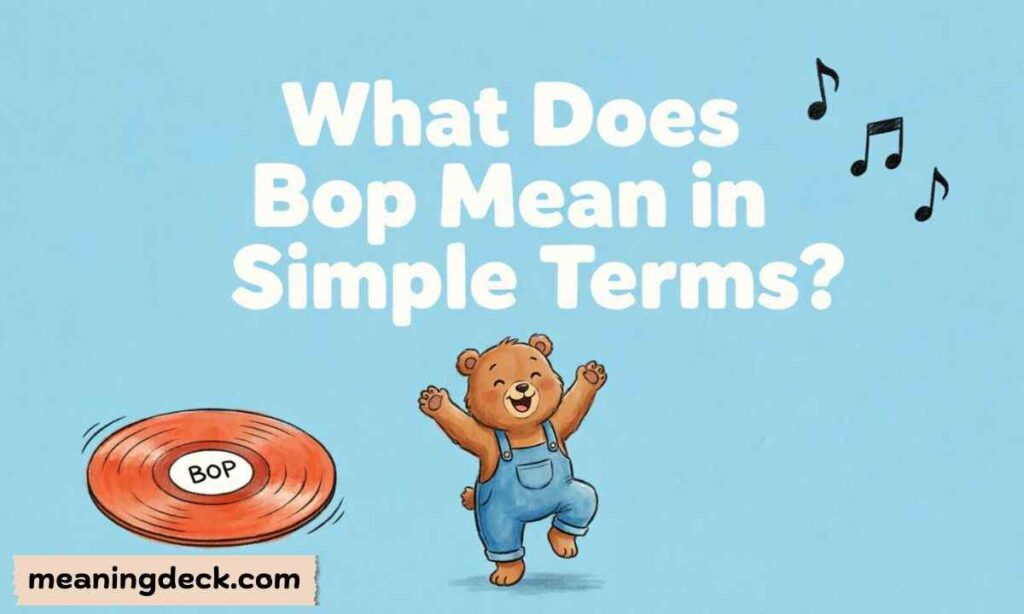
At its most basic level, a bop means a song that is extremely catchy, upbeat, and enjoyable. When someone calls a track a bop, they are giving it the highest casual compliment possible. It is the kind of song that plays once and suddenly you are humming it in the shower three days later.
The word is used as both a noun and a verb. As a noun: “That new track is a bop.” As a verb: “This song has me bopping my head.” Both uses point to the same core idea: pure, infectious musical energy.
Think of it as the modern version of saying a song “slaps” or “hits different.” They all orbit the same idea, which is that the music just works on a deep, almost involuntary level.
Where Did the Word Bop Come From? The Origin Story
Read This: MIA Meaning: What It Really Means and How to Use It Correctly
The word bop did not appear overnight. It has a surprisingly rich history that traces back decades before social media made it go viral.
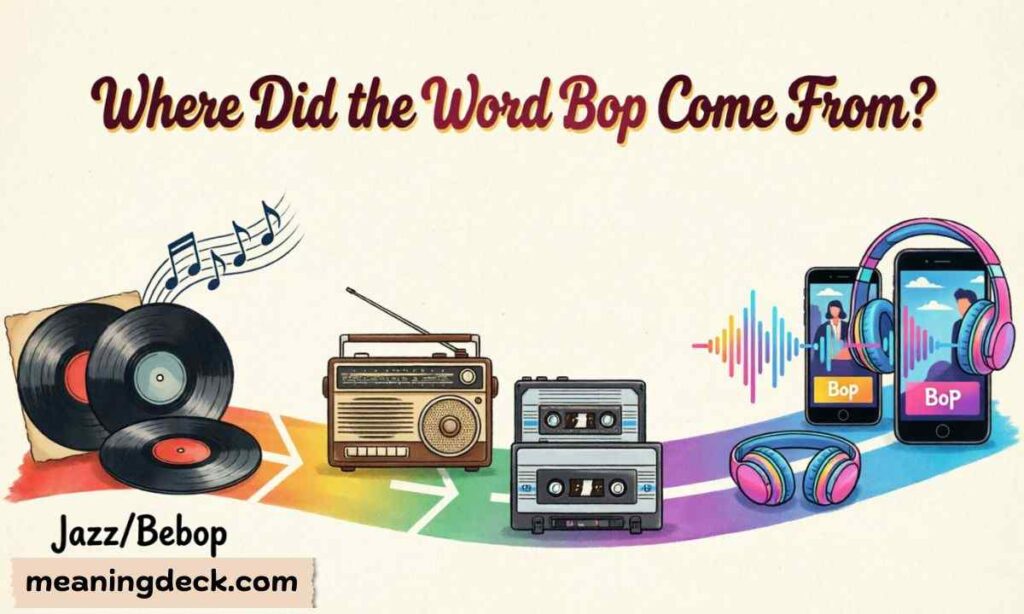
The earliest and most important root is bebop, the jazz movement that exploded in the 1940s. Bebop was fast, complex, and improvisational. Musicians like Charlie Parker and Dizzy Gillespie were playing at tempos that made listeners physically move. Over time, “bebop” got shortened to simply “bop,” and the word became associated with music that makes your body react before your brain catches up.
By the 1980s and 1990s, bop was being used in African American communities to describe any great song, particularly in hip hop and R&B circles. It carried energy, rhythm, and a sense of undeniable groove.
Then came social media, and the word exploded into mainstream pop culture around 2016 to 2018. Suddenly everyone from teenagers to music critics was calling songs bops, and the word had officially crossed over into everyday English.
Bop Meaning in Music Specifically
In the music world, calling something a bop is a very specific kind of praise. It is not just saying a song is good. It is saying the song has a particular quality that makes it irresistible.
A bop typically has these qualities:
- A strong, driving beat that makes you want to move
- A catchy hook or chorus that sticks in your head
- An upbeat or energetic feel, even if the lyrics are sad
- The ability to make you replay it immediately after it ends
Interestingly, a song can be a bop even if its lyrics are heartbreaking. Plenty of pop songs about loss and longing are total bops because the production is so infectious. The feeling of a bop lives in the sound more than the words.
Bop Meaning in Slang: Beyond Just Music
Here is where things get interesting. Bop in slang has expanded beyond music in recent years. Depending on the context and the community, it can carry a few different meanings.
In some slang circles, particularly online, “bop” can refer to someone who is considered very attractive or charming. This usage is less common and more informal, but it exists.
In older slang, a “bop” could mean a punch or a hit, as in “I’ll give you a bop on the head.” This usage is much older and mostly appears in older movies, cartoons, or British slang. Think of the old cartoon sound effects: “bam, pow, bop!”
So when someone uses the word, context is everything. In a music conversation, bop means a great song. In a text message calling someone a bop, it is likely a compliment on their attractiveness. And in an old detective movie, someone is probably about to get a mild tap on the head.
Bop vs. Slap vs. Banger: What Is the Difference?
People often use bop, slap, and banger interchangeably, but there are subtle differences worth knowing. Here is a quick breakdown:
| Word | Core Meaning | Energy Level | Common Context |
| Bop | Catchy, upbeat, fun song | Medium to high | Pop, R&B, general |
| Slap | Song that hits hard and impresses | High | Hip hop, trap, bass-heavy |
| Banger | Intense, high-energy track | Very high | EDM, hip hop, club music |
| Jam | A song you love and enjoy | Medium | Casual, nostalgic |
| Hit | A commercially successful song | Varies | Mainstream music |
The key difference is intensity and mood. A bop is fun and catchy. A slap hits harder. A banger is almost aggressive in its energy. You can enjoy a bop while sipping coffee. A banger is what plays at 2am on a dance floor.
Real Life Examples of Bop Used in Sentences
Seeing a word in context is the fastest way to truly understand it. Here are some natural, real-world examples:
In music conversations: “Have you heard that new Dua Lipa track? It is an absolute bop.” “I made a playlist of nothing but bops for the road trip.”
In casual texting: “This song just came on shuffle and I forgot what a bop it was.” “I cannot stop playing this. It is such a bop.”
Using bop as a verb: “We were all bopping our heads the entire concert.” “The crowd was bopping from the first beat.”
In older or British slang: “He gave the pinball machine a little bop on the side to keep the ball going.”
Notice how the tone and setting change the meaning entirely. Music context equals great song. Physical context equals a gentle hit or tap.
Does Bop Have Any Biblical or Historical Significance?
This is a fair question, especially since many words carry layers of historical meaning. When it comes to bop, the biblical connection is essentially nonexistent. The word in its modern form is entirely rooted in 20th century American culture, particularly in jazz and African American musical tradition.
However, the concept behind a bop is ancient. Music that makes people move involuntarily, that creates communal energy and joy, has existed across every culture and era in history. Ancient Greek philosophers wrote about music’s power to affect the soul. African drumming traditions were built on rhythmic patterns designed to move both the body and spirit.
So while the word “bop” is modern, the experience of a bop is as old as humanity itself. That song that makes you stop what you are doing and just feel it? Every generation had one. We just finally have the perfect word for it.
Common Mistakes People Make When Using Bop
Even a simple slang word comes with its own set of misuses. Here are the most common mistakes to avoid:
Calling every good song a bop. Not every great song is a bop. A slow, emotional ballad that moves you to tears is beautiful but probably not a bop. Bops have energy. They have drive. Respect the criteria.
Using bop in formal writing. This one seems obvious, but it still happens. Do not call a classical composition a bop in a music review for a serious publication. The word carries a casual, modern tone that clashes with formal contexts.
Confusing the old and new meanings. If your grandmother says something is a bop, she might mean it literally got hit. If your younger sibling says it, they mean it is a great song. Context, always context.
Overusing it. When every single song becomes “such a bop,” the word loses its meaning. Reserve it for songs that genuinely earn it. Let it mean something.
Which One Should You Use: Bop, Slap, or Banger?
Here is a simple guide to picking the right word for the right moment:
Use bop when: The song is upbeat, catchy, and fun. It works for pop, R&B, or any genre with a strong groove. It is the most versatile and widely understood term.
Use slap when: The song hits particularly hard and you want to emphasize its impact. More common in hip hop conversations and among younger audiences.
Use banger when: The energy is intense and the track is built for a high-energy setting like a gym, party, or club. Bangers do not usually have quiet moments.
Use jam when: The song is personal and nostalgic, something you have loved for a long time regardless of whether it is trendy or not.
When in doubt, bop is always a safe and well-understood choice across age groups and music communities.
Why the Word Bop Became So Popular
Read This: RLS Meaning: What It Really Stands For & Why People Get It Wrong
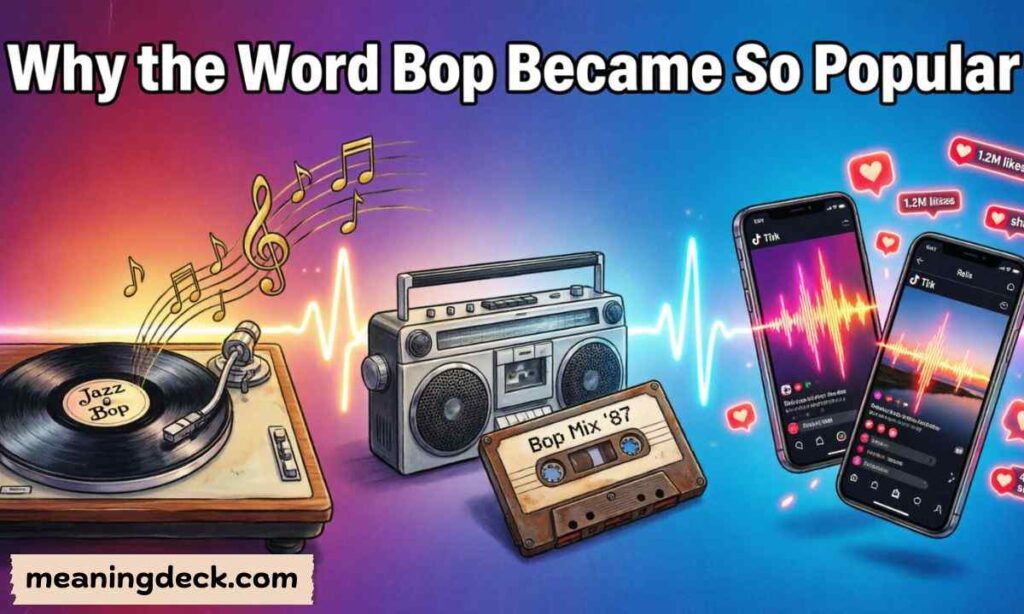
Language follows culture, and bop became popular because it filled a gap. English speakers needed a word that captured the specific joy of an incredibly catchy song without being too formal or too aggressive.
Words like “masterpiece” feel heavy. “Nice” feels weak. “Bop” lands perfectly in the middle. It is enthusiastic without being over the top. It communicates instant understanding in a single syllable.
The rise of streaming platforms, short-form video, and music playlists also played a massive role. When you can share a song in seconds and it needs to grab someone in the first five seconds, the concept of a bop became central to how people talk about music online.
Social media platforms essentially turned the word into a global compliment, crossing language and cultural barriers because music itself is universal.
Bop in Pop Culture: Famous Uses You Might Recognize
The word has made its way into some memorable cultural moments. Artists have used it to describe their own work. Music journalists use it constantly in headlines. Even major publications have adopted it as standard vocabulary.
One of the most famous uses was when fans began calling certain Taylor Swift, Cardi B, and Doja Cat tracks absolute bops, helping cement the word as a permanent part of music criticism vocabulary.
The song “Bop” by DaBaby, released in 2019, brought the word directly into a mainstream hip hop title and reached the top ten on the Billboard Hot 100, introducing the term to an entirely new audience.
Today, calling something a bop is not just slang anymore. It is recognized music vocabulary that appears in everything from Rolling Stone articles to TikTok captions to casual family group chats.
Frequently Asked Questions
Can a slow song be a bop?
Technically, a slow song can be called a bop if it is incredibly catchy and addictive, but it is uncommon. The word usually implies upbeat energy. A slow song is more likely to be called a “vibe” or a “jam.”
Is bop a compliment?
Absolutely. Calling a song a bop is one of the most enthusiastic compliments you can give in casual music conversation. It means the song is not just good but genuinely enjoyable and irresistible.
Where is bop most commonly used?
Bop is most common in the United States, UK, and other English-speaking countries, especially in online spaces. You will see it heavily on music streaming comments, social media, and anywhere people casually discuss songs they love.
Final Thoughts
The word bop has traveled a long road from 1940s jazz clubs to your phone screen. It started as a musical movement, became slang, and eventually turned into one of the most instantly understood compliments in modern music vocabulary.
At its heart, a bop is simply a song that makes you feel something immediately. It does not ask permission. It just grabs you and makes your head move before your brain has time to think about it.
So the next time a song earns that reaction from you, you now have the perfect word for it. And you will use it correctly, confidently, and without calling a quiet piano ballad a bop. Because you know better now.

Welcome to MeaningDeck! I’m Alex, an AI-Powered SEO, and Content Writer with 2 years of experience.
I help websites rank higher, grow traffic, and look amazing. My goal is to make SEO and web design simple and effective for everyone.
Let’s achieve more together!