
Many writers pause while typing this word, unsure whether it needs one p or two. The debate over Proper or Propper shows up daily in emails, school assignments, and casual chats.
This guide gives a clear answer, the word’s history, and real examples so the Proper or Propper question never trips you up again.
Proper
Proper is the correct, dictionary recognized spelling. It means correct, suitable, fitting, or socially acceptable, and appears in formal documents, news, and everyday conversation.
Propper
Propper is not a standard English word. It only appears as a surname or as informal internet slang, and as a spelling of correct or suitable, it is simply a mistake.
Proper or Propper – Quick Answer
If you only remember one thing from this guide, remember this: the word is proper, spelled with a single p in the middle. Whenever the Proper or Propper question comes up, proper wins every single time, in every English speaking country and in every type of writing.
Simple Examples:
- She wore proper safety gear on the construction site.
- The report needs proper formatting before submission.
- He never learned the proper way to hold a violin.
- They followed proper procedure during the inspection.
proper or propper spelling
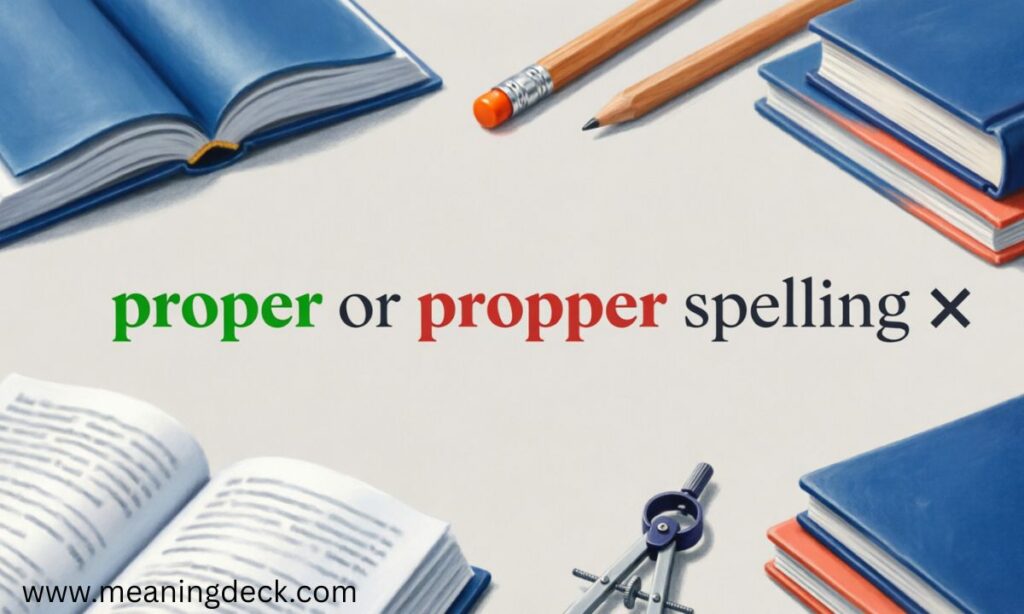
The confusion around proper or propper spelling usually comes from sound rather than structure. English has many double consonant words such as letter, bigger, and slipper, so writers assume the same pattern applies here, even though it does not. The rule for proper or propper spelling stays simple: only one p follows the first syllable.
The Origin of Proper or Propper
Understanding where this word came from explains why the Proper or Propper debate has only one correct outcome.
Origin of Proper
Proper entered English in the thirteenth century through Old French propre, which came from the Latin proprius, meaning one’s own or particular. The original sense pointed to belonging uniquely to a person or thing, and over time it broadened into the modern meaning of correct or appropriate.
Why Propper Exists
Propper survives mainly because of phonetic guesswork and typing habits. Since the spoken word can sound slightly stressed in the middle, some writers double the letter without checking, and fast typing plus casual internet slang keep the misspelling alive.
Key Point
No stage of the word’s history, from Latin to Old French to modern English, ever included a double p. Anyone weighing Proper or Propper can rely on etymology alone to settle the matter.
Read This: Openning or Opening: Which Spelling Is Correct? Update (2026)
British English vs American English Spelling
Unlike pairs such as colour and color, the Proper or Propper question does not change across regions. Both British and American dictionaries list only one accepted form.
Comparison Table
| Region | Accepted Spelling | Notes |
| British English | proper | Used identically in UK dictionaries and style guides |
| American English | proper | Matches Merriam Webster and other US references |
| Australian English | proper | Same spelling, no regional variation |
| Canadian English | proper | Follows the same single p rule |
Proper synonym
When you need an alternative word instead of worrying over Proper or Propper, several options carry a similar meaning. Common choices include:
- Suitable
- Appropriate
- Correct
- Fitting
- Right
- Acceptable
- Decent
Each of these can replace proper depending on context, and none of them carry the Proper or Propper spelling confusion at all.
Which Spelling Should You Use?
The answer to Proper or Propper never changes based on tone, audience, or platform. Proper is always correct, and propper should be avoided in every situation, including casual messages where small mistakes feel harmless.
Audience-based advice
Regardless of who is reading your work, the Proper or Propper decision never changes.
- Students and academics: use proper in essays, research papers, and exam answers.
- Business professionals: use proper in emails, reports, and client communication to protect credibility.
- Bloggers and content writers: use proper consistently to maintain reader trust and search engine accuracy.
- Casual writers and social media users: even informal posts benefit from correct spelling, so stick with proper.
Common Mistakes with Proper or Propper
Several patterns explain why this mistake keeps appearing across the internet.
1. Double p errors
Writers sometimes add an extra p because English contains many double consonant words. This pattern does not apply here, and the Proper or Propper error usually starts with this false assumption.
2. Confusing pronunciation with spelling
Spoken English can blur small details. Because the middle sound feels slightly stressed, some assume the spelling needs to match that emphasis, leading directly to the Proper or Propper mistake.
3. Informal usage pitfalls
Online slang occasionally uses propper as a stylized or playful spelling. Carrying that habit into formal writing creates a Proper or Propper error that readers and employers notice quickly.
4. Autocorrect mistakes
Most modern keyboards and writing tools automatically flag or correct the Proper or Propper error. When autocorrect is turned off or ignored, the incorrect spelling can slip through unnoticed.
Proper or Propper in Everyday Examples
Seeing the word in real contexts makes the correct choice easier to remember.
Emails
“Please send the proper documents before Friday.” Getting Proper or Propper right in business emails protects your professional image.
News
“Officials confirmed that proper safety checks were completed before the launch.” News writing relies on standard spelling to protect credibility.
Social Media
“Finally learned the proper way to fold a fitted sheet!” Even casual posts look more polished once Proper or Propper is settled correctly.
Formal Writing
“The committee requires proper documentation for all applicants.” Academic and legal writing has zero tolerance for the propper mistake.
Proper or Propper – Google Trends & Usage Data
Search data shows a steady stream of curiosity around this spelling question.
Search Intent
Most searches for Proper or Propper come from people writing in real time, such as students or professionals who pause to confirm spelling before hitting send.
Popular Regions
English speaking countries including the United States, the United Kingdom, India, Pakistan, and the Philippines show consistent search volume for Proper or Propper questions.
Context of Searches
Searchers typically look for quick confirmation rather than a long explanation, which is why featured snippet style answers and short definitions perform well for this topic.
Comparison Table: Proper vs Propper
| Feature | Proper | Propper |
| Dictionary status | Recognized standard word | Not recognized as a word |
| Origin | Latin proprius, Old French propre | No legitimate etymology |
| Regional variation | None, same everywhere | Not applicable |
| Formal writing use | Always acceptable | Never acceptable |
| Common context | All English writing | Surname or internet slang only |
Read This: Seak or Seek? Which Spelling Is Correct? (2026)
Conclusion
The Proper or Propper question has a short, dependable answer. Proper is the only correct spelling, supported by centuries of etymology and consistent use across British, American, Australian, and Canadian English.
Propper carries no legitimate grammatical standing. Keeping one rule in mind, one p in the middle and never two, will help you avoid the Proper or Propper mistake for good.
Frequently Asked Questions
Is propper ever correct?
No, propper is not a recognized English word and should never replace proper.
Does British English spell it differently?
No, British and American English both use the same spelling, proper.
Why do people misspell it as propper?
Pronunciation, fast typing, and exposure to double consonant words cause the common Proper or Propper mistake.
Can proper describe objects as well as people?
Yes, proper can describe people, objects, actions, or methods.
Is there a difference in meaning between proper and propper?
No, propper has no meaning of its own since it is simply a misspelling.
Will autocorrect fix propper automatically?
Most tools will flag or correct it, but it is safer to type proper correctly the first time.
Is proper used in formal writing?
Yes, proper is fully acceptable and expected in formal, academic, and business writing.

Welcome to MeaningDeck! I’m Alex, an AI-Powered SEO, and Content Writer with 2 years of experience.
I help websites rank higher, grow traffic, and look amazing. My goal is to make SEO and web design simple and effective for everyone.
Let’s achieve more together!