

If you have ever stopped mid-sentence wondering whether to write spinned or spun, you are not alone. This is one of those grammar questions that trips up both native speakers and English learners alike. The confusion is totally understandable. English has hundreds of irregular verbs that refuse to follow the normal rules, and spinned or spun is a perfect example of that challenge.
This guide on spinned or spun gives you a clear, complete answer on spinned or spun, backed by grammar rules, real examples, and usage data. Whether you are writing a school essay, a blog post, or a professional email, this article will make sure you always pick the right form.
Do you say “spinned” or “spun”?
The short answer is: you say spun, not spinned. In everyday speech and formal writing, native English speakers use spun as the past tense of the verb spin. You would say “She spun the wheel” or “He spun around quickly,” never “she spinned” or “he spinned.”
The reason most people get confused about spinned or spun is simple. Many English verbs form their past tense by adding “-ed” to the base form. Think of words like walk (walked), talk (talked), or jump (jumped). If spin followed that same pattern, the past tense would logically be spinned. But spin does not follow that pattern because it is an irregular verb.
Is “spinned” a real word?
Technically, spinned does not exist as a standard English word. You will not find it accepted in major dictionaries like Merriam-Webster, Oxford, or Cambridge as a correct past tense form. The word spinned is considered a non-standard and incorrect form when used in place of spun.
That said, Wiktionary does note that spinned appears occasionally as a nonstandard form, mostly in informal or dialectal usage. Language does evolve, and some writers use spinned in very casual settings. However, in any formal, academic, or professional context, spinned is wrong. Always choose spun when writing anything that matters.
Read This: Modelling vs Modeling: Which Spelling Is Correct in 2026?
Spinned or Spun Quick Answer
Here is the fastest way to remember the rule for spinned or spun:
- Spin is the base form (present tense)
- Spun is the simple past tense
- Spun is also the past participle
So the full conjugation looks like this: spin → spun → spun
This pattern is similar to other irregular verbs in English such as win → won → won, or run → ran → run. Whenever you are unsure about spinned or spun, think of the word “win.” Nobody says “winned.” The same logic applies here.
The Origin of Spinned or Spun
The verb spin traces back to Old English spinnan, meaning “to draw out and twist fibers into thread.” It was a strong verb, meaning it changed its vowel sound for the past tense rather than adding “-ed.” Over time, the past tense settled into the modern form spun we use today.
This Germanic root is also the ancestor of similar words in German, Dutch, and Old Norse. Because of this long history, spinned never became an accepted form. The word spun was established early and has remained the standard ever since.
Spinned or spun meaning
The word spun carries several meanings depending on the context. Here is how spinned or spun breaks down in terms of meaning when used correctly as spun:
- Rotational meaning: Something turned or revolved rapidly. Example: “The top spun across the table.”
- Textile meaning: Fibers were twisted together to form thread or yarn. Example: “The wool was spun into a fine thread.”
- Figurative meaning: Information or a story was presented in a particular way to influence perception. Example: “The politician spun the news to his advantage.”
- Informal meaning: A person became dizzy or disoriented. Example: “My head spun after the long flight.”
All of these meanings belong to spun, not spinned. No matter which meaning you intend, spun is always the right word.
Spinned or spun synonym
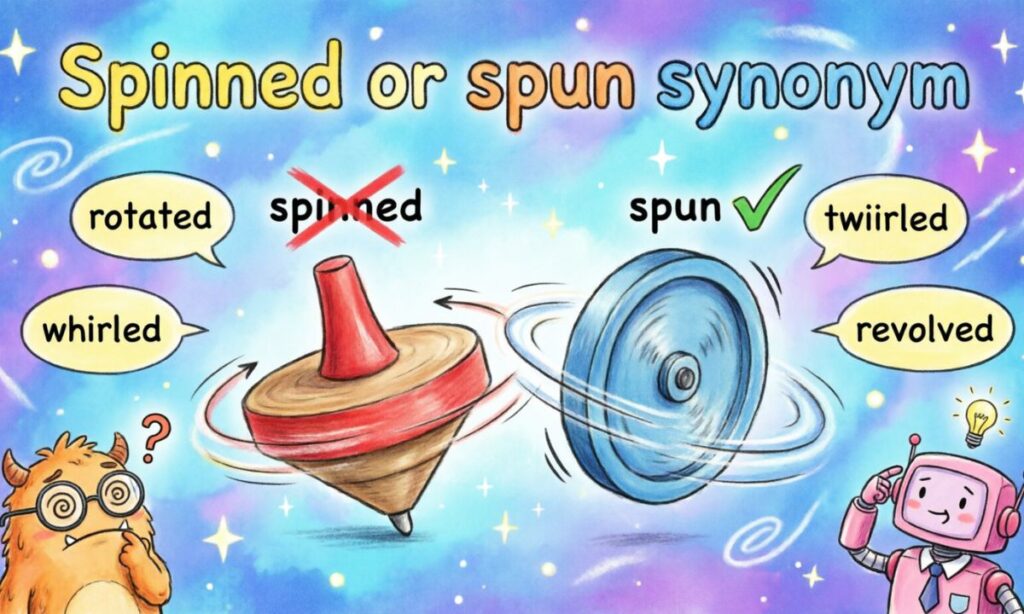
When you want to vary your language instead of repeating spun, try these synonyms: rotated, whirled, twirled, revolved, twisted, or turned. These work well in both formal and informal writing, though none fully replaces spun in every context.
Spinned or spun grammar
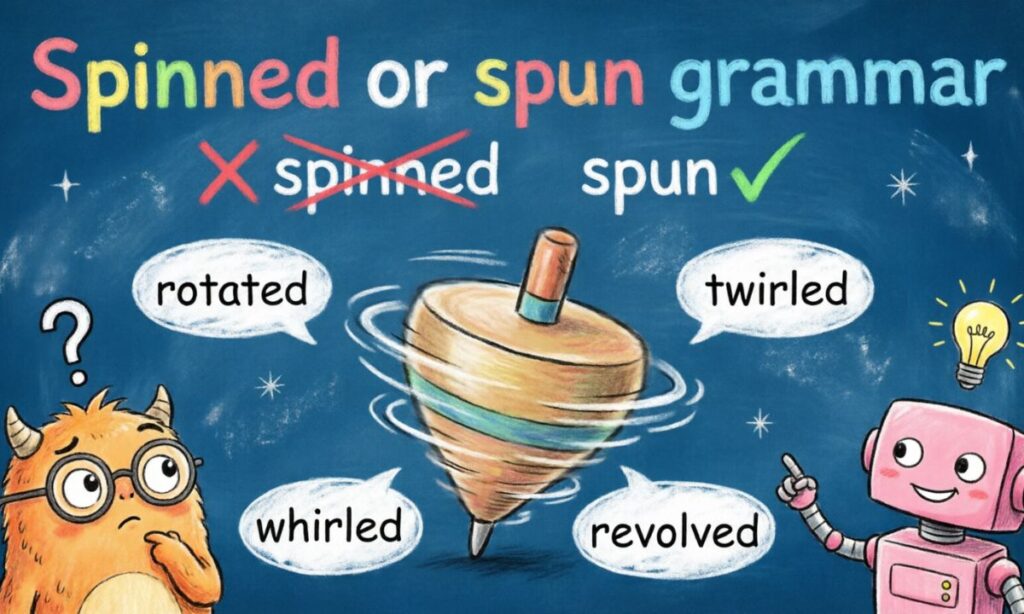
From a grammatical standpoint, the spinned or spun question comes down to regular vs. irregular verbs.
Regular verbs add “-ed” to form the past tense:
- Play → Played
- Walk → Walked
- Jump → Jumped
Irregular verbs change internally:
- Sing → Sang
- Drink → Drank
- Spin → Spun
Spin belongs firmly in the irregular category. This means:
- The simple past tense is spun (not spinned)
- The past participle is also spun (not spinned)
- The present participle is spinning
In a sentence: “She has spun the wheel three times” uses spun as a past participle with the auxiliary verb “has.” This is the present perfect tense. You would never write “she has spinned.”
British English vs American English Spelling
Both British English and American English agree that spun is the correct past tense of spin. There is no regional split on this word the way there is with “colour vs. color” or “realise vs. realize.” Whether you are writing for a UK or US audience, spun is correct and spinned is wrong. Some older British texts used span as a past tense, but that form is now archaic and no longer common in either variety.
Which Spelling Should You Use?
The answer to spinned or spun is always spun. There is no situation in modern English where spinned is the better choice. Formal writing, academic essays, journalism, casual conversation, and creative writing all require spun as the correct form.
Spinned or spun past tense
To be completely clear about spinned or spun in the past tense, here is the full verb table for spin:
| Tense | Form | Example |
| Simple Present | spin / spins | She spins the wheel every day. |
| Present Participle | spinning | He is spinning the globe. |
| Simple Past | spun | She spun around twice. |
| Past Participle | spun | The thread has been spun. |
| Past Perfect | had spun | By noon, he had spun the yarn. |
Notice that spun appears in both the simple past and past participle columns. This is another feature of irregular verbs. The word spinned does not appear anywhere in this table because it has no legitimate place in correct English grammar.
Common Mistakes with Spinned or Spun
Writers who are unsure about spinned or spun tend to make the same types of errors. Here are the most common ones and how to avoid them:
Wrong: The dancer spinned gracefully across the stage. Right: The dancer spun gracefully across the stage.
Wrong: She had spinned the bottle before anyone noticed. Right: She had spun the bottle before anyone noticed.
Wrong: The story was spinned by the media. Right: The story was spun by the media.
Spinned or Spun in Everyday Examples
Seeing spinned or spun in real sentences makes the rule much easier to remember. Here are examples across different contexts:
- The gymnast spun through the air with perfect form.
- The artisan spun raw wool into soft yarn.
- The campaign team spun the bad news into a positive story.
- He spun the pizza dough high into the air.
- My head spun when I heard the surprising announcement.
Spinned or Spun Google Trends and Usage Data
Search data confirms that spun consistently outperforms spinned across all major markets including the US, UK, Canada, and Australia. Searches for “spinned” mostly come from grammar-check and spelling queries, meaning people search it because they are unsure, not because they use it.
Google Books data shows spun has dominated written English for centuries, while spinned barely registers in published texts.
Comparison Table: Spinned vs Spun
| Feature | Spinned | Spun |
| Grammatically correct | No | Yes |
| Accepted in formal writing | No | Yes |
| Found in major dictionaries | No | Yes |
| Used by native speakers | Rarely | Always |
| British English | Incorrect | Correct |
| American English | Incorrect | Correct |
| Past tense of spin | Non-standard | Standard |
| Past participle of spin | Non-standard | Standard |
Read This: Atleast or At Least: Which One Is Correct in 2026?
Conclusion
The debate over spinned or spun has a very clear winner: spun is correct, and spinned is not. The verb spin is irregular, which means it changes its vowel sound rather than adding “-ed” to form the past tense. This pattern goes back to Old English and has stayed consistent across both British and American English for centuries.
Every time you write about something that rotated, turned, or was presented in a certain way, the right word is spun. Whether you are writing a novel, a school assignment, or a professional report, choosing spun keeps your English accurate and your writing professional.
The rule is simple when it comes to spinned or spun: spin → spun → spun. Remember it once, and you will never have to search for spinned or spun again.
Frequently Asked Questions
Q: What is the correct answer to spinned or spun?
The answer to spinned or spun is always spun. Spinned is non-standard and should be avoided in formal writing.
Q: Is spinned a real word?
No. For spinned or spun, only spun is accepted in standard dictionaries.
Q: Is spun the same in British and American English?
Yes. Both use spun. There is no regional difference for this word.
Q: Can I ever use spinned in writing?
When choosing spinned or spun, always pick spun for formal or professional writing.
Q: What type of verb is spin?
Spin is an irregular verb, which is why its past tense is spun rather than spinned.
Q: What does spun mean in media?
In media and politics, spun means information was presented in a selective way to shape public opinion.

Welcome to MeaningDeck! I’m Alex, an AI-Powered SEO, and Content Writer with 2 years of experience.
I help websites rank higher, grow traffic, and look amazing. My goal is to make SEO and web design simple and effective for everyone.
Let’s achieve more together!