
If you have ever typed the phrase upsale or upsell and paused to wonder which one is right, you are far from alone. The question of upsale or upsell comes up constantly in sales teams, marketing departments, and content writing circles. Sales professionals, marketers, and business writers make this mistake every single day.
The confusion is understandable because both words sound almost identical when spoken out loud. However, only one of them belongs in your emails, reports, and pitch decks. This guide settles the debate for good, explains the correct spelling, and walks you through real examples so you never second-guess yourself again.
Upsale or Upsell: Quick Answer
Upsell is the correct spelling. It is a recognized English word that appears in Merriam-Webster, the Cambridge Dictionary, and Collins English Dictionary.
Upsale is not a real word in standard English and does not appear in any major dictionary. Whenever you are choosing between upsale or upsell, always go with upsell.
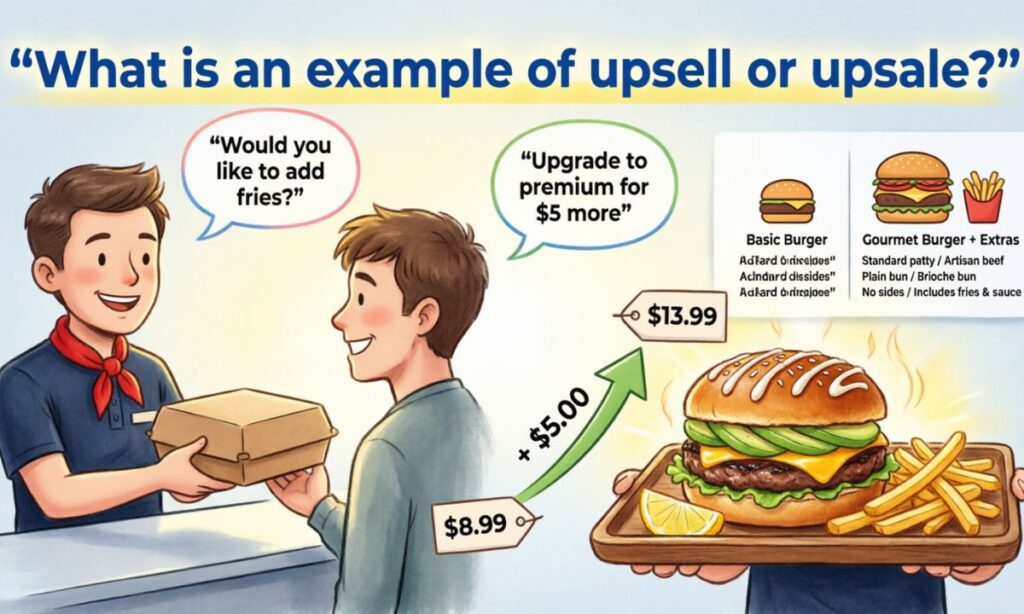
What is an example of upsell or upsale?
Read This: Nicked or Knicked: The Ultimate Spelling Guide for 2026
Here are clear, everyday examples that show how upsell or upsale plays out in real situations:
- A barista asks if you would like to upgrade your medium coffee to a large for only fifty cents more. That is an upsell.
- A car dealership representative suggests adding a leather interior package to the model you are already buying. That is an upsell.
- A software company invites you to move from a basic plan to a professional plan with more features. That is an upsell.
- An airline offers a seat upgrade from economy to business class at checkout. That is an upsell.
In every single case above, the correct term is upsell. Writing upsale in any of these contexts would be a spelling error.
Is upsell a word?
Yes, upsell is absolutely a real word. The confusion around upsale or upsell persists because upsale looks plausible on the surface. However, it has been part of business English since the 1970s. Dictionary.com notes that upsell was first recorded around 1975 to 1980, formed by combining the prefix “up” with the verb “sell.” It functions as both a verb and a noun in modern usage.
Upsell as a verb:
“The server tried to upsell the customer on a premium dessert platter.”
Upsell as a noun:
“The checkout page included a well-timed upsell that increased the average order value.”
The present participle form is upselling, and the past tense is upsold. All three forms are widely used in professional sales and marketing writing.
Upsell synonym
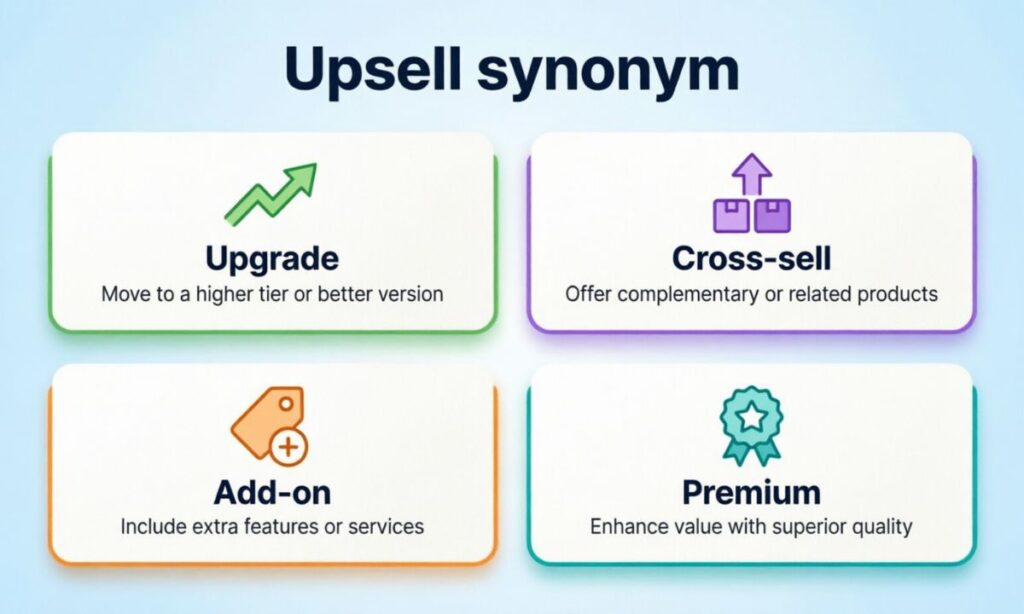
If you want to vary your language and avoid repeating upsell too often, here are some accepted synonyms and related terms:
- Upgrade pitch
- Premium offer
- Value add
- Tier upgrade
- Enhancement offer
- Add-on promotion
- Revenue expansion
These alternatives work well in formal writing, but none of them replace the precision that the word upsell carries in a sales context. Most industry professionals will still recognize and prefer the term upsell in business communication.
The Origin of Upsale or Upsell
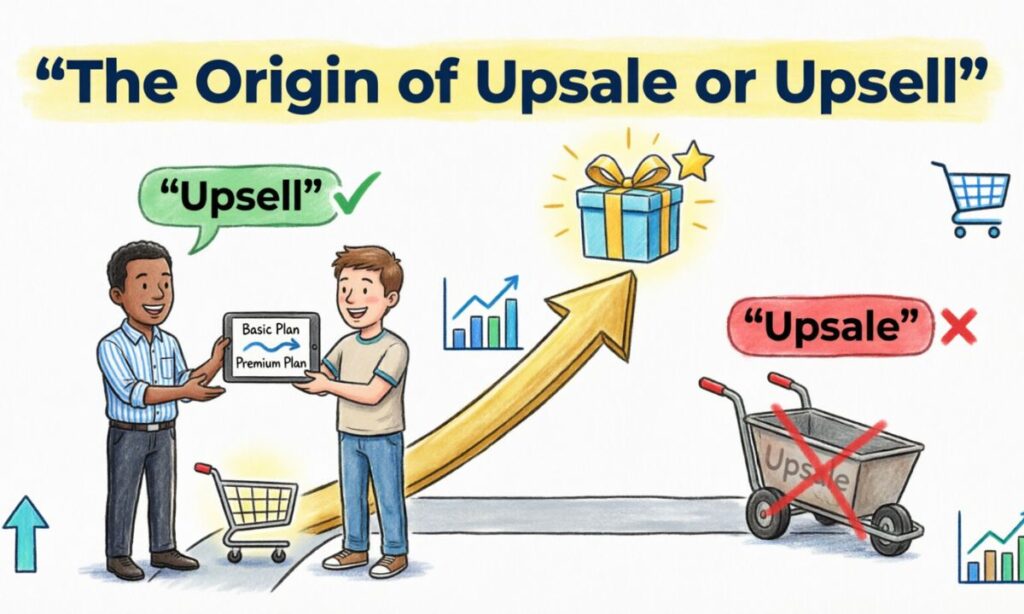
The word upsell was born in American commercial culture during the mid-twentieth century. It combines the directional prefix “up,” meaning higher or more, with the foundational verb “sell.” The logic is simple: you are selling upward, meaning toward a higher price point or a greater value.
Upsale, on the other hand, has no documented origin story because it was never formally adopted into English. People began using it by analogy with words like “resale” or “presale,” which do end in “sale.” However, those words are nouns built on the noun “sale.”
Upsell was always built on the verb “sell,” which is why it ends differently. Understanding this distinction makes it much easier to remember the correct form of upsale or upsell going forward. Anyone who types upsale or upsell into a search engine is looking for exactly this kind of clarity.
British English vs American English Spelling
One question that comes up frequently around upsale or upsell is whether British and American English treat the word differently. The answer is no. Both varieties of English use upsell as the standard spelling. Neither the Oxford English Dictionary tradition nor American lexicography recognizes upsale as an acceptable variant.
You may occasionally see the hyphenated form up-sell in older British publications, but even that usage has largely faded. Today, both regions simply write it as one word: upsell. This makes the upsale or upsell question even simpler because there is no regional exception to memorize. When it comes to upsale or upsell, the answer is universal across all English dialects.
Which Spelling Should You Use?
Always use upsell. The answer to upsale or upsell never changes based on context. Here is a quick checklist to guide you:
- Writing a sales email? Use upsell.
- Creating a marketing report? Use upsell.
- Drafting a social media post about revenue strategy? Use upsell.
- Composing a customer success playbook? Use upsell.
- Writing product descriptions or checkout page copy? Use upsell.
There is no professional context where upsale is the safer or more accepted choice. It will flag as a spelling error in most word processors and will undermine your credibility with readers who know the correct form.
Upsell and cross sell meaning
Now that the upsale or upsell debate is settled, it helps to understand how upsell fits alongside its close companion: cross sell. The upsale or upsell clarification is only the first step toward mastering sales language. These two strategies are often confused, but they are distinct techniques.
Upsell means encouraging a customer to buy a higher-priced or more advanced version of the same product or service they are already considering. The goal is to move them up the value ladder.
Cross sell means recommending a complementary product that is different from but related to the original purchase. The goal is to add items to the transaction rather than upgrade a single item.
Quick comparison:
| Feature | Upsell | Cross Sell |
| Goal | Upgrade to a better version | Add a related product |
| Example | Basic to premium software plan | CRM software plus analytics tool |
| Focus | Higher price on same item | Additional items alongside main purchase |
| Timing | Usually before purchase completes | Before, during, or after purchase |
| Revenue impact | Higher per-unit value | Higher transaction volume |
Both strategies increase revenue, but upsell focuses on depth while cross sell focuses on breadth.
Common Mistakes with Upsale or Upsell
Knowing the correct spelling is only half the battle. Writers searching for clarity on upsale or upsell often fall into the same traps repeatedly. Here are the most common errors writers make when using upsale or upsell:
Mistake 1: Writing upsale instead of upsell This is the most frequent error. It looks plausible because of words like “resale,” but it is always wrong.
Mistake 2: Using upsell as a plural noun incorrectly Correct: “We ran three upsells this quarter.” Incorrect: “We ran three upsell this quarter.”
Mistake 3: Confusing upsell with cross sell These are not interchangeable. An upsell upgrades; a cross sell adds.
Mistake 4: Hyphenating unnecessarily in modern writing “Up-sell” is an outdated form. Modern style guides prefer the single word upsell in almost all cases.
Mistake 5: Treating upsell as exclusively a noun Upsell works equally well as a verb: “Let’s upsell the premium tier to new subscribers.”
Upsale or Upsell in Everyday Examples
Let’s look at how upsale or upsell appears naturally across different industries. These real-world scenarios answer the upsale or upsell question in context:
Retail: “The store associate used a smart upsell to move the customer from a standard warranty to a full-coverage protection plan.”
E-commerce: “The checkout page displayed an upsell offer showing the larger bundle at a reduced per-unit cost.”
Hospitality: “The hotel front desk team was trained to upsell ocean-view rooms during the check-in process.”
SaaS and technology: “The account manager spotted an opportunity to upsell the client to an enterprise license after noticing heavy platform usage.”
Food service: “Fast-food chains have perfected the upsell by asking customers if they want to supersize their order.”
Each example shows upsell in its natural habitat, used confidently and correctly.
Upsale or Upsell: Google Trends and Usage Data
When you search for upsale or upsell on Google Trends, the data tells a clear story. People who search for upsale or upsell are almost always looking for spelling confirmation. The term “upsell” consistently dominates search volume across every region and time period.
“Upsale” does appear occasionally, but its spikes are almost always linked to misspellings or non-English language contexts where the word carries different meaning in another tongue.
Professional publications including Forbes, Harvard Business Review, and the Wall Street Journal exclusively use the spelling upsell. Major dictionaries including Merriam-Webster, Cambridge, and Collins all list only upsell. There is zero data-backed justification for choosing upsale in any English-language professional context.
Upsale vs Upsell: Comparison Table
| Factor | Upsale | Upsell |
| Is it a real word? | No | Yes |
| In major dictionaries? | No | Yes |
| Used by professionals? | Rarely (as misspelling) | Universally |
| Correct in emails? | No | Yes |
| Correct in marketing copy? | No | Yes |
| British English accepted? | No | Yes |
| American English accepted? | No | Yes |
| Past tense form? | None | Upsold |
| Present participle? | None | Upselling |
| Noun usage? | Incorrect | Correct |
Read This: 12th or 12nd? Which Ordinal Number Is Correct? (2026)
The table makes the choice completely clear when it comes to upsale or upsell. Upsell wins across every single category. Upsale fails them all.
Conclusion
The upsale or upsell question has one clean, definitive answer: always use upsell. Settling the upsale or upsell debate once and for all lets you focus on what matters most: writing clear, professional content that earns trust. It is the only spelling recognized by dictionaries, used by business professionals, and accepted in both American and British English.
Whether you are writing a sales proposal, a marketing email, or a product page, upsell is your go-to term. Upsale is simply a misspelling that arose from a logical but incorrect analogy with words like resale. Now that you know the difference between upsale or upsell, you can write with full confidence.
The next time someone on your team questions whether to write upsale or upsell, you have both the answer and the data to back it up. Upsell is the right choice every time you face the upsale or upsell decision.

Welcome to MeaningDeck! I’m Alex, an AI-Powered SEO, and Content Writer with 2 years of experience.
I help websites rank higher, grow traffic, and look amazing. My goal is to make SEO and web design simple and effective for everyone.
Let’s achieve more together!