
If you have ever paused while typing and wondered whether to write openning or opening, you are not alone. This is one of the most common spelling mix ups in English, and it shows up everywhere from emails to event invitations to school essays. The good news is that the answer is simple once you understand the small rule behind it.
In this guide, you will learn the correct spelling, why so many people get it wrong, the meaning and origin of the word, and how to use it confidently in any sentence. By the end, the openning or opening debate will never confuse you again.
Openning
Openning is not a recognized English word. It is a misspelling that happens when people apply a doubling rule that does not actually belong to this term. You may see it in rushed texts, social media captions, or first drafts, but it should always be corrected before publishing or sending anything formal.
Opening
Opening is the correct and only accepted spelling. It works as a noun, an adjective, and a verb form (the present participle of open). It appears in business writing, news headlines, casual conversation, and academic papers without exception.
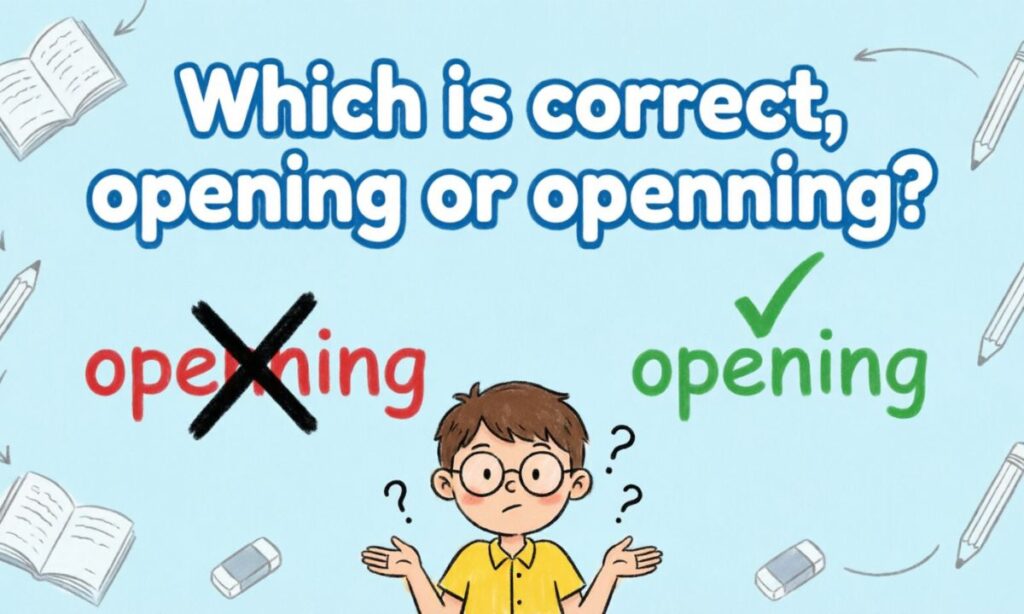
Which is correct, opening or openning?
Read This: Admitted vs Accepted: What They Mean in College Admissions
Opening is correct. Openning is incorrect in every context, whether you are writing casually or formally. There is no version of English, British or American, where the double n form is accepted. So when you are choosing between openning or opening, always choose opening.
Openning or opening synonym
Since openning is not a real word, it has no synonym of its own. However, opening has several useful alternatives depending on context:
- Beginning
- Launch
- Debut
- Inauguration
- Gap or aperture (when referring to a physical space)
- Vacancy (when referring to a job opening)
Choosing the right synonym depends on whether you mean an event, a physical space, or a job opportunity.
Spelling of Opening: Correct Usage, Meaning, and Examples
Understanding how opening is built helps you remember its spelling for good. The word comes from the base verb open, plus the suffix ing. No letter is added or doubled in between.
The correct spelling is Opening. ✅
This is the simple, snippet ready answer for anyone Googling openning or opening: opening is correct, openning is wrong.
📘 How Do You Spell Opening?
Opening is spelled o p e n i n g. It has three syllables: o-pen-ing. The stress falls on the very first syllable, which is actually the reason behind the spelling rule explained later in this article.
✔ Correct Formation
| Base Word | Suffix | Final Spelling |
| open | ing | opening |
There is no extra letter inserted. You simply attach ing directly to open.
❌ Incorrect Spelling
| Incorrect Form | Why It’s Wrong |
| openning | Adds an unnecessary extra n |
| opening (without context confusion) | Correct, often mistakenly doubted |
| oppening | Doubles the wrong letter entirely |
📖 Meaning of “Opening”
As a noun, opening refers to a gap, an act of starting something, or an available position, such as a job opening. As a verb form, opening describes the ongoing action of making something accessible, such as opening a door or opening a new store.
🔤 Pronunciation
Opening is pronounced OH-puh-ning, with clear emphasis on the first syllable. The middle and final syllables are softer and faster.
📌 Quick Summary
- Correct spelling: opening
- Incorrect spelling: openning
- Word type: noun, adjective, or verb form
- Origin: Old English open plus ing suffix
Openning vs Opening: Quick Answer
When comparing openning vs opening side by side, only one survives a dictionary check. Opening is listed in every major English dictionary. Openning appears in none of them. This single fact settles the openning or opening debate immediately.
Openning or opening grammar
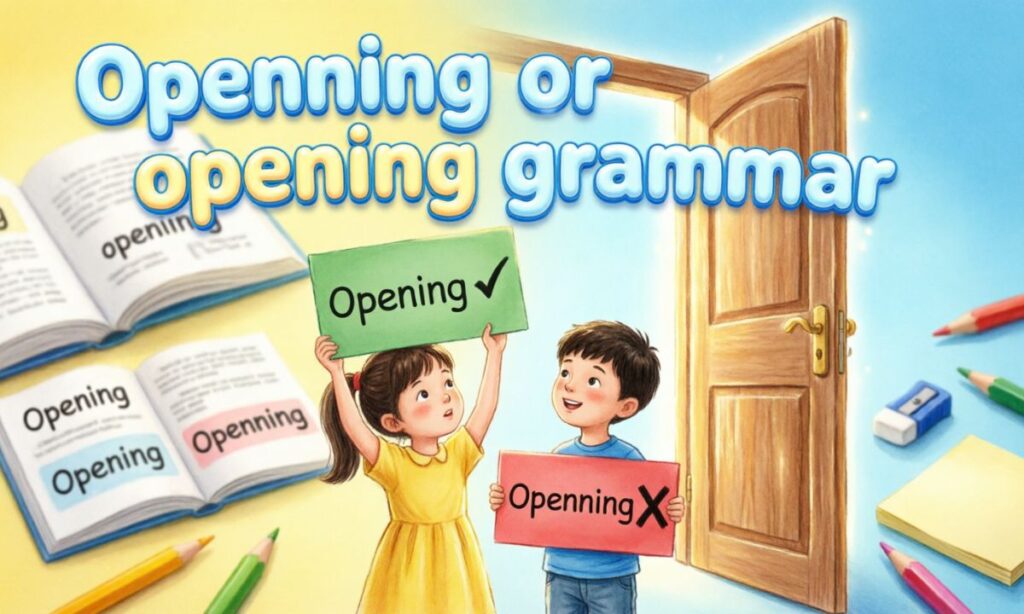
From a grammar standpoint, opening functions as the gerund or present participle of the verb open. Gerunds typically follow strict spelling rules tied to syllable stress, and that is exactly why opening keeps a single n while similar looking words double their final consonant.
Here is a simple breakdown:
- Identify the base verb: open
- Check where the stress falls: on the first syllable (OH pen)
- Apply the suffix ing directly, since the final syllable is unstressed
- Result: opening, with just one n
The Origin of Opening
The word opening traces back to Old English. The verb open itself developed from the Old English word openian, meaning to make accessible or to set free. As English evolved, the gerund form followed naturally by adding ing, producing opening rather than any double letter variation. This historical root explains why the spelling has remained consistent for centuries.
opening или openning: Which Is the Correct Spelling?
Even when the question is typed with mixed scripts or appears in non English search habits, the answer does not change. Opening is the universally correct form across every English speaking region and every standard keyboard layout. There is no regional or linguistic variation that supports openning as a legitimate spelling.
British English vs American English Spelling
One common assumption is that British and American English might handle this word differently, similar to colour versus color. That assumption is incorrect here.
| Spelling Aspect | British English | American English |
| Word | opening | opening |
| Pronunciation | OH-puh-ning | OH-puh-ning |
| Usage in business | Common | Common |
| Usage in events | Common | Common |
Both versions of English use the exact same spelling, with zero differences. This consistency makes opening one of the easier words to remember once the rule clicks.
Which Spelling Should You Use?
Always use opening. There is no situation, formal or informal, academic or casual, where openning is acceptable. If you are writing:
- A resume or job application
- A business email
- A blog post or article
- A text message or social caption
- An academic paper
The answer remains the same every time: opening is correct.
Common Mistakes with Opening
Many writers fall into predictable traps when typing this word. Here are the most frequent ones:
- Adding a double n because of words like running or planning
- Confusing it with openning when typing quickly on mobile keyboards
- Mixing it up with oppening, which doubles the wrong letter
- Forgetting that open already ends in a single consonant after a vowel, which affects the doubling rule
- Assuming British spelling rules add an extra letter, which they do not
Avoiding these mistakes is simple once you remember the core rule: the stress in open falls on the first syllable, so the final consonant is never doubled.
Opening in Everyday Examples
Seeing the word in real sentences makes the correct usage easier to remember.
- The store’s grand opening attracted a large crowd.
- She is opening the windows to let in fresh air.
- There is a job opening in the marketing department.
- The opening chapter of the novel introduces the main character.
- He gave a strong opening statement during the trial.
- The opening ceremony will begin at noon.
Notice that opening fits naturally as a noun, an adjective, and part of a verb phrase, without changing its spelling.
opening ou openning: Which Is Correct?
No matter how the question is phrased, in English, French influenced spelling, or casual online shorthand, the correct answer stays fixed. Opening is correct. Openning has no place in standard English writing.
✔ Why “Opening” Is Correct
The reason ties back to a core English spelling principle: when a two syllable verb ends in a single consonant after a vowel, you only double that consonant if the stress falls on the final syllable. In open, the stress sits on the first syllable, not the second. That single detail is why opening keeps one n while words like beginning, which stresses the second syllable, double theirs.
Opening: Google Trends and Usage Data
Search behavior strongly favors the correct spelling. Data from search trends consistently shows that opening receives dramatically higher search volume than openning, which appears mostly as a typo correction query. Writers, students, and business professionals overwhelmingly search for confirmation that opening is right, rather than searching for openning as an intentional spelling choice. This pattern holds across the United States, the United Kingdom, India, Pakistan, and Australia, confirming that opening is the globally accepted standard.
Read This: Seak or Seek? Which Spelling Is Correct? (2026)
Final Thoughts
The openning or opening question has one clear answer: opening is correct, and openning is always a mistake. The rule behind this comes down to where the stress falls in the original verb open, which sits on the first syllable rather than the last. Because of this, no extra letter is ever added when forming the gerund.
Whether you are writing a business announcement, a school assignment, or a casual social media post, remembering this simple fact will help you avoid an easy and avoidable error. The next time you type openning or opening into a search bar or a document, you can move forward with confidence: the correct word is always opening.
Frequently Asked Questions
Is openning a real word?
No, openning is not a real word in any dictionary.
What is the correct spelling, opening or openning?
Opening is the correct spelling.
Why do people write openning by mistake?
They incorrectly apply the double letter rule used in words like running or planning.
Is opening spelled differently in British and American English?
No, both versions use the exact same spelling.
Can opening be used as both a noun and a verb?
Yes, it works as a noun, an adjective, and a verb form.
What does opening mean?
It refers to a beginning, a gap, an available position, or the act of making something accessible.
Is openning ever correct in informal writing?
No, it is incorrect in every context, including informal writing.
Does British spelling double the n in opening?
No, British English also uses a single n.
Is opening hard to spell?
No, once you know the stress falls on the first syllable, the spelling becomes easy to remember.
Should I use opening or openning in a resume?
Always use opening, since openning is considered a spelling error.

Welcome to MeaningDeck! I’m Alex, an AI-Powered SEO, and Content Writer with 2 years of experience.
I help websites rank higher, grow traffic, and look amazing. My goal is to make SEO and web design simple and effective for everyone.
Let’s achieve more together!