

Every year, millions of students refresh their email inboxes waiting for one life-changing word. But when the decision finally arrives, many are left puzzled by the exact language used. Are you admitted? Accepted? And what is the difference, if any? The terms admitted vs accepted appear throughout the college application process, yet most students use them without truly knowing what each one means.
This guide breaks down the admitted vs accepted distinction clearly. You will also learn about conditional admission, deferred status, waitlists, referrals, and what to do after each type of decision. Whether you are a high school senior, a transfer applicant, or a parent helping your child navigate this process, understanding this language gives you a real advantage.
What is the difference between admit and accept?

The words “admit” and “accept” sound almost identical in casual conversation, but in the college admissions world, they describe two different actions made by two different parties.
To admit is something a college does. When a school admits you, it formally offers you a seat in its upcoming class. The institution has reviewed your transcripts, test scores, essays, and recommendations and decided you are qualified to attend.
To accept is something a student does. When you accept, you are responding to the school’s offer and confirming that you want to attend. In the most technical sense, you cannot be “accepted” by a college because acceptance is an action you take, not one the college takes.
In everyday language, however, most people use admitted vs accepted interchangeably, and colleges themselves often blur this line. Knowing the technical difference still helps you understand exactly where you stand at every stage of the process.
What does “admitted” mean?
Being admitted means a college or university has officially offered you a place in its incoming class. The school reviewed your full application and decided you meet its academic and personal standards for admission. This is a formal decision that comes directly from the admissions office.
However, being admitted does not mean you are enrolled. It does not mean you have paid a deposit, confirmed your plans, or locked in your spot. Admission is an offer, not a guarantee. You can be admitted to five schools and still choose to attend none of them or only one of them.
Admitted vs accepted meaning

Read This: Manuel Vs. Manual 2026: Key Differences & How to Use Each Correctly
The core admitted vs accepted meaning comes down to direction. Admission flows from the college to the student. Acceptance flows from the student back to the college.
Think of it as a handshake. The college extends its hand first by admitting you. You complete the handshake by accepting the offer. Without both sides completing the motion, enrollment does not happen.
In everyday use, students commonly say things like “I got accepted to three schools,” even though technically the schools admitted them. This informal use is so widespread that many admissions websites themselves use both terms loosely. Still, being clear on the admitted vs accepted meaning helps you read decision letters accurately and respond correctly.
Understanding “Admitted” in the College Context
What Getting “Admitted” Generally Means
When you receive an admission offer, it typically means:
- The college has reviewed your complete application file
- You have met the minimum academic and personal requirements
- The school is officially inviting you to join its next incoming class
- You will receive information about financial aid, housing, and orientation
- A deadline will be set for you to respond to the offer
Being admitted is a significant milestone. It means the admissions committee evaluated your grades, essays, activities, and recommendations and decided you belong there.
What “Admitted” Status Doesn’t Automatically Include
Being admitted does not automatically mean:
- Your financial aid package is finalized
- Your housing is secured
- You are officially enrolled
- The offer cannot be taken back
- All conditions have been cleared (especially for conditional admits)
Many students make the mistake of treating admission as enrollment. They are separate steps. Admission is the invitation. Enrollment is what happens after you accept the invitation, pay the deposit, and complete the required paperwork.
Example
A student applies to the University of Michigan in January. In March, she receives an email stating she has been admitted to the College of Literature, Science, and the Arts. She has been offered a spot. She still needs to log into the admissions portal, confirm her intention to enroll, and submit a deposit by May 1 before she is officially enrolled. Until then, she is admitted but not yet fully committed.
Understanding “Accepted” and How It Differs
What Being “Accepted” Typically Means
In the technical sense used by college admissions professionals, being accepted refers to the moment a student formally agrees to attend a school. When you accept an offer of admission, you are:
- Confirming your intention to enroll
- Usually paying a non-refundable enrollment deposit
- Withdrawing or declining offers from other schools
- Beginning the enrollment process (registering for orientation, applying for housing, etc.)
Acceptance is the student’s active response to an admission offer. It completes the process that admission starts.
Variations and How Schools Use the Term
In practice, the admitted vs accepted distinction plays out differently across institutions:
- Some schools use “accepted” and “admitted” interchangeably in their decision letters
- Some universities use “admitted” for conditional offers and “accepted” for unconditional ones
- Community colleges may use “accepted” to mean you are eligible to enroll, without a formal review process
- Graduate programs often use “admitted” for conditional offers and “accepted” for fully confirmed enrollment
Example
A student receives an admission letter from Boston College. He logs into the applicant portal and clicks “Accept Offer of Admission.” He pays the enrollment deposit. At this point, he has accepted Boston College’s offer. He was admitted by Boston College; he accepted their offer. Two different actions, one completed process.
Admitted vs Accepted – Side-by-Side Comparison
| Feature | Admitted | Accepted |
| Who performs the action | The college | The student |
| What it means | College offers you a spot | Student confirms they will attend |
| When it happens | After the admissions decision | After the student chooses a school |
| Is it final? | Not until the student responds | Yes, once the deposit is paid |
| Can it be reversed? | Yes, offer can be rescinded | Yes, but usually with financial penalty |
| Requires student action? | Yes, must respond by deadline | Already is the student’s action |
| Linked to enrollment? | No, enrollment comes after | Yes, acceptance begins the enrollment |
Understanding this admitted vs accepted chart helps you see why the two terms are not truly synonyms, even if they are casually treated as such.
Conditional Admission / Conditional Acceptance
What “Conditional” Actually Means in College Admissions
A conditional admission means you have been admitted to a college, but your offer comes with specific requirements you must fulfill before you can fully enroll. The school sees potential in your application but needs you to clear certain academic or administrative hurdles first.
This is one area where the admitted vs accepted distinction becomes especially important. A conditional admit has been admitted but has not yet secured a fully confirmed spot.
Why Schools Issue Conditional Offers?
Schools issue conditional offers for several reasons:
- Your final high school grades have not yet arrived
- You need to complete certain prerequisite courses
- You are an international student who needs to meet language proficiency requirements
- Your GPA was slightly below the standard threshold but the school sees other strengths
- Your application was submitted before all required test scores were available
Sample Conditional Requirements You Might See
- Maintain a minimum GPA (usually 2.5 to 3.0) through your senior year
- Submit final official transcripts by a specific date
- Complete English language courses (common for international students)
- Participate in a summer bridge or readiness program
- Provide outstanding letters of recommendation or portfolios
How the Conditional Admission Process Actually Works?
- You receive a conditional admission letter outlining your specific requirements
- You accept the conditional offer and pay any required deposit
- You work to meet each listed condition before the stated deadline
- Once conditions are verified by the admissions office, your status becomes fully confirmed
- If you fail to meet conditions, your offer may be delayed or rescinded
Schools like Rutgers University and the University of Alabama use formal conditional admission programs, particularly for international applicants and students who need additional academic preparation.
Deferred, Referred, Waitlisted, Denied – Other Admissions Statuses
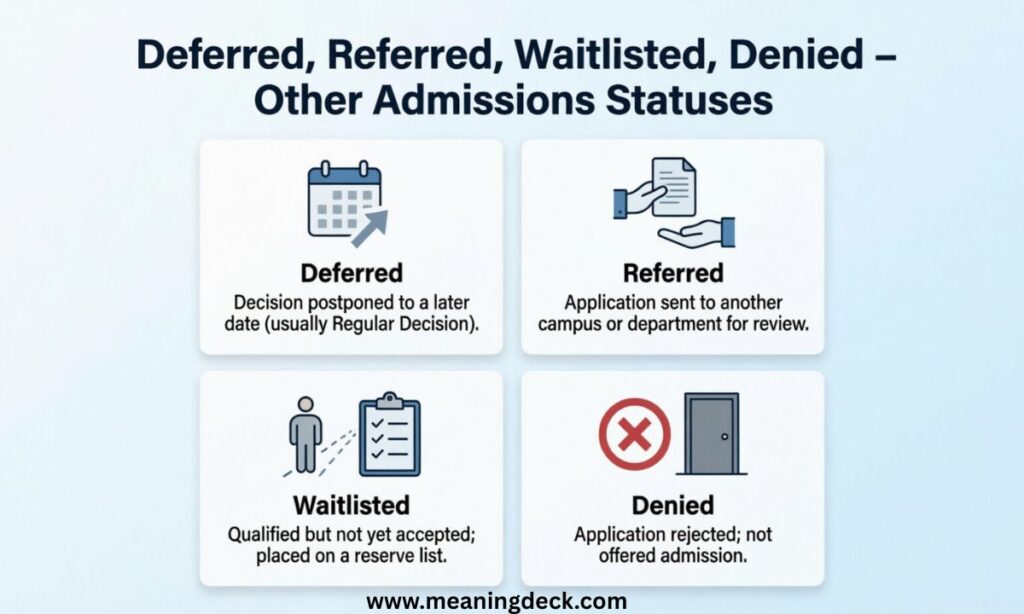
Not every college decision falls neatly into the admitted vs accepted category. Here are the other outcomes you might encounter.
Deferred
Deferral happens when a student applies through Early Action or Early Decision and the college does not make a final decision during the early round. Instead, it moves the application into the regular decision pool for further review.
Why Deferral Happens
- The admissions committee wants to see senior year grades
- Your application is competitive but needs to be compared to the full applicant pool
- The school is managing class composition and has not yet committed
What You Can Do
- Submit a letter of continued interest to reaffirm your commitment to the school
- Share any new achievements, awards, or improved test scores
- Continue applying to other schools through regular decision
- Avoid contacting the admissions office excessively; one thoughtful update is enough
Referred
A referred status means your application has been reviewed but redirected to a different program, department, or division within the same university.
Why Applications Get Referred
- You applied to a highly selective major and your scores better fit a different program
- The university wants to offer you a pathway program or special support track
- Your application qualifies for a 2+2 transfer or bridge program
- A specific academic department needs additional review before confirming your status
What to Do
- Read the referral letter carefully to understand exactly where you have been redirected
- Contact the admissions office to clarify what the referral means for your intended major
- Ask whether the referral affects financial aid eligibility
- Confirm deadlines for accepting or declining the referred offer
Waitlisted
Being waitlisted means the college has not rejected you but cannot offer you a spot right now. If admitted students decline their offers and space opens up, the school may extend offers to waitlisted applicants.
What to Expect
- No guarantee of admission; waitlist outcomes vary dramatically by school and year
- Some highly selective schools admit very few students off the waitlist each year
- You may be ranked on the waitlist or reviewed based on institutional needs
Strategies While on the Waitlist
- Submit a short, polished letter of continued interest to the admissions office
- Share genuinely new information the committee has not seen (an award, a new grade, a project)
- Accept an offer at another school to protect yourself while waiting
- Do not withdraw from your backup school until you have a confirmed offer from the waitlisted school
Denied / Cancelled / Rescinded
A denial means the college has decided not to offer you admission at this time. A rescission or cancellation means an offer that was already extended has been withdrawn.
Reasons for Denial
- The applicant pool was highly competitive
- Academic performance did not meet the school’s threshold
- The student’s profile did not align with the institutional priorities for that cycle
- Required materials were missing or submitted past deadlines
Reasons for Rescission
- A significant drop in senior year grades
- Failure to complete required coursework listed in the admission letter
- A disciplinary incident at your current school
- Discovery of false or misleading information in the application
Next Steps After Receiving an Admission Decision
If You Receive Unconditional Admission
Review your financial aid package carefully. Compare offers from all schools that admitted you. Pay your enrollment deposit before the deadline (usually May 1 for domestic students). Complete your housing application, orientation registration, and any enrollment paperwork.
If You’re Offered Conditional Admission
Read every condition listed in your letter. Create a checklist and calendar for each requirement. Contact the admissions office if anything is unclear. Meet every deadline, and request written confirmation once your conditions have been verified.
If You’re Deferred
Write a concise letter of continued interest. Update the admissions office about any meaningful new achievements. Continue applying to other schools during regular decision. Do not assume deferral leads to admission.
If Your Application Is Referred
Contact the admissions office to understand exactly what the referral means for your enrollment pathway, financial aid, and major eligibility. Some referred programs are excellent opportunities, not consolation prizes.
If You’re Placed on a Waitlist
Accept an offer at a school you are genuinely happy attending. Submit a letter of continued interest to the waitlisted school. Check whether the school accepts additional materials from waitlisted applicants. Keep your backup plans solid.
If You’re Denied or Your Offer Gets Rescinded
A denial is not a reflection of your worth as a person or student. Focus on schools where you hold solid offers. If rescinded, contact the admissions office immediately to understand whether an appeal or explanation is possible. In some cases, a brief academic downturn can be explained, and the office may work with you.
Weighing Multiple Acceptance Offers
If you hold offers from more than one school, compare financial aid packages, campus culture, program strength, location, and your gut feeling. Visit campuses if possible. Talk to current students. The admitted vs accepted process ends when you commit to the school that fits you best.
Real Stories: Case Studies and Quotes
Case Study 1: Jordan applied Early Decision to Vanderbilt University and was deferred in December. Rather than panicking, he sent a two-paragraph letter of continued interest in January, sharing a state-level science award he had just received. In March, he received full admission through the regular decision round.
Case Study 2: Maria received conditional admission to a large public university, contingent on completing an ESL preparation program over the summer. She completed the program, submitted her certificate, and was fully enrolled by August. She graduated four years later with honors.
Expert Quote: “When a school says you’re admitted, that’s the institution’s green light. When you say you’re accepted, that’s your own commitment.” – College counselor, IvyPrep
Practical Tips and Best Practices for Applicants
- Keep every email and letter from each college in a dedicated folder
- Track all deadlines in a shared calendar with your parent or counselor
- Never assume your offer is final until you have completed every required step
- If you have a conditional offer, ask for written confirmation that each condition has been cleared
- Do not brag publicly about your admitted status before you have accepted and paid a deposit; offers can still be rescinded
- Reach out to the admissions office with specific questions, not vague ones
- Compare financial aid award letters using the same criteria at every school
- Apply to a balanced list that includes reach, match, and safety schools so you always have strong options
Reading Between the Lines of an Admission Letter
Key Phrases That Signal Unconditional Admission
- “We are pleased to offer you admission to the Class of [Year]”
- “Congratulations on your admission”
- “You have been selected for admission”
- “Welcome to [University Name]”
These phrases suggest you have received a firm offer with no strings attached, as long as you graduate and your credentials hold.
Warning Signs of Conditional Acceptance
- “Your admission is contingent upon…”
- “This offer is conditional on the receipt of…”
- “Your enrollment will be confirmed once you have satisfied…”
- “You are invited to participate in our conditional admission program”
These phrases mean you are admitted, but action is still required on your part before the offer is fully secured.
Language That Indicates Uncertainty
- “Your application is currently under review”
- “We have placed your application in our regular decision pool”
- “We are unable to offer you admission at this time, but…”
- “You have been placed on our waitlist”
This language means no final decision has been made. You are in a holding pattern.
What to Look For in the Details
Beyond the headline decision, look carefully at:
- The enrollment deposit deadline
- Any listed conditions or requirements
- Contact information for your assigned admissions counselor
- Financial aid award details and appeal deadlines
- Housing application deadlines, which are often earlier than expected
Example Analysis
A student receives the following opening line: “We are pleased to inform you that you have been admitted to our Fall entering class, contingent upon the successful completion of your current academic year with no grade below a B in core subjects.”
This is a conditional admission. The student has been admitted but the offer will only fully convert to an unconditional spot after the admissions office reviews the final transcript. The student should not celebrate as if it is a firm offer until that review is complete.
Red Flags to Watch For
- A required deposit deadline that is unusually short (less than two weeks)
- No mention of financial aid in the same communication (ask immediately)
- Vague conditions with no clear verification process
- Missing contact information for the admissions office
- Admission to a program or campus you did not apply to
Read This: Unenroll vs Disenroll: Meaning, Differences & Correct Usage
Last Words
The admitted vs accepted question is not just a matter of word choice. It reflects two distinct steps in a process that shapes your educational future. Being admitted means a school has chosen you. Accepting means you have chosen that school back.
Understanding the admitted vs accepted difference gives you the confidence to read your decision letters clearly, respond appropriately, and avoid costly mistakes like missing deposit deadlines or misreading conditional offers. Whether you are working through a conditional admission, navigating a waitlist, or holding multiple offers, knowing exactly where you stand at each stage of the admitted vs accepted process puts you in control.
Read every letter carefully. Ask questions when the language is unclear. And when the right school admits you and you are ready to accept, do it with full confidence that you understand exactly what that moment means.
Frequently Asked Questions
Is admitted the same as accepted in college?
In casual use, yes. Technically, “admitted” is the college’s offer to you, while “accepted” is your confirmation of that offer.
Is it better to be admitted or accepted?
Accepted is the more complete status because it means both sides have confirmed the agreement. Admitted is just the first step.
Can a college rescind an admission offer?
Yes. Colleges can withdraw an offer if your grades drop significantly, you violate conduct policies, or false information is found in your application.
What is conditional admission?
Conditional admission means you have been offered a spot, but you must meet specific requirements before enrollment is finalized.
What does deferred mean in college admissions?
Deferred means your application was not decided during the early round and has been moved to the regular decision pool for further review.
What happens if I am waitlisted?
You are not rejected but also not admitted yet. If enrolled students decline, you may receive an offer later in the spring or summer.
What does referred mean in college admissions?
Referred means your application has been redirected to a different program, department, or support pathway within the same university.
Should I accept a waitlist offer?
You can remain on a waitlist, but always protect yourself by also accepting an offer from another school before your deposit deadline.
Can I be admitted to multiple colleges?
Yes. You can hold admission offers from multiple schools until you choose one and pay your deposit, at which point you should decline the others.
What does it mean when an acceptance is rescinded?
It means the college has withdrawn a previously issued admission offer, usually due to academic decline, conduct violations, or application fraud.

Welcome to MeaningDeck! I’m Alex, an AI-Powered SEO, and Content Writer with 2 years of experience.
I help websites rank higher, grow traffic, and look amazing. My goal is to make SEO and web design simple and effective for everyone.
Let’s achieve more together!