

Have you ever paused while typing an email and wondered if you should write unenroll or disenroll? You are not the only one. This tiny word choice trips up students, parents, HR teams, and even native English speakers every single day.
The confusion around unenroll vs disenroll is completely normal because both words look similar, sound similar, and even mean almost the same thing. Yet there is a subtle difference that changes the tone of your sentence completely.
In this guide, you will learn exactly what unenroll vs disenroll means, when to use each word, how to pronounce them correctly, and which spelling fits your audience best. By the end, choosing between unenroll vs disenroll will feel simple and natural.
Disenroll or Unenroll – Quick Answer
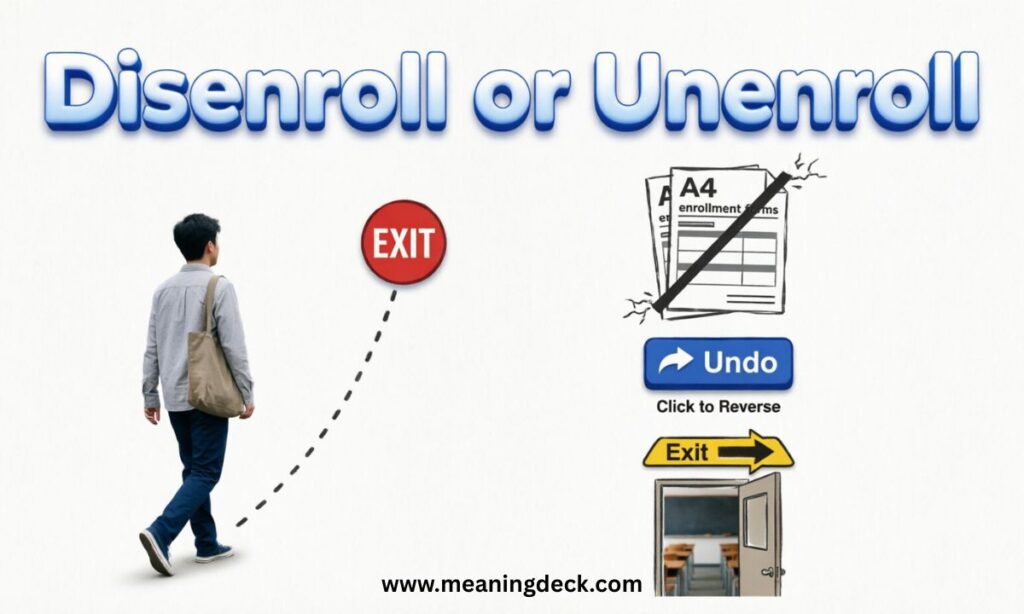
If you only have ten seconds, here is the short version of unenroll vs disenroll.
Unenroll means to voluntarily remove yourself from a course, program, plan, or membership. It is the word you use when you make the choice.
Disenroll means to be removed from a course, program, plan, or membership, often by an organization, school, or system. It carries a more formal and sometimes involuntary tone.
So when comparing unenroll vs disenroll, think of it this way: unenroll usually starts with you, while disenroll usually starts with the institution. Both spellings are correct in standard English, but the context decides which one fits.
Define Unenroll
Unenroll is a verb formed by adding the prefix “un” to the word “enroll.” Enroll means to register or sign up for something, so unenroll naturally means to cancel that registration.
When someone unenrolls, they are taking action on their own. This word feels personal, casual, and user driven. You will often see it in:
- Online learning platforms like Coursera or Udemy
- School portals where students manage their own schedule
- Subscription services and apps
- Health insurance marketplaces where members make changes themselves
Example: “She decided to unenroll from the yoga class after her work schedule changed.”
In this sentence, the choice clearly belongs to the person. That is the heart of the unenroll vs disenroll comparison: control and intention.
Read This: 22 Opposite of Nonchalant: Key Antonyms You Should Know
Define Disenroll
Disenroll is formed using the prefix “dis,” which often signals a more formal type of removal or reversal. Disenroll means to remove someone from enrollment, and this removal is frequently handled by a school, company, or government program rather than the individual.
You will commonly find disenroll in:
- Health insurance and Medicare or Medicaid documents
- School disciplinary policies
- Government benefit programs
- Corporate training systems
Example: “The state may disenroll members who no longer meet the eligibility requirements.”
Notice the tone here. It sounds official, administrative, and rule based. That formal feeling is exactly why disenroll appears so often in policy documents when discussing unenroll vs disenroll situations.
How to Properly Use Unenroll and Disenroll in a Sentence?
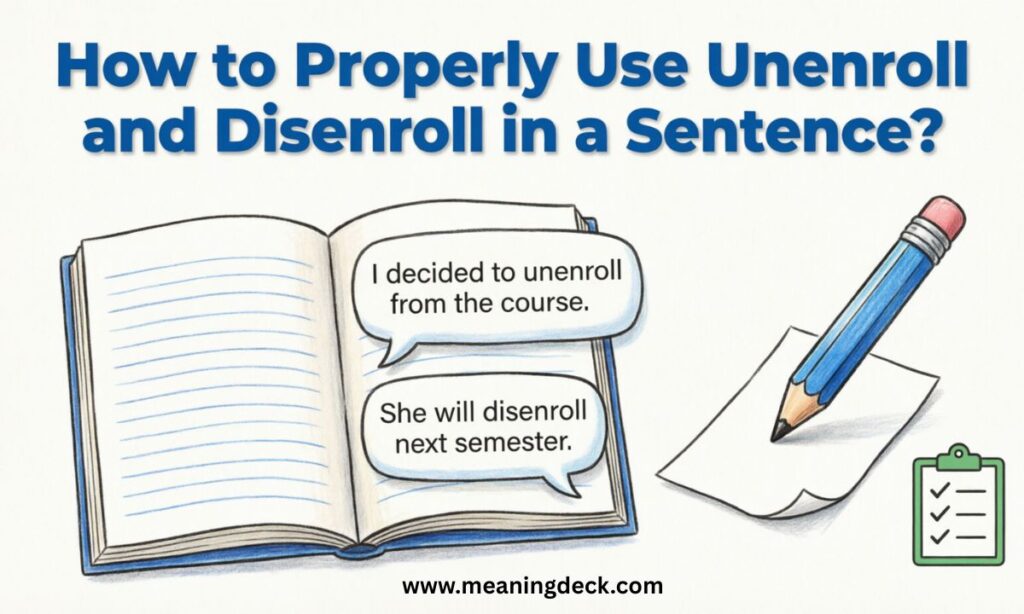
Getting unenroll vs disenroll right comes down to one simple question. Who is making the decision?
If the person is making the choice, use unenroll.
If an organization, system, or set of rules is making the decision, use disenroll.
Here is a simple table that breaks down the correct usage pattern for unenroll vs disenroll.
| Situation | Correct Word | Example Sentence |
| A student drops a class on their own | Unenroll | “You can unenroll from the course anytime before the deadline.” |
| A school removes a student for poor attendance | Disenroll | “The district decided to disenroll the student after repeated absences.” |
| A user cancels a streaming subscription | Unenroll | “He unenrolled from the premium plan last week.” |
| An insurance provider removes inactive members | Disenroll | “Members may be disenrolled if premiums remain unpaid.” |
| Someone leaves a gym membership voluntarily | Unenroll | “I unenrolled from the gym after moving cities.” |
This table makes the unenroll vs disenroll rule easy to remember at a glance.
More Examples Of Unenroll & Disenroll Used In Sentences
To really lock in the difference between unenroll vs disenroll, here are additional real world examples grouped by category.
Education examples
- “Students who unenroll before the refund deadline will receive their tuition back.”
- “The university may disenroll students who fail to register for classes on time.”
- “He chose to unenroll from his online course after finding a better program.”
Workplace and training examples
- “Employees can unenroll from optional training modules through the HR portal.”
- “The company will disenroll staff who do not complete mandatory compliance training within thirty days.”
Insurance and healthcare examples
- “You can unenroll from the wellness program at any time by contacting support.”
- “Members will be disenrolled automatically if they move out of the coverage area.”
Subscription and app examples
- “To unenroll from notifications, go to your account settings.”
- “Users were disenrolled from the beta program once it officially closed.”
Across all these examples, the unenroll vs disenroll pattern stays consistent. Voluntary action equals unenroll, while institutional or automatic action equals disenroll.
Unenroll or Disenroll From School
This is one of the most searched versions of the unenroll vs disenroll debate, and for good reason. Parents and students deal with this situation constantly.
When a student or parent decides to leave a school by choice, the correct word is unenroll. For example, “We need to unenroll our son from his current school before moving to a new district.”
When a school removes a student because of rule violations, missed enrollment paperwork, or eligibility issues, disenroll is the better fit. For example, “The school may disenroll students who do not submit updated immunization records.”
Some school districts use both words in their official handbooks, but the underlying logic of unenroll vs disenroll remains the same. Voluntary withdrawal leans toward unenroll, while administrative removal leans toward disenroll.
Disenrolled in Spanish
If you need to translate disenroll into Spanish, the most common and accurate options are “dar de baja” or “desinscribir,” depending on the context.
- “Dar de baja” is widely used in school, insurance, and subscription contexts. Example: “El estudiante fue dado de baja por falta de asistencia,” which means “The student was disenrolled due to lack of attendance.”
- “Desinscribir” is closer to a literal translation and is sometimes used in academic or formal writing.
For unenroll, Spanish speakers often use “darse de baja” when the action is voluntary. Example: “Decidí darme de baja del curso,” meaning “I decided to unenroll from the course.”
Translation context matters just as much in Spanish as it does in English, so understanding unenroll vs disenroll in your source language helps you pick the right Spanish term.
Common Mistakes To Avoid
Even confident writers slip up when dealing with unenroll vs disenroll. Here are the most frequent errors.
- Using disenroll when describing a voluntary action. Saying “I disenrolled myself from the gym” sounds overly formal and slightly incorrect. “I unenrolled from the gym” reads more naturally.
- Forgetting that both spellings exist. Some writers assume only one word is correct, but both unenroll and disenroll appear in dictionaries and are accepted.
- Mixing British and American spelling inconsistently within the same document. Stick to one style throughout.
- Confusing disenroll with “unroll,” which is an unrelated word about physically unrolling something like a carpet or a poster.
- Overusing formal language in casual writing. If you are writing a friendly blog post or app notification, unenroll usually feels more approachable.
Avoiding these mistakes will instantly make your writing around unenroll vs disenroll sound more polished.
Context Matters
Context is the single biggest factor in the unenroll vs disenroll decision. The same action can technically be described with either word, but the surrounding tone changes everything.
Consider these two sentences:
“You can unenroll from the newsletter anytime.”
“You will be disenrolled from the newsletter if you do not confirm your subscription.”
Both sentences describe leaving a mailing list, yet the first feels friendly and user controlled, while the second feels like a policy notice. When writing emails, app messages, or website copy, ask yourself whether you want the tone to feel personal or official. That answer usually solves the unenroll vs disenroll puzzle instantly.
Exceptions To The Rules
Like most grammar guidelines, the unenroll vs disenroll rule has a few exceptions worth knowing.
- Some government health programs use “disenroll” even when the action is technically voluntary, simply because it is the standard legal term in their documentation.
- Certain older textbooks and British English sources use “disenrol” with a single L as the default term, regardless of whether the action is voluntary or not.
- In casual conversation, many people use both words interchangeably without anyone noticing or correcting them, especially in spoken English.
These exceptions do not break the general rule of unenroll vs disenroll, but they explain why you might see disenroll used in places where unenroll would technically fit better.
Practice Exercises
Test your understanding of unenroll vs disenroll with these quick exercises. Choose the correct word for each sentence.
- “Maria wants to ______ from the dance class because she found a better schedule.” (Answer: unenroll)
- “The insurance company will ______ members who fail to pay premiums for three consecutive months.” (Answer: disenroll)
- “Click here if you wish to ______ from future emails.” (Answer: unenroll)
- “Students may be ______ if they do not meet the minimum attendance requirement.” (Answer: disenroll)
- “I ______ from the trial subscription before it charged my card.” (Answer: unenrolled)
If you got most of these right, you have a solid grasp of unenroll vs disenroll already.
The Origin of Disenroll or Unenroll
Both words trace back to the verb “enroll,” which comes from Old French “enroller,” meaning to write something onto a roll or list. Over centuries, this evolved into the modern English word “enroll,” meaning to officially register.
English speakers later added two different prefixes to create opposite meanings. The prefix “un” generally signals a reversal of an action performed by the same person, like undo, unlock, or unpack. The prefix “dis” often signals separation, removal, or formal undoing, as seen in disconnect, discharge, or disengage.
This is exactly why unenroll vs disenroll developed slightly different connotations over time. Un suggests reversing your own action, while dis suggests a more formal or external removal. Understanding this history makes the unenroll vs disenroll distinction much easier to remember.
British English vs American English Spelling
Spelling differences add another layer to the unenroll vs disenroll conversation.
| Region | Common Spelling | Notes |
| American English | Unenroll, Disenroll | Double L is standard |
| British English | Unenrol, Disenrol | Single L is more traditional |
| Academic and formal writing | Disenroll or Disenrol | Depends on regional style guide |
| Digital platforms | Unenroll | Almost always double L, even outside the US |
If you are writing for a global audience, American spelling with the double L tends to be the safer choice, since most major platforms and dictionaries favor it. However, if your audience is primarily UK based, using the single L versions for unenroll vs disenroll may match local expectations better.
When Should You Use “Unenroll”?
Use unenroll whenever the action is initiated by the person themselves. Here is a quick checklist.
- The user is making a personal choice
- The tone of the writing is casual, friendly, or instructional
- You are writing for apps, websites, or customer facing emails
- The context involves subscriptions, online courses, or memberships
Example: “To unenroll from the program, simply visit your dashboard and click the cancel button.”
This word choice feels approachable and matches how most people speak in everyday situations.
When Is “Disenroll” Appropriate?
Use disenroll when the removal happens because of rules, eligibility checks, or institutional decisions. Here is when it fits best.
- The action is performed by a school, company, or government body
- The tone needs to sound official or legal
- The context involves insurance, healthcare, or compliance
- The removal may be involuntary or automatic
Example: “Patients who relocate outside the service area will be disenrolled from the plan.”
This word adds weight and authority, which is exactly why policy writers prefer it.
Pronunciation Guide for Disenroll and Unenroll
Pronunciation rarely causes confusion, but getting it right helps you sound confident, especially in presentations or videos discussing unenroll vs disenroll.
- Unenroll is pronounced “un in ROLE,” with the stress on the final syllable.
- Disenroll is pronounced “dis in ROLE,” also with stress on the final syllable.
Both words rhyme with “roll,” like rolling a ball. A common mispronunciation is saying “un ROLL,” which confuses the word with “unroll,” a completely different term meaning to open something that was rolled up.
Prefix Deep Dive: Un- vs Dis-
Understanding prefixes is the fastest way to master unenroll vs disenroll permanently.
The prefix “un” typically means “not” or “reverse the action of.” It often applies to actions a person can do and undo themselves, such as unlock, untie, or undress.
The prefix “dis” typically means “apart,” “away,” or “not,” and often carries a more formal or external quality, as seen in disconnect, dismiss, or discharge.
| Prefix | General Meaning | Tone | Example Words |
| Un | Reverse your own action | Casual, personal | Undo, Unpack, Unenroll |
| Dis | Remove or separate, often externally | Formal, official | Discharge, Dismiss, Disenroll |
Once you internalize this table, the unenroll vs disenroll choice becomes almost automatic.
Disenroll or Unenroll – Google Trends & Usage Data
Search interest data shows a clear pattern when it comes to unenroll vs disenroll. Unenroll consistently receives more search volume overall, especially from users in the United States, Canada, and Australia, largely because digital platforms like online course providers, learning management systems, and apps default to using “unenroll” in their interfaces.
Disenroll, on the other hand, shows steadier but smaller search interest, with spikes often tied to insurance enrollment periods, school policy updates, and government program changes. This makes sense, since disenroll is the preferred term in formal healthcare and education policy documents.
In short, if you are writing consumer facing content, unenroll is the safer and more familiar choice for most readers. If you are writing policy documents, insurance materials, or formal academic communication, disenroll fits the expected tone.
Read This: Treck or Trek – Clear Up the Confusion Once and for All
Frequently Asked Questions
Is disenroll a real word?
Yes, disenroll is a legitimate English word found in major dictionaries.
Is unenroll one word or two?
Unenroll is always written as one word, with no space or hyphen.
Can disenroll and unenroll be used interchangeably?
Technically yes, but unenroll fits voluntary actions while disenroll fits formal or institutional removal.
Which spelling is more common, unenroll or unenrol?
Unenroll with double L is more common in American English and most digital platforms.
What is the opposite of enroll?
Both unenroll and disenroll serve as opposites of enroll, depending on context.
How do you say disenroll in Spanish?
The most common translations are “dar de baja” or “desinscribir.”
Last Words
The unenroll vs disenroll debate comes down to one simple idea: who controls the action. Unenroll fits voluntary, personal decisions, while disenroll fits formal, institutional, or rule based removals. Both spellings are correct English words, and both appear across education, insurance, subscriptions, and government programs.
Now that you understand the difference between unenroll vs disenroll, you can choose the right word with confidence every time you write an email, fill out a form, or create content for your website. Keep this guide handy, and you will never second guess unenroll vs disenroll again.

Welcome to MeaningDeck! I’m Alex, an AI-Powered SEO, and Content Writer with 2 years of experience.
I help websites rank higher, grow traffic, and look amazing. My goal is to make SEO and web design simple and effective for everyone.
Let’s achieve more together!