

You send a message. The reply comes back: “Mhm.” Now you are sitting there wondering if that is agreement, boredom, or a polite signal to stop talking. You are not alone. Mhm is one of those responses that looks simple but carries surprising depth depending on tone, context, and the person typing it. So let us clear up the confusion once and for all.
Mhm means “yes” or “I agree.” It is an informal written version of the sound people make when they nod along in conversation. Simple as that. But like most things in communication, the full story is a little more interesting.
What Does Mhm Mean Exactly?
At its core, mhm is an affirmative interjection. It signals agreement, acknowledgment, or confirmation without using a full word like “yes” or “correct.”
Think of it as the written cousin of a nod. When someone asks, “Are you coming to the party?” and you reply “Mhm,” you are saying yes without the effort of typing the full word. It is casual, quick, and gets the job done.
The tone behind it matters a lot though. Written language does not carry vocal pitch, so mhm can feel warm and engaged or flat and dismissive depending on what surrounds it. More on that in a moment.
Where Did Mhm Come From?
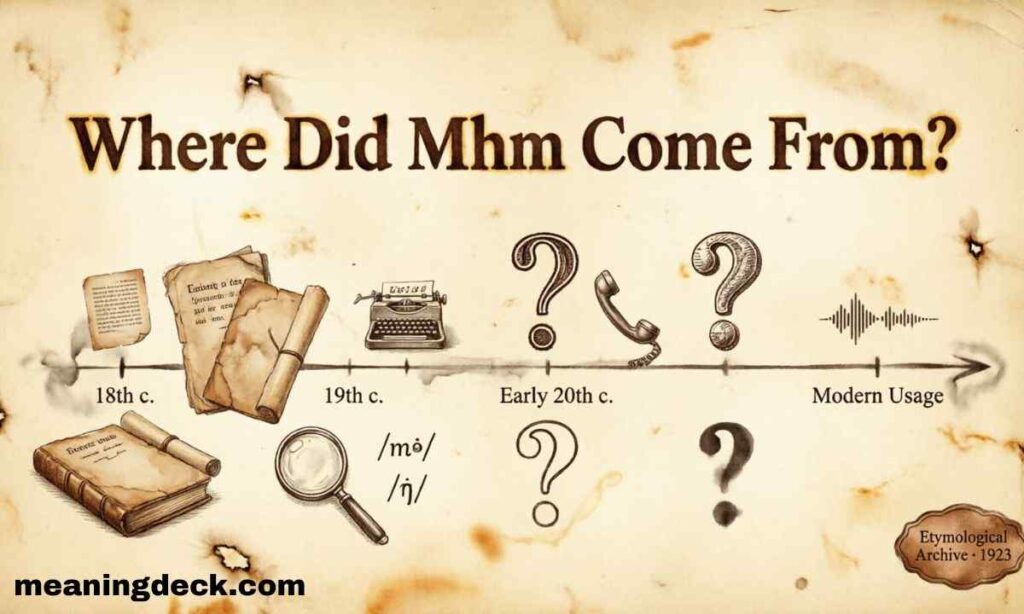
Long before texting existed, people were making this sound in face to face conversations. Linguists call it a back-channel signal, which is a fancy way of saying it is a small verbal cue that tells the speaker, “Keep going, I am still with you.”
The spoken version of “mm-hmm” has roots in everyday American and British English going back at least to the early 20th century. It appears in transcripts of natural conversations, radio recordings, and even early telephone exchanges where people needed quick ways to confirm they were still listening.
When digital messaging arrived, people simply started spelling out the sound they had always made. Mhm migrated from mouth to keyboard naturally, the same way “ugh,” “hmm,” and “oh” did.
Interestingly, the sound itself may have even older roots. Some researchers point to humming as one of humanity’s oldest forms of agreement, a sound that crosses many language families. You cannot fully say “mhm” without closing your mouth, which is part of why it feels almost instinctive.
Mhm in the Bible and Historical Texts
Here is a surprising place to look: ancient texts and scripture. While the exact letters “mhm” obviously did not appear in the Bible or ancient manuscripts, the concept of non-verbal affirmation absolutely did.
In the Old Testament, figures often responded to God or elders with brief, reverent acknowledgments. The Hebrew word “hineni” (meaning “here I am” or “yes, I am present”) served a similar function to mhm: a short, sincere signal of agreement and attentiveness. Abraham used it. Moses used it. It was the ancient equivalent of “Mhm, I hear you, and I am paying attention.”
The New Testament similarly uses brief affirmations. The Greek word “nai” (yes/indeed) appears frequently as a simple confirming response, much like the role mhm plays today.
So while mhm is modern in spelling, the human instinct behind it stretches all the way back through recorded history. People have always needed a quick way to say, “Yes, I understand, carry on.”
Read This: SYBAU Meaning: What It Really Means and How to Use It Right
Mhm vs Similar Words: A Quick Comparison
People often confuse mhm with its close relatives. Here is how they actually differ:
| Word | Meaning | Tone | Best Used When |
| Mhm | Yes / I agree | Neutral to warm | Casual agreement or acknowledgment |
| Hmm | I am thinking | Uncertain or reflective | You need a moment to consider |
| Uh-huh | Yes / Correct | Informal, relaxed | Confirming something casually |
| Yeah | Yes | Friendly, energetic | Direct, upbeat agreement |
| Mm | Possibly yes | Vague, non-committal | Mild acknowledgment, no strong opinion |
| Nah | No | Dismissive or casual | Casual disagreement |
The key difference between mhm and hmm is direction. Mhm leans toward yes. Hmm leans toward “I am not sure yet.” Mixing them up is a classic texting mistake that changes your meaning completely.
How Mhm Sounds Versus How It Reads
This is where things get genuinely interesting. In spoken conversation, “mm-hmm” is almost always warm and engaged. The rising tone on the “hmm” part signals active listening and agreement.
In text, that vocal warmth disappears. So mhm in a message can land very differently depending on what comes before and after it.
Compare these two conversations:
Version A:
“Did you enjoy dinner tonight?” “Mhm! It was amazing, I loved the pasta.”
Version B:
“Did you enjoy dinner tonight?” “Mhm.”
In Version A, mhm feels enthusiastic and positive. In Version B, that single “Mhm” with a period feels flat, almost cold. Same word. Completely different experience for the reader.
This is why context and punctuation matter when you use mhm in writing. A lone mhm can read as disinterested even when you mean it warmly.
Real Life Usage Examples of Mhm
Seeing mhm in actual conversations makes its meaning much clearer. Here are some realistic examples across different situations:
Casual agreement:
“So we are meeting at 7, right?” “Mhm, see you then.”
Polite acknowledgment while distracted:
“I was telling her about the project and she just kept saying mhm the whole time. I do not think she was listening.”
Showing someone you are engaged:
“And then he said the funniest thing…” “Mhm?” “He thought Tuesday was a weekend!”
Mild, unenthusiastic agreement:
“You are okay with pizza again?” “Mhm.” (Translation: Fine, whatever, I stopped fighting this battle.)
Genuine enthusiastic agreement:
“This coffee is incredible.” “Mhm!! Right?! Where did you find this place?”
Notice how exclamation marks and extra context transform mhm from passive to excited. The word itself is neutral. You do the emotional heavy lifting around it.
Common Mistakes People Make with Mhm
A few habits around mhm trip people up regularly. Here is what to watch out for:
Using it when a clear yes is needed. In professional or semi-formal situations, replying with just “mhm” can seem dismissive or unprofessional. If your manager asks, “Can you finish the report by Friday?” a plain mhm might not inspire confidence. Say “Yes, absolutely” instead.
Confusing mhm with hmm. As noted above, these mean different things. Mhm is agreement. Hmm is thought. Replying “Hmm” when someone asks if you want to grab lunch reads as hesitation. Replying “Mhm” is a clean yes.
Letting mhm become a conversation killer. If someone shares exciting news and gets back a solo “Mhm,” they will feel ignored. When you genuinely care about the topic, follow mhm with something that proves you were listening.
Spelling variations. You will see mmhm, mm-hm, mm-hmm, mhmm, and more. All of these are acceptable informal variants. None of them is technically “wrong.” But in formal writing, just avoid the word entirely.
Mhm in Different Contexts: Work, Dating, and Friendships
The same word changes meaning depending on where it shows up. Here is a quick guide:
In work messages: Tread carefully. A quick “Mhm, got it” is fine with a close colleague. But to a client or senior manager, replace it with “Understood” or “Sounds good.”
In romantic conversations: Mhm can actually be quite flirty when used right. A slow, drawled “mhm” in response to a compliment carries a playful, confident energy. It is the text equivalent of a knowing smile.
In friendships: This is where mhm lives most comfortably. Friends understand each other’s texting rhythms. A mhm between close friends rarely gets misread.
In group chats: A lone mhm in a group chat can get lost or seem passive. Better to say “Mhm, agreed” or just react with an emoji if you only want to signal you saw the message.
Which One Should You Use: Mhm, Yeah, or Yes?
The right choice depends on who you are talking to and what you want to signal:
Use yes when you need to be clear, professional, or emphatic. It is the gold standard of agreement and works in every context.
Use yeah when you want to sound friendly, casual, and approachable. It has energy that mhm lacks.
Use mhm when you want to signal that you heard something, agree mildly, or keep the conversation flowing without committing to a big enthusiastic response. It is the verbal equivalent of a nod, which is perfect when a nod is exactly what the moment calls for.
Use uh-huh when you want something even more casual than mhm, mostly in spoken conversation or very relaxed texting with close friends.
When in doubt, yes is always safe. Mhm is contextual. It shines in the right moment and falls flat in the wrong one.
Read This: BTA Meaning: What It Really Stands For (and When to Actually Use It)
Related Words and Phrases Worth Knowing
While exploring mhm, you will likely run into these related interjections that share similar roles in conversation:
Mm is a softer, less committed version of mhm. It signals you heard something but does not firmly agree or disagree.
Uh-huh is mhm’s louder, slightly more enthusiastic cousin. Both mean yes, but uh-huh feels more actively affirming.
Oh is another short interjection used for realization or acknowledgment rather than agreement.
Mmkay (or mkay) is a casual spoken blending of “mm” and “okay,” meaning fine or understood with a slightly reluctant undertone.
All of these belong to the same family of discourse markers, small words and sounds that keep conversation moving without adding new information. They are the lubricant of human dialogue.
Frequently Asked Questions
Is mhm rude to use in conversation?
Not inherently. Mhm is casual and informal, which makes it feel dismissive in formal or emotional conversations. With close friends in a relaxed chat, it reads as completely normal. The context determines whether it lands as rude or natural.
What is the difference between mhm and hmm?
Mhm leans toward agreement and yes. Hmm signals thought, hesitation, or uncertainty. They sound similar but mean very different things. Mixing them up changes your message significantly, so it is worth keeping the distinction in mind.
Is mhm used in all English-speaking countries?
Yes, though it is most common in American English. British and Australian English speakers use it too, but you might also hear “mm” or “yeah” more often in those regions. The spelling and frequency vary, but the meaning stays the same.
Final Thoughts
Mhm means yes. It signals agreement, acknowledgment, or that you are listening. It comes from a real spoken sound that humans have used for a very long time, long before anyone had a phone to type it on. In text, it carries a casual, warm energy when used well, and a flat, distant one when dropped alone into silence.
Use it freely with friends. Use it carefully with colleagues. And remember that a single mhm at the end of a long message your friend just poured their heart into might earn you a very pointed follow-up question.
Now that you actually know what mhm means, the next time it lands in your inbox, you can read it for exactly what it is: a small, honest little yes.

Welcome to MeaningDeck! I’m Alex, an AI-Powered SEO, and Content Writer with 2 years of experience.
I help websites rank higher, grow traffic, and look amazing. My goal is to make SEO and web design simple and effective for everyone.
Let’s achieve more together!