

Have you ever typed “treck” in a blog post, a travel caption, or a school essay and then paused to wonder if that looks right? You are not alone. Thousands of people search for treck or trek every single month because both spellings look almost identical on screen.
The difference is just one letter, and yet that one letter changes everything. This article will settle the treck or trek debate for good. You will walk away knowing the correct spelling, the real meaning, the history behind the word, and how to use it confidently in any kind of writing.
Treck or Trek – Quick Answer
The short answer is this: trek is correct. Treck is a misspelling. There is no situation in standard English where treck or trek should go in favor of “treck.” Every major dictionary, including Merriam-Webster, Oxford, and Collins, recognizes only “trek” as the valid spelling.
Quick comparison:
| Spelling | Correct? | Recognized in Dictionaries? | Use in Writing |
| Trek | Yes | Yes (all major dictionaries) | Always use this |
| Treck | No | No | Never use this |
Usage Tips:
- Always write trek when describing a long, difficult journey.
- The past tense is trekked (double k), not “trecked.”
- The continuous form is trekking, not “trecking.”
- As a noun: “The trek took five days.”
- As a verb: “We will trek through the valley tomorrow.”
Examples in sentences:
- The school group went on a trek through the national forest.
- She planned to trek across Nepal before the monsoon season.
- After a two-hour trek, they finally reached the summit.
The Origin of Treck or Trek
Understanding where trek comes from helps explain why “treck” is always wrong. The word entered English in the mid-1800s, borrowed directly from Afrikaans, the language spoken by Dutch settlers in South Africa. In Afrikaans, “trek” came from the Dutch verb “trekken,” which originally meant “to pull” or “to haul.”
Historically, this word was tied to the Great Trek of 1835, when tens of thousands of Boer settlers (Dutch descendants) moved away from the Cape Colony by ox wagon. Each stage of that wagon journey was measured not in miles but in “treks.” British colonists picked up the word and brought it into English, where it kept its original, compact spelling: trek.
Notice that the Dutch root was “trecken,” with a “c.” But when Afrikaans shortened it into everyday use, the “c” was dropped. English borrowed the Afrikaans short form, not the old Dutch root. This is why the correct spelling of treck or trek will always be “trek.” The “c” was left behind in history.
Treck or trek meaning
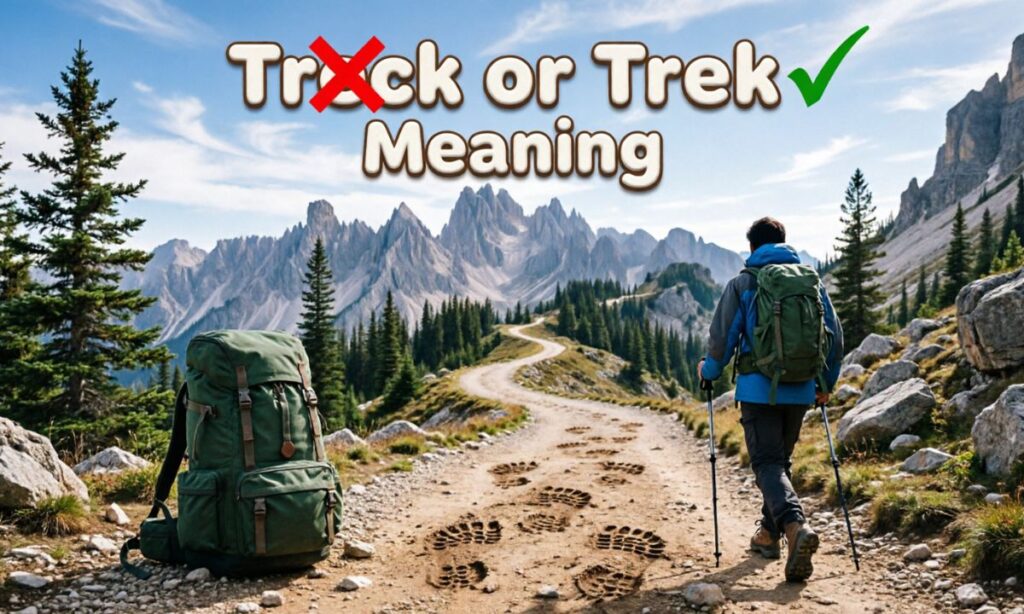
When it comes to the treck or trek meaning, the definition is straightforward. A trek refers to a long journey, usually on foot, that involves significant effort or physical challenge. It commonly describes travel through natural environments such as mountains, forests, deserts, or remote wilderness.
Over time, the meaning expanded. In modern usage, people use trek or treck (incorrectly) to describe any tiring or time-consuming trip, even a casual one. For example: “It was quite a trek to find parking at the mall.” The word carries a sense of distance, effort, and sometimes adventure, even when used informally.
Key forms of the word include:
- Trek (noun/verb) – base form
- Trekked (past tense verb)
- Trekking (present participle)
- Trekker (noun, a person who treks)
British English vs American English Spelling
One common question people ask when debating treck or trek is whether the spelling changes across dialects. Does British English spell it differently from American English?
The answer is no. Trek is spelled the same way in both British and American English. This is one of the rare cases where there is zero regional variation. Unlike words such as “colour/color” or “travelling/traveling,” the spelling of trek or treck does not shift depending on which side of the Atlantic you are on.
Key Points:
- British English: trek
- American English: trek
- Australian English: trek
- South African English: trek (where the word originated)
No matter where you are writing, treck or trek always resolves to one answer: trek.
Which Spelling Should You Use?

Read This: ALR Meaning in Text: What “ALR” Really Means in Chats
This section could not be simpler. You should always use trek. The question of treck or trek is not a style choice, a regional preference, or a matter of context. It is purely a matter of correct versus incorrect spelling.
Quick Do’s & Don’ts:
Do:
- Use “trek” in travel articles, blog posts, adventure stories, academic essays, and social media captions.
- Double the “k” in past and continuous forms: trekked, trekking.
- Use “trek” as both a noun and a verb depending on the sentence.
Don’t:
- Write “treck” in any context.
- Use “trecking” or “trecked” as verb forms.
- Assume that seeing “treck” online makes it acceptable.
Example in context:
Wrong: “We went trecking in the Himalayas last summer.” Right: “We went trekking in the Himalayas last summer.”
Common Mistakes with Treck or Trek
The confusion around treck or trek happens for real reasons. English spelling does not always follow phonetic logic, and our brains often try to fill gaps with familiar patterns. Here is why people misspell this word so frequently.
Typical mistakes include:
- Spelling by sound pattern: “Trek” sounds like “check,” “deck,” or “neck,” all of which end in “ck.” The brain naturally tries to apply the same pattern, producing “treck.”
- Influence of similar words: Words like “track” and “trick” sit close to “trek” in both sound and spelling. The confusion bleeds over.
- Fast typing: At speed, fingers sometimes insert an extra “c” without the writer noticing.
- Seeing the wrong version online: Misspellings spread. Once a person sees “treck” in a popular blog or social media post, they assume it is correct.
- Dutch root memory: The original Dutch root “trecken” does contain a “c,” so people with some knowledge of etymology mistakenly carry that “c” into English.
Spell-check tools like Grammarly and Microsoft Word flag “treck” as an error. If you ever see a red underline under that word, you know which version of treck or trek to use.
Treck or Trek in Everyday Examples
One of the best ways to lock in the correct spelling of treck or trek is to read it used correctly in natural sentences. Below are examples ranging from formal writing to casual, everyday conversation.
Formal / travel writing:
- The researchers completed an eight-day trek across the Gobi Desert.
- Mountain guides led a group trek up the trail before dawn.
- She documented her trek through Patagonia in a popular travel journal.
Casual / figurative use:
- Getting to the back of the parking lot was a real trek.
- The new office is a whole trek from the subway station.
Examples in texting or casual writing:
- “That grocery run was a whole trek lol”
- “Can’t believe we trekked all the way there and they were closed”
- “Planning a trek this weekend, anyone in?”
Notice that in every single example, the correct form of treck or trek is used. Consistent reading of the correct spelling trains the eye to recognize it instantly.
Treck or Trek – Google Trends & Usage Data
Data from Google Trends confirms what grammar guides already tell us: “trek” dominates global search volume by a massive margin. The misspelling “treck” does appear in searches, but almost always as a question, as in “is treck or trek correct?” rather than as intentional usage.
Content platforms, travel sites, and major media outlets consistently use “trek” in headlines and body text. The Associated Press Stylebook and other professional style guides make no mention of “treck” because it simply does not exist as a valid option.
Trek synonym
When you want to vary your language without repeating trek or treck, you have several strong synonyms available.
| Synonym | Meaning / Nuance |
| Hike | Walking journey, often in nature |
| Expedition | Organized journey, often with a goal |
| Journey | General movement from one place to another |
| Odyssey | Long, eventful journey (often metaphorical) |
| March | Steady, purposeful walking |
| Slog | Slow, difficult movement through challenging terrain |
| Pilgrimage | Journey to a sacred or meaningful place |
Insights from usage trends:
- “Trek” is most common in travel content, adventure writing, and outdoor recreation.
- “Expedition” is preferred in scientific or exploration contexts.
- “Hike” is the most casual American English alternative.
- “Odyssey” suits literary or metaphorical writing.
Meaning of Trek (Dictionary Definition)
According to Merriam-Webster, trek functions as both a verb and a noun. As a verb, it means “to make one’s way arduously” or, more broadly, simply “to journey.” As a noun, it refers to a slow or difficult journey, particularly one made on foot through natural terrain.
Collins English Dictionary defines trek as “a long and often difficult journey.” The Oxford Learner’s Dictionary adds that it often involves travel through mountains, forests, or wilderness areas.
Key points for clarity:
- Trek is accepted in all major English dictionaries worldwide.
- Treck does not appear in any standard dictionary as a valid entry.
- The word can describe both physical journeys (mountain trek) and figurative ones (the trek through endless paperwork).
- Dictionary.com notes its first recorded use around 1845 to 1850.
Pronunciation of Trek
Pronouncing trek is simple once you know it. The word rhymes with “deck,” “check,” and “neck.” Here is a breakdown:
- Phonetic spelling: /trɛk/
- Sound: One syllable, short “e” vowel sound, ends with a hard “k”
- Stress: Single syllable, so no stress distinction needed
The pronunciation never changes regardless of whether it is used as a noun or verb. “She decided to trek” sounds the same as “it was a long trek.” This consistent pronunciation is part of why people mistakenly add a “c” when spelling treck or trek: the hard final “k” sound creates an expectation of “ck” at the end, as in “check” or “wreck.”
Trek vs Similar Words (Track, Travel, Journey)
When writing about movement or distance, it helps to understand how trek or treck compares to similar words in meaning and usage.
| Word | Meaning | Key Difference vs Trek |
| Trek | Long, difficult journey usually on foot | Implies physical effort and challenge |
| Track | A path or to follow something | Refers to route or pursuit, not the journey itself |
| Travel | General movement from place to place | Broad term, no implication of difficulty |
| Journey | Any trip from one place to another | Neutral, no implication of difficulty or terrain |
| Hike | Walk in nature, often recreational | Usually shorter and more recreational than a trek |
Trek carries a specific emotional weight that the others lack. When you use it, you signal effort, endurance, and often adventure. This is why travel writers and outdoor enthusiasts favor it over more generic alternatives.
Is “Treck” Ever Correct?
Key points:
- In standard written English, no. Treck is never correct.
- It does not appear in Merriam-Webster, Oxford, Collins, or any other major English dictionary.
- Grammarly, Microsoft Word, and other spell-check tools flag it as an error.
- You may sometimes see “treck” as part of a brand name, a username, or a deliberate stylistic choice in creative writing, but none of these make it standard.
Example:
If a company calls itself “Treck Outdoors,” that is a brand decision, not a grammar rule. You would still write “we went on a trek” rather than “we went on a treck.”
The bottom line on treck or trek: one letter makes all the difference, and the correct letter to leave out is always “c.”
Read This: LG Meaning in Text: What It Really Stands For and How to Use It
Trek as a Verb vs Trek as a Noun
Part of what makes trek so useful is its flexibility. Understanding how treck or trek works as both a verb and a noun gives you more ways to use it confidently.
As a noun: Trek describes the journey itself.
- “The trek took three days.”
- “It was a challenging mountain trek.”
- “She wrote about her solo trek in her memoir.”
As a verb: Trek describes the action of making such a journey.
- “They plan to trek across the Sahara.”
- “We trekked for eight hours before setting up camp.”
- “He has been trekking in Nepal for two weeks.”
One important grammar note: when trek functions as a verb, it follows regular conjugation rules. Past tense becomes trekked (double k), and the continuous form is trekking. There is no version of this conjugation that uses “treck,” “trecked,” or “trecking.”
Last Words
The treck or trek question has a definitive, simple answer: always use trek. The word has a rich history rooted in Afrikaans and Dutch, it has been part of the English language since the mid-1800s, and every reputable dictionary confirms its spelling without any alternative form.
Using the correct version of treck or trek signals clear thinking, careful writing, and professional attention to detail. Whether you are crafting a travel blog about a Himalayan adventure, sending a casual text about a long walk, or writing a school essay about an expedition, the rule does not change.
Trek. Not treck. One syllable, no extra “c,” and no confusion once you know the story behind it. Keep this guide bookmarked, share it with anyone who hesitates over treck or trek, and write every future journey with complete confidence.

Welcome to MeaningDeck! I’m Alex, an AI-Powered SEO, and Content Writer with 2 years of experience.
I help websites rank higher, grow traffic, and look amazing. My goal is to make SEO and web design simple and effective for everyone.
Let’s achieve more together!