
You want a tattoo that actually means something. Not just something that looks cool on Pinterest but fades into “just a tree” when someone asks about it. You searched poison tree tattoo meaning because you felt drawn to this image and want to understand what it really stands for before it becomes a permanent part of your skin. Smart move. Here is everything you need to know, explained clearly and honestly.
A poison tree tattoo symbolizes suppressed anger, hidden resentment, toxic emotions, and the dangerous consequences of holding grudges. It represents how unchecked negative feelings grow silently inside a person until they cause serious damage, either to themselves or to others. The image comes directly from William Blake’s famous poem A Poison Tree, written in 1794, and it carries layers of meaning that go far deeper than most tattoo websites bother to explain.
What Is the Core Meaning of a Poison Tree Tattoo?
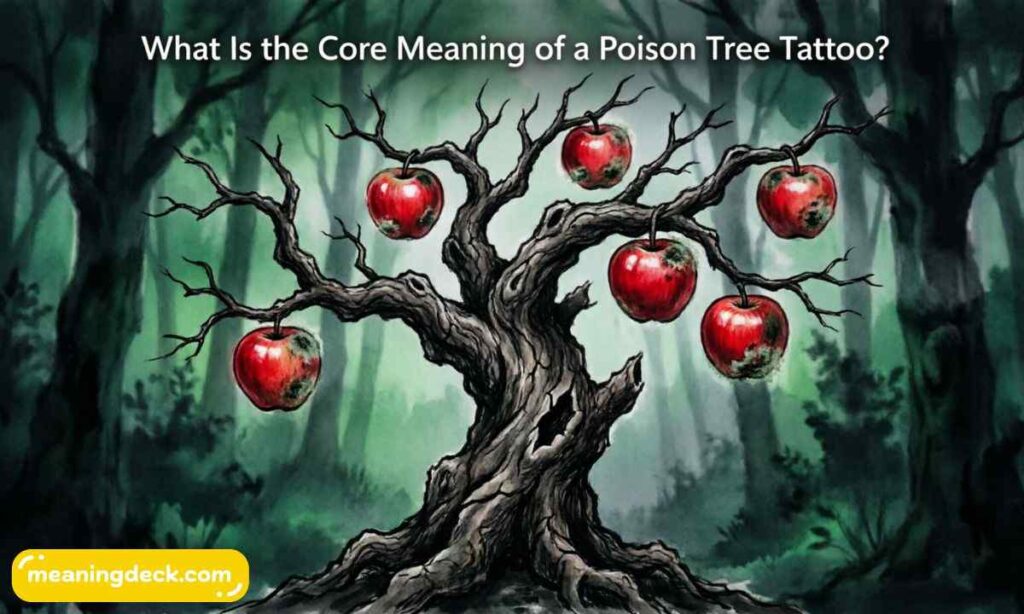
The core meaning is rooted in one powerful idea: what you suppress will eventually destroy something.
Blake’s poem tells the story of a person who feels angry at an enemy but chooses to hide that anger instead of expressing it. That hidden anger grows like a tree, nurtured silently by fake smiles and dark thoughts, until it produces a poisoned apple. The enemy eats the apple and dies. The narrator feels no guilt. He feels glad.
That is a chilling story told in just a few lines of poetry. And it is exactly what a poison tree tattoo captures on skin.
People who choose this tattoo are usually communicating one of these truths about themselves or about life in general. They understand that silence can be a weapon, that resentment grows in the dark, and that toxic relationships and emotions have real consequences.
The William Blake Poem That Started It All
To truly understand this tattoo, you need to understand its source. In 1794, the English poet William Blake published A Poison Tree as part of his collection Songs of Experience. The poem is short, only four stanzas, but its impact has lasted over two centuries.
Here is the central idea without quoting the poem directly. A person is angry at a friend and resolves the conflict by speaking honestly. The anger disappears. But when that same person feels angry at an enemy, they say nothing. They smile, they act politely, and all the while the anger festers underneath. That hidden anger feeds on false emotions and grows into a tree. The tree produces a shiny, tempting apple. The enemy sneaks into the garden at night, eats the apple, and is found dead in the morning.
Blake was not writing a horror story. He was writing a psychological truth. Repression does not neutralize emotion. It transforms it into something far more dangerous.
That is the literary DNA of the poison tree tattoo meaning, and it gives the design far more intellectual weight than most body art carries.
Read This: What Does ISK Mean in Text? Full Meaning Explained Simply 2026
Biblical and Historical Roots Behind the Poison Tree Symbol
Blake was deeply influenced by biblical imagery, and the poison tree tattoo carries that influence whether the wearer knows it or not.
The most obvious connection is the Tree of Knowledge in the Garden of Eden. In Genesis, a beautiful tree bears forbidden fruit. The serpent tempts Eve, she eats, and the consequences are catastrophic for all of humanity. The tree looked good. It was deadly. Sound familiar?
Blake drew on this imagery intentionally. His poison tree mirrors the Eden tree in structure: something that appears alive and even beautiful on the outside but carries ruin inside. Both trees represent the consequences of hidden knowledge, temptation, and forbidden desire.
In ancient Greek mythology, poisoned gifts also appear frequently. The concept of something beautiful being secretly deadly was a recurring theme in cultures that understood how betrayal rarely announces itself loudly.
Historically, the image of a twisted or dark tree has symbolized death, the underworld, and forbidden knowledge across many civilizations. The Norse Yggdrasil connected all realms of existence. The Egyptian Ished tree held the names of pharaohs. Trees have always meant more than just wood and leaves. They represent life systems, consequences, and hidden truths.
What Do Different Poison Tree Tattoo Designs Communicate?
This is where it gets genuinely interesting, because the specific design choices a person makes completely shift what the tattoo communicates. Two people can both have a “poison tree tattoo” and be saying entirely different things.
Here is a breakdown of the most common design variations and what they tend to express:
A bare, leafless dead tree communicates emptiness, emotional exhaustion, or the aftermath of something toxic. This person has already been through the fire.
A tree with dark, twisted branches and a single glowing fruit stays closest to Blake’s original poem. It speaks to suppressed anger and the seductive nature of revenge.
A tree with roots visible underground often symbolizes that the damage runs deep, that what you see above the surface is only part of the story.
A tree with a skull or figure beneath it leans into the mortality aspect. Something died here, literally or emotionally.
A tree with snakes or thorns adds layers of temptation, betrayal, and danger. This design often speaks to toxic relationships or trauma.
A blooming tree with dark coloring creates a contradiction on purpose. Beauty on the surface, darkness underneath. This speaks to people who have experienced something that looked good but turned out to be deeply harmful.
Poison Tree Tattoo Meaning: A Quick Comparison Table
Different people choose this tattoo for different reasons. Here is a clear comparison of what it tends to mean across various contexts:
| Design Element | Core Meaning | Who Often Chooses It |
| Bare twisted tree | Loss, grief, emotional emptiness | Survivors of trauma or heartbreak |
| Tree with apple or fruit | Suppressed anger, temptation, revenge | People with deep emotional awareness |
| Tree with visible roots | Deep-seated pain, hidden strength | Those healing from long-term wounds |
| Tree with a serpent | Betrayal, temptation, toxic relationships | People who have been deceived |
| Dark tree, bright background | Inner darkness despite outward calm | Those who mask emotions publicly |
| Tree with a human figure | Personal reckoning, mortality, consequence | Philosophical or literary ink lovers |
Real-Life Reasons People Get a Poison Tree Tattoo
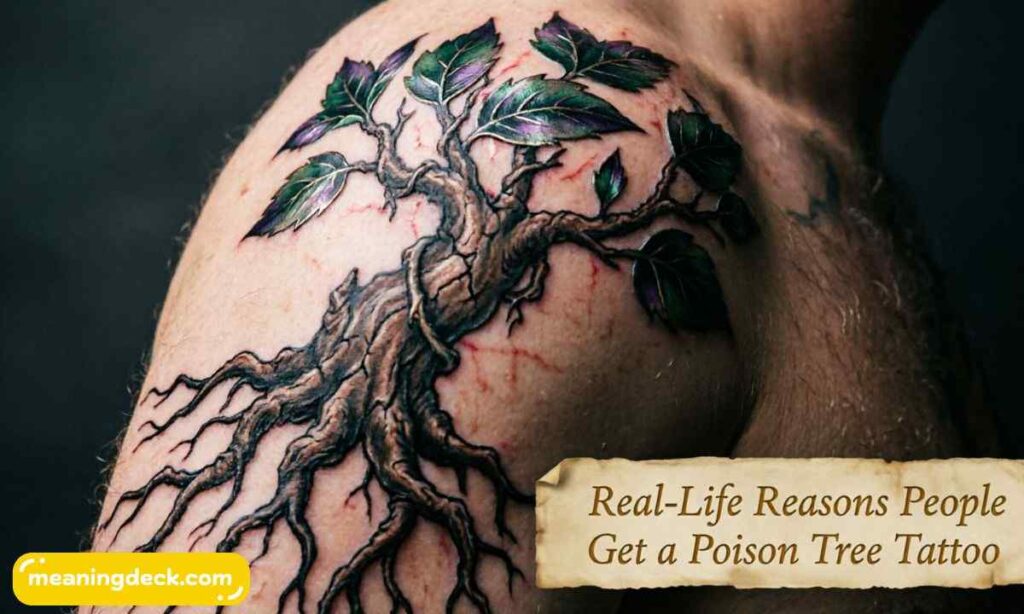
Walk into any serious tattoo studio and ask about this design. The stories you hear will be remarkably consistent in their emotional core, even when the details differ completely.
Some people get it after surviving a toxic relationship, one that looked healthy and promising from the outside but was quietly destroying them. The poison tree becomes a reminder that beautiful things can carry venom.
Others get it as a personal warning to themselves. They know they carry anger or resentment that they have historically bottled up, and the tattoo serves as a daily visual reminder to speak their truth before the silence turns poisonous.
Some choose it purely as a literary tribute to Blake. These are the readers, the poets, the people who genuinely connect with the idea that a poem written in 1794 still perfectly describes something they felt last Tuesday.
A smaller group uses it to represent surviving someone else’s poison. They were the one offered the metaphorical apple. They bit into it. They nearly did not make it. The tattoo marks their survival.
What Does a Poison Tree Tattoo Say About the Person Wearing It?
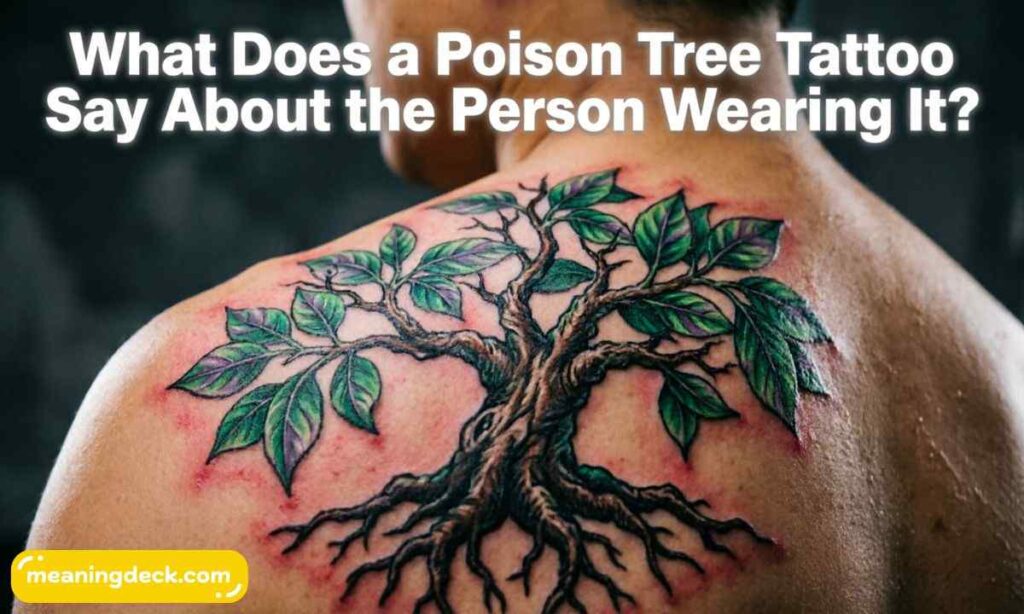
This is the question people rarely think to ask but always want answered. A tattoo is a statement, and a poison tree tattoo makes a very specific one.
People who wear this design tend to be emotionally intelligent but privately intense. They think deeply about cause and effect. They understand that actions have consequences and that emotional neglect is its own form of action.
They are often introverted or selective about who they trust. They have likely been hurt by someone who appeared safe. They know firsthand what it feels like when something you thought was good turns out to have roots in something dark.
They are also usually readers or creative types who appreciate symbols and metaphors over literal statements. They did not choose a skull because death was too obvious. They chose a tree because the story behind it says everything they need to say without saying a word.
Common Mistakes People Make With This Tattoo
Here is where a lot of tattoo decisions go sideways, and the poison tree design is no exception.
Choosing it purely for aesthetics without understanding the meaning. Dark trees are visually striking, no question. But if someone asks what your tattoo means and you shrug, you have wasted a remarkable symbol on decoration. Do the reading. Know the poem. Own the meaning.
Getting a design that looks too generic. A plain dead tree without any distinctive elements gets confused with a dozen other tree tattoo styles. A weeping willow, a dead oak, and a poison tree all look similar in the wrong hands. Work with your tattoo artist to include elements that connect it clearly to the poem or to your personal story.
Placing it somewhere that minimizes its impact. The poison tree is not a small behind-the-ear design. It carries weight. Forearms, shoulders, ribs, back pieces, and chest placements tend to do justice to the visual complexity this design deserves.
Copying someone else’s design directly. The whole point of this tattoo is personal meaning. Lifting someone else’s exact design defeats the purpose entirely.
How Does a Poison Tree Tattoo Compare to Similar Dark Tree Tattoos?
People often confuse the poison tree with other dark tree tattoo styles. They are related but not identical.
A dead tree tattoo focuses primarily on loss, death, and the end of something. It does not necessarily carry the emotional suppression angle.
A dark forest tattoo leans more toward mystery, the unknown, and feeling lost or hidden from the world.
A Tree of Life tattoo is almost the opposite in energy. It represents growth, connection, and cyclical existence rather than toxic consequence.
A hanging tree tattoo carries associations with grief, legacy, and sometimes justice or injustice depending on its cultural context.
The poison tree stands alone in its specific focus on the internal emotional process of suppressing anger and the outward consequences that process eventually creates. That specificity is what makes it such a meaningful and unusual choice.
Read This: PTSO Meaning in Slang: Chat & Social Media Explained (2026)
Which Placement Works Best for a Poison Tree Tattoo?
Placement matters more than most people realize, not just visually but symbolically. Here are the most common placements and what they tend to communicate:
Forearm or inner arm keeps the design visible to the wearer, which suits people who got it as a personal reminder or daily reflection piece.
Chest or over the heart makes a direct statement about emotional pain, heartbreak, or the source of suppressed feeling being internal.
Back piece allows for the most artistic complexity and often signals that this person is carrying something heavy that others rarely see.
Ribs is a painful placement choice for a painful symbol. Many people find that poetic alignment meaningful.
Thigh or calf allows for a larger detailed design while keeping it more private and personal.
Frequently Asked Questions
Do you have to know the William Blake poem to get this tattoo?
You do not have to, but you should want to. The poem is four short stanzas and takes about two minutes to read. It will completely transform how you understand the image on your skin. Consider it required reading before the appointment.
Is a poison tree tattoo considered negative or dark?
It depends on your perspective. Yes, it deals with anger, resentment, and consequence. But many people wear it as a symbol of self-awareness and emotional honesty rather than as a celebration of darkness. Context and intention matter significantly.
Can a poison tree tattoo have a positive spin?
Absolutely. Some people pair it with design elements that represent growth, healing, or transformation. The tree does not have to be purely a warning. For some, it represents the moment they chose to stop suppressing their emotions and start living more honestly.
Final Thoughts
A poison tree tattoo is not for everyone, and that is actually the point. It is for the person who has felt something quietly eat away at them from the inside. It is for the reader who recognized themselves in Blake’s four stanzas. It is for the survivor who wants their skin to tell a truth that words rarely capture well enough.
It is one of the rare tattoo choices that gets more interesting the older you get, because the older you get, the more you understand what happens when you let the wrong things grow in the dark.
If this symbol speaks to you, it probably speaks to you for a reason. Trust that. Just make sure you give it the design, placement, and intention it deserves.

Welcome to MeaningDeck! I’m Alex, an AI-Powered SEO, and Content Writer with 2 years of experience.
I help websites rank higher, grow traffic, and look amazing. My goal is to make SEO and web design simple and effective for everyone.
Let’s achieve more together!