
When we talk about how people think, judge, and interpret the world around them, the word “perspective” holds tremendous power. It shapes conversations, decisions, and relationships. But understanding the opposite of perspective is just as valuable. Knowing these antonyms helps you identify when thinking becomes one-sided, closed off, or distorted. Whether you are a student, writer, teacher, or simply someone who loves vocabulary, this guide gives you 35 antonyms of perspective, complete with definitions, examples, and usage tips.
Exploring the opposite of perspective also sharpens your communication skills. It lets you describe rigid thinking, missing context, or distorted judgment with far more precision. From objectivity to tunnel vision, each antonym paints a unique picture of how understanding breaks down or changes shape. Let us dive deep into this topic together.
Definition of “Perspective”
The word perspective refers to a particular way of thinking about or interpreting something. It is a mental standpoint shaped by personal experience, beliefs, cultural background, or position in life. According to Merriam-Webster, perspective means “a mental view or prospect” or “the interrelation in which a subject or its parts are mentally viewed.”
In everyday speech, we use perspective to describe how someone understands a situation, issue, or idea. For example: “From a scientific perspective, the data tells a clear story.” The word carries the idea of a lens through which reality is filtered.
Perspective can be visual (as in art and drawing) or conceptual (as in thought and reasoning). Both meanings share the core idea of a point of view, a position from which things are seen or judged.
Structural Breakdown of “Perspective”
Breaking the word apart reveals a great deal about its meaning.
| Element | Origin | Meaning |
| Per | Latin | Through |
| Specere | Latin | To look or see |
| Perspectiva | Medieval Latin | The science of optics |
The full Latin root “perspicere” means “to look through clearly.” Over time, the word evolved from a technical term in optics to a broad philosophical concept. Today it covers everything from artistic rendering to philosophical worldviews.
Part of speech: Noun (primarily), though it can function as an adjective in some contexts.
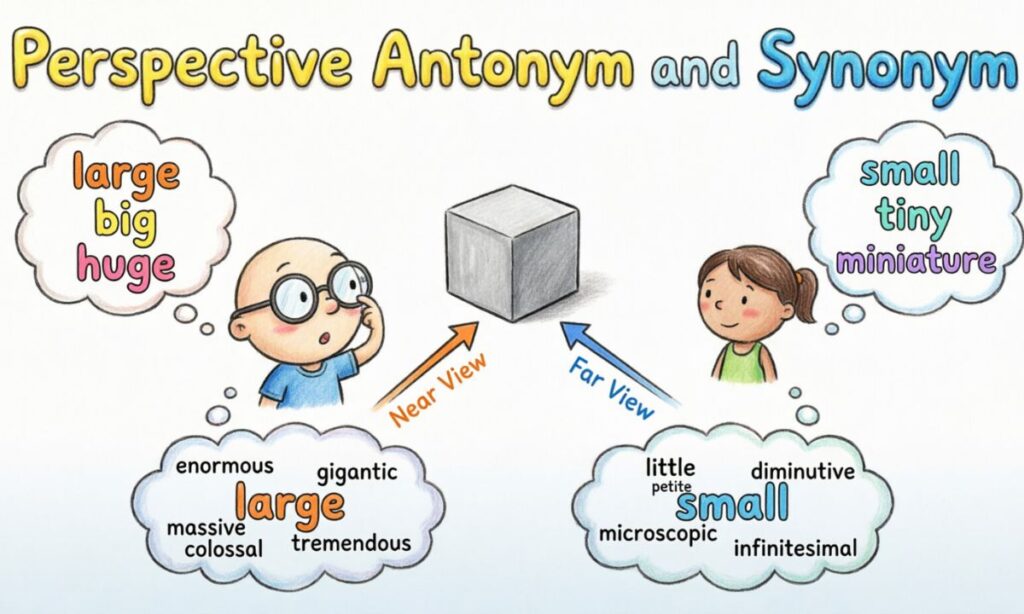
Perspective Antonym and Synonym
Read This: Manuel Vs. Manual 2026: Key Differences & How to Use Each Correctly
Before listing full antonyms and synonyms, it helps to understand the relationship between them.
| Category | Example Words |
| Synonyms of Perspective | Viewpoint, outlook, standpoint, angle, attitude, mindset, frame of reference |
| Antonyms of Perspective | Ignorance, bias, narrow-mindedness, tunnel vision, impartiality, objectivity |
Synonyms share the meaning of “perspective,” while antonyms point toward its opposite: a state where clear, informed, balanced understanding is absent or distorted. The opposite of perspective is not always a single concept. It is a spectrum of ideas, from neutral objectivity to extreme bias.
Synonyms of Perspective
Here are the most commonly used synonyms for the word “perspective,” each with a brief explanation:
- Viewpoint – A position from which someone considers an issue
- Outlook – A personal belief or attitude about the future or a situation
- Standpoint – A fixed position from which someone evaluates something
- Angle – The particular approach or emphasis someone brings to a topic
- Attitude – A settled way of thinking or feeling about something
- Frame of reference – The context that shapes how someone understands things
- Mindset – A set of attitudes or beliefs that influence how one thinks
- Vantage point – A position that offers a broad or advantageous view
- Worldview – A comprehensive framework through which a person sees reality
- Lens – A metaphor for the filter through which ideas are understood
These synonyms all reflect the presence of a clear, active perspective. They contrast directly with the opposite of perspective, which often suggests the absence or distortion of that clarity.
Types of Perspective
Perspective is not one-size-fits-all. It takes different forms depending on the context. Here are the six main types you should know:
Personal Perspective
This is the most individual form of perspective. It is rooted in a person’s unique life experiences, memories, emotions, and values. Personal perspective often makes two people interpret the same event in completely different ways. For example, two siblings growing up in the same household can have very different personal perspectives on their childhood.
Historical Perspective
Historical perspective means understanding events through the lens of their time and place. It requires stepping back from present-day assumptions and considering the values, knowledge, and limitations of a past era. Historians and educators rely heavily on this type of perspective to avoid judging past events by modern standards.
Cultural Perspective
Cultural perspective shapes how people see the world based on their ethnicity, language, religion, traditions, and social norms. It is why the same gesture, color, or word can mean something entirely different in two cultures. Acknowledging cultural perspective is essential in international communication and diplomacy.
Ethical Perspective
An ethical perspective involves evaluating situations through a moral lens. It asks: What is right? What is fair? What causes harm? Philosophers, doctors, lawyers, and policymakers all use ethical perspectives when making complex decisions that affect others.
Economic Perspective
An economic perspective looks at issues in terms of costs, benefits, resources, and financial impact. From this viewpoint, decisions are evaluated based on efficiency, scarcity, and incentives. Economists and business leaders naturally default to this mode of thinking.
Political Perspective
A political perspective filters reality through the ideas of power, governance, ideology, and policy. It influences how people interpret news, history, and social issues. Political perspectives can range from conservative to progressive and everything in between.
Opposite of Perspective
The opposite of perspective is not a single word but a rich collection of antonyms. Each one describes a different way that perspective breaks down, disappears, or becomes distorted. Here are 35 words that represent the opposite of perspective:
| # | Antonym | Brief Meaning |
| 1 | Ignorance | Lack of knowledge or awareness |
| 2 | Objectivity | Removal of personal bias |
| 3 | Subjectivity | Excessive reliance on personal feeling |
| 4 | Bias | Unfair tendency to favor one side |
| 5 | Impartiality | Equal treatment without personal favor |
| 6 | Tunnel Vision | Narrow, one-track focus |
| 7 | Broad-Mindedness | Openness to all viewpoints |
| 8 | Narrow-Mindedness | Refusal to consider other views |
| 9 | Myopia | Short-sightedness in thinking |
| 10 | Shortsightedness | Inability to see long-term consequences |
| 11 | Closed-Mindedness | Unwillingness to accept new ideas |
| 12 | Misconception | A false or mistaken view |
| 13 | Misunderstanding | An incorrect interpretation |
| 14 | Confusion | A state of unclear thinking |
| 15 | Fogginess | Mental cloudiness or lack of clarity |
| 16 | Dogmatism | Rigid belief in one fixed doctrine |
| 17 | Prejudice | Pre-formed judgment without evidence |
| 18 | Partiality | Unfair preference for one side |
| 19 | Cluelessness | Complete lack of understanding |
| 20 | Blindness (figurative) | Inability to see or recognize truth |
| 21 | Naivety | Simplistic, unsophisticated understanding |
| 22 | Incomprehension | Failure to grasp meaning |
| 23 | Blinkered View | Severely restricted way of thinking |
| 24 | Rigidity | Inability to adapt thinking |
| 25 | Fanaticism | Extreme, unreasoning enthusiasm for one view |
| 26 | Distortion | A twisted, inaccurate understanding |
| 27 | Opacity | Lack of mental transparency |
| 28 | One-Sidedness | Seeing only one angle of a situation |
| 29 | Detachment | Emotional disconnection from understanding |
| 30 | Indifference | Lack of interest or concern |
| 31 | Flatness (visual) | Lack of depth in art or representation |
| 32 | Skepticism | Doubt that blocks open understanding |
| 33 | Resentment | Emotional distortion of fair judgment |
| 34 | Absolutism | Belief that one truth applies universally |
| 35 | Benightedness | State of moral or intellectual darkness |
Each of these words captures a specific shade of what it means to lack, lose, or distort perspective. Together, they form the full landscape of the opposite of perspective.
Objectivity
Objectivity is one of the most commonly cited antonyms of perspective. It refers to the quality of being free from personal feelings, biases, or individual interpretations. When someone is being objective, they rely on verifiable facts rather than opinions or emotions.
The word is used in science, journalism, law, and academic writing. It represents the ideal of removing the “self” from judgment entirely.
Example sentences:
- “The judge maintained objectivity throughout the entire trial, refusing to let emotion influence the verdict.”
- “Scientific research depends on objectivity to produce results that others can verify and trust.”
- “Her objectivity was admirable, especially given how personally she was affected by the outcome.”
Objectivity is the opposite of perspective in the sense that it aims to eliminate the personal standpoint that perspective always brings.
Subjectivity
Subjectivity is the tendency to interpret things based purely on personal feelings, tastes, and experiences. While perspective involves a point of view grounded in some context, subjectivity can tip into extreme personalization that ignores outside reality.
Subjectivity becomes an issue when someone cannot separate their personal preferences from a fair evaluation of facts.
Example sentences:
- “The art critic was accused of subjectivity because she only praised artists she personally admired.”
- “Too much subjectivity in grading makes students doubt the fairness of the system.”
- “His subjectivity clouded the report and made it unreliable for policy decisions.”
Bias
Bias is a preconceived tendency to favor or oppose something in a way that is unfair or unbalanced. Unlike perspective, which can be balanced and self-aware, bias operates below the surface and skews judgment without the person even noticing.
Bias is one of the strongest words in the list of the opposite of perspective because it actively undermines fair understanding.
Example sentences:
- “The journalist’s bias was obvious from the headlines she chose to write.”
- “Confirmation bias made him ignore every piece of evidence that challenged his belief.”
- “Media bias affects how millions of people form opinions about current events.”
Impartiality
Impartiality means treating all sides equally, without showing favor or prejudice. It is an idealized state where no single perspective dominates. While this sounds like the absence of perspective, it is actually its opposite in a more structural sense: impartiality seeks to balance all perspectives rather than hold one.
Example sentences:
- “The mediator’s impartiality helped both sides reach an agreement they could accept.”
- “We expect impartiality from judges, referees, and news reporters.”
- “His impartiality earned him respect from people across every political faction.”
Tunnel Vision
Tunnel vision describes a state of extreme mental narrowness. The person with tunnel vision focuses so intensely on one goal, idea, or belief that they cannot see anything else. It is a vivid and concrete opposite of perspective because it literally describes the collapse of a wide view into a single narrow channel.
Example sentences:
- “The manager’s tunnel vision about profit caused him to overlook serious team morale problems.”
- “In a crisis, tunnel vision can lead decision makers to miss creative solutions.”
- “She was so obsessed with winning that tunnel vision blocked out everything that mattered.”
Broad-Mindedness
Broad-mindedness is the opposite of narrow-mindedness, and in a specific sense, it is also an opposite of perspective because it represents openness to all viewpoints rather than holding a fixed one. The broad-minded person does not cling to a single interpretation.
Example sentences:
- “The professor’s broad-mindedness encouraged students to present unconventional arguments.”
- “Broad-mindedness is a rare quality in polarized political environments.”
- “His broad-mindedness made him the best person to lead cross-cultural negotiations.”
Examples of Antonyms in Sentences
Understanding the opposite of perspective becomes clearer when you see these antonyms used in context and compared directly.
Objectivity vs. Perspective
| Perspective | Objectivity |
| “From my perspective, the project was a success.” | “Objectively, the project missed three key targets.” |
| “Her perspective shaped every recommendation she made.” | “The data offers objectivity that no personal opinion can match.” |
| “He always brings a fresh perspective to the team.” | “We need objectivity here, not personal feelings.” |
Subjectivity vs. Perspective
| Perspective | Subjectivity |
| “From a global perspective, the policy seems reasonable.” | “Her subjectivity made the review feel personal and unfair.” |
| “Different perspectives enrich the conversation.” | “Excessive subjectivity narrows rather than enriches.” |
| “A historical perspective helps us avoid bias.” | “Subjectivity without context leads to poor decisions.” |
Bias vs. Perspective
| Perspective | Bias |
| “From an economic perspective, the merger makes sense.” | “His bias against the merger was clear from his tone.” |
| “Multiple perspectives were included in the report.” | “The report suffered from obvious bias toward one company.” |
| “A balanced perspective helps in complex negotiations.” | “Bias broke down the trust that negotiations required.” |
Usage Rules for Antonyms of Perspective
Using the opposite of perspective correctly in writing and speech requires some care. Here are the key rules to follow:
- Match the context carefully. Use “ignorance” for intellectual contexts and “narrow-mindedness” for social or emotional ones.
- Distinguish rational from emotional antonyms. Bias reflects flawed logic, while resentment reflects emotional distortion. Do not mix them up.
- Avoid overlapping terms carelessly. “Confusion” and “misunderstanding” both point to unclear thinking but are not identical. Confusion is general; misunderstanding is specific to a communication breakdown.
- Balance tone and formality. Words like “dogmatism” and “myopia” sound formal and academic. Words like “close-mindedness” and “shortsightedness” work in casual writing too.
- Show contrast clearly. When using an antonym of perspective in a sentence, make the contrast with a balanced viewpoint obvious so the reader understands your meaning.
- Never use these words as insults without context. Calling someone biased or narrow-minded without evidence undermines your own credibility.
Common Mistakes When Using Antonyms of Perspective
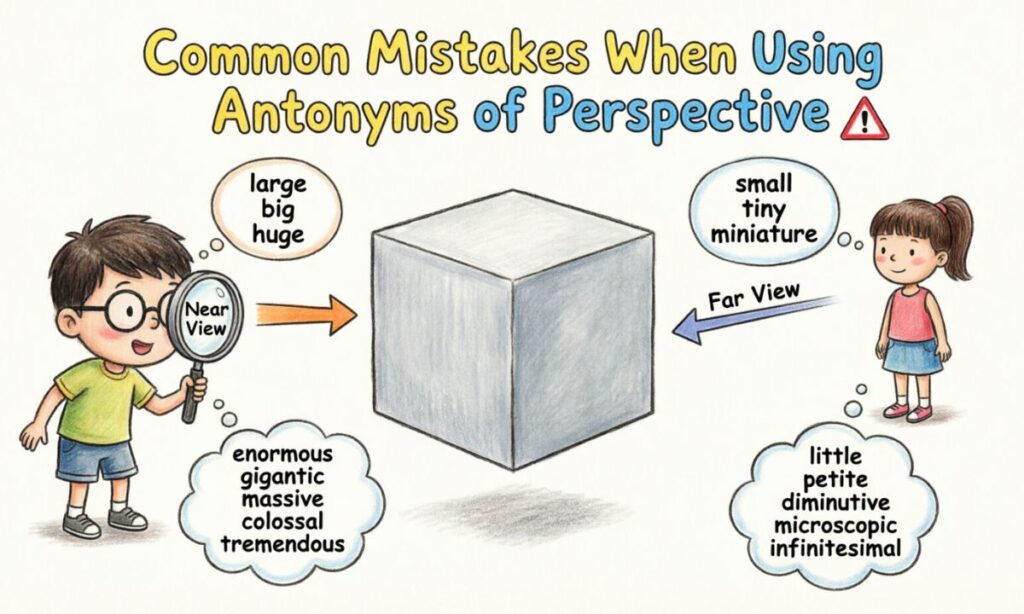
Writers and speakers often fall into predictable traps when using the opposite of perspective. Here are the most frequent errors to avoid:
- Treating all antonyms as interchangeable. “Objectivity” and “impartiality” are both antonyms, but objectivity concerns facts while impartiality concerns fairness. Using them interchangeably weakens your writing.
- Assuming objectivity is always positive. Complete objectivity can also mean emotional detachment, which is not always ideal in human relationships.
- Confusing subjectivity with bias. Subjectivity is a natural human trait; bias is a flaw. They are related but not the same.
- Using “tunnel vision” too casually. This is a strong clinical-sounding phrase. Use it only when the narrowness of focus is genuinely extreme.
- Ignoring visual vs. conceptual meaning. In art and design, the opposite of perspective refers to flatness or distortion. In philosophy and daily language, it means a lack of insight or a skewed viewpoint. Always clarify which meaning you intend.
Practice Exercises
Test your understanding of the opposite of perspective with these exercises.
Exercise 1: Fill in the Blank
Choose the best word from the list (Objectivity, Subjectivity, Bias, Impartiality, Tunnel Vision, Broad-Mindedness) to complete each sentence.
- The referee’s __________ was praised by fans of both teams.
- Her __________ about healthy eating made her dismiss all fast food without question.
- The documentary was criticized for showing clear __________ toward one political party.
- Scientists strive for __________ when interpreting experimental results.
- His __________ allowed him to appreciate both classical and modern art.
Exercise 2: Identify the Antonym
Select the best antonym for “perspective” in each context:
- A judge who sets aside personal feelings: (objectivity / tunnel vision)
- A voter who only reads news that confirms their views: (broad-mindedness / bias)
- A student who cannot see any use in history class: (myopia / impartiality)
Answers: Exercise 1: 1. Impartiality, 2. Tunnel Vision, 3. Bias, 4. Objectivity, 5. Broad-Mindedness | Exercise 2: 1. Objectivity, 2. Bias, 3. Myopia
Advanced Topics: Nuances and Context
The opposite of perspective is not always a static concept. Context changes how these antonyms function. Here are some nuanced points to consider:
Positive vs. Negative Antonyms
Some antonyms of perspective are neutral or even positive. Objectivity and impartiality are widely considered virtues. Others like bias, tunnel vision, and dogmatism carry clearly negative connotations. Understanding this spectrum helps you use each word with the right emotional weight.
Overlap Between Antonyms
Many antonyms of perspective share overlapping territory. Narrow-mindedness, tunnel vision, and myopia all describe limited thinking. The difference lies in degree and context. Myopia suggests a failure to think ahead. Tunnel vision suggests obsessive focus on one thing. Narrow-mindedness suggests a refusal to consider other views socially or morally.
Cultural Relativity
What counts as an “opposite of perspective” can itself be culturally shaped. In some cultures, strong group loyalty is not seen as bias but as virtue. This means even the concept of “closed-mindedness” can be interpreted differently depending on perspective, an irony worth noting.
Read This: Treck or Trek – Clear Up the Confusion Once and for All
How Context Shapes and Distorts Perspective?
Context is the silent force that surrounds every perspective. It can expand thinking or shrink it. Understanding how context works helps explain why the opposite of perspective takes so many forms.
When context is missing, ignorance fills the gap. People make judgments without the information they need, which produces misconceptions and misunderstandings.
When context is distorted, bias and prejudice emerge. Someone who only receives information from one source will develop a skewed view that feels true but lacks balance.
When context is overwhelming, confusion and fogginess take over. Too much conflicting information can collapse a person’s ability to hold any clear perspective at all.
When context is fixed and rigid, dogmatism and absolutism appear. The person stops questioning and starts defending a single truth regardless of new evidence.
Each of these scenarios represents a different opposite of perspective in action. Recognizing which one is at play in a conversation or text helps you respond more precisely and thoughtfully.
Good writers and thinkers use context to anchor their perspective and prevent it from drifting into any of these negative states. The goal is always to hold a perspective that is informed, flexible, and open to challenge.
Last Words
The opposite of perspective covers a rich and varied landscape of human thinking. From the cold clarity of objectivity to the distorted lens of bias, from the expansive freedom of broad-mindedness to the suffocating grip of tunnel vision, each antonym tells a story about how perspective can fail, freeze, or flip.
Understanding the opposite of perspective is not just an exercise in vocabulary. It is a tool for clearer thinking, better writing, and more honest communication. When you can name what is missing or distorted in someone’s thinking, including your own, you gain the ability to correct it.
The opposite of perspective also reminds us why perspective matters so much in the first place. It is not just a word. It is the lens through which we see, understand, and connect with the world. Guard it, question it, and above all, keep it wide open.
Whether you are a student preparing for an exam, a writer searching for the perfect word, or a professional trying to communicate with clarity and precision, this guide has given you 35 powerful tools. Use them well, and your understanding of the opposite of perspective will serve you in every conversation you have.

Welcome to MeaningDeck! I’m Alex, an AI-Powered SEO, and Content Writer with 2 years of experience.
I help websites rank higher, grow traffic, and look amazing. My goal is to make SEO and web design simple and effective for everyone.
Let’s achieve more together!