

You spotted it in a marketplace listing. Maybe a classified ad. Someone is selling a guitar for “$250 OBO” and you are staring at those three letters like they owe you an explanation. Does it mean the price is firm? Is it an invitation to negotiate? Can you offer $50 and keep a straight face?
OBO is one of those abbreviations that seems obvious once you know it, but genuinely confusing before that moment. Let’s clear it up right now.
What Does OBO Mean?
OBO stands for “Or Best Offer.” It is a term used in buying and selling situations to signal that the listed price is not final. The seller has a number in mind, but they are open to hearing a reasonable offer below it.
If something is listed at “$300 OBO,” the seller is essentially saying: “I want $300, but if you come to me with a fair number, let’s talk.”
It is not a guarantee you will get a discount. It is an invitation to negotiate.
Where Did OBO Come From?
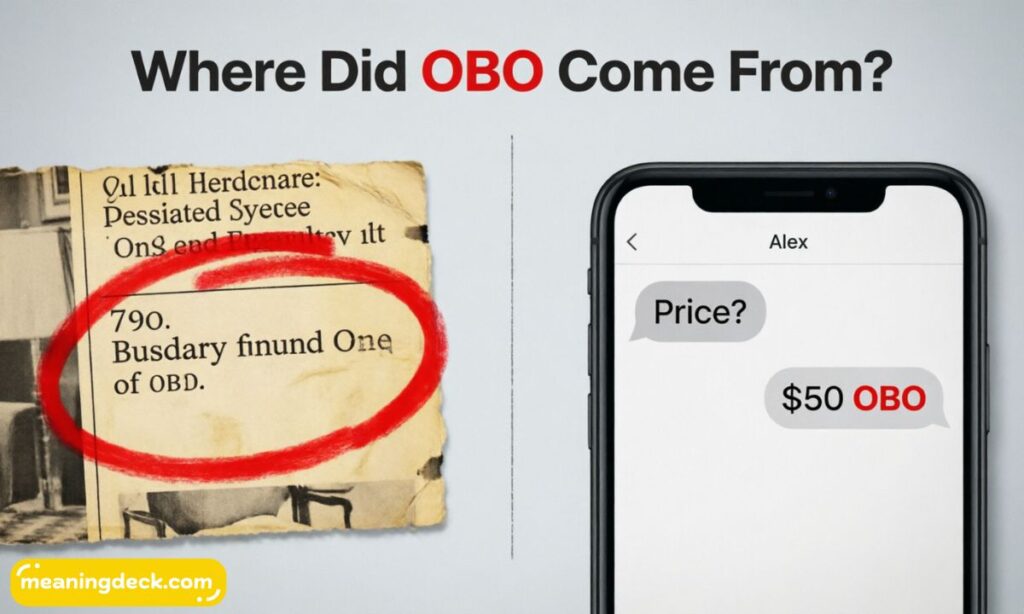
OBO has its roots in traditional commerce and classified advertising. Long before the internet existed, people sold items through newspaper classifieds, community bulletin boards, and garage sales. Negotiation was simply a normal part of those transactions.
The phrase “or best offer” became a standard way for sellers to signal flexibility without lowering their asking price upfront. It kept the door open without committing to anything.
When online marketplaces like eBay launched in the mid-1990s, OBO became a formal listing option. eBay literally had a “Best Offer” feature built into its platform, which made the term even more widely recognized.
From there, it spread across Craigslist, Facebook Marketplace, classified sites, and eventually into casual texting and general conversation.
Read This: RLS Meaning in Text: Shocking Truth Revealed (2026 Guide)
OBO in Online Marketplaces: The Place You See It Most
Today, OBO lives primarily in buying and selling spaces. You will find it constantly on:
- Facebook Marketplace: Sellers add OBO to invite negotiation on furniture, electronics, and vehicles.
- Craigslist: A classic OBO territory where everything from bicycles to boats comes with negotiable pricing.
- eBay: Has a dedicated “Make an Offer” feature that operates exactly on the OBO principle.
- OfferUp and Letgo: Apps built around peer-to-peer selling where OBO is practically the default culture.
- Classified ads in local newspapers: Still in use, still carrying OBO proudly.
The moment you see OBO in any of these places, you know the seller is at least somewhat flexible. How flexible depends on how motivated they are to sell.
OBO vs. OBO: Does It Mean the Same Thing Everywhere?
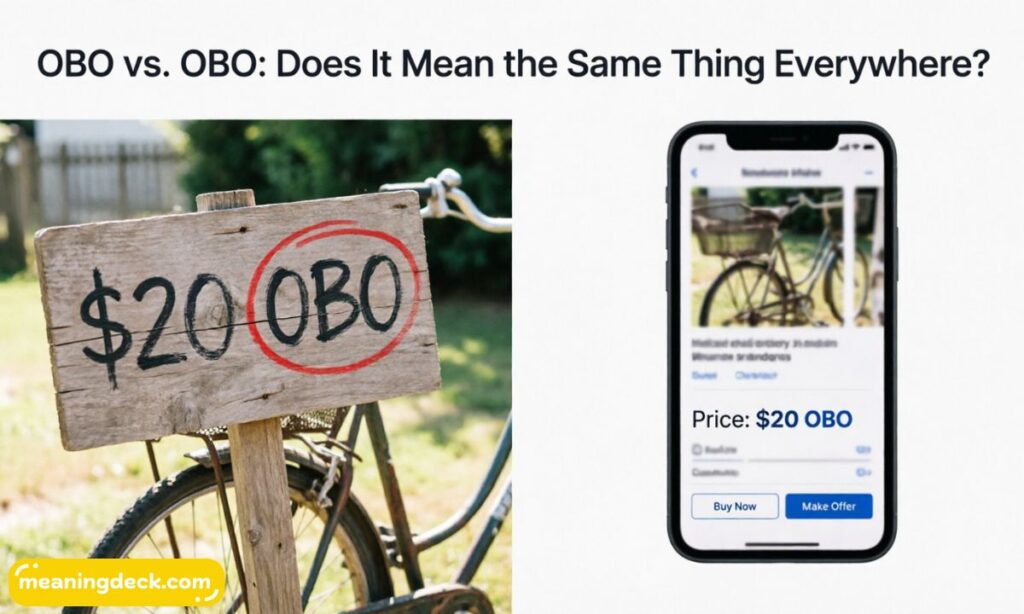
Here is something most articles skip entirely. OBO is not a single-meaning abbreviation. In different contexts, it can stand for different things entirely.
| Context | OBO Stands For | What It Means |
| Buying and Selling | Or Best Offer | Price is negotiable |
| Sports (Baseball) | On Behalf Of | Representing someone else |
| General Communication | On Behalf Of | Acting for another person |
| Rare Usage | Out of Business Operations | A company shutting down functions |
The most common meaning by far is “Or Best Offer” in commerce. But if someone uses OBO in a formal letter or professional email, they almost certainly mean “On Behalf Of.”
Context is everything with this abbreviation. Always check the setting before assuming.
OBO as “On Behalf Of”: A Completely Different Use
“On Behalf Of” has a long, formal history in business, legal, and diplomatic communication. When someone signs a document or sends a communication on behalf of another person or organization, they use this phrase to make clear they are acting as a representative, not as themselves.
You have seen this more often than you realize. Formal emails sometimes read “Sent on behalf of [Name].” Legal documents use “on behalf of the plaintiff.” Business correspondence uses it constantly.
The historical roots go even deeper. In medieval legal tradition, representatives would speak or act “on behalf of” lords, kings, and landowners in formal proceedings. The concept of authorized representation is ancient and deeply embedded in how institutions and societies have always functioned.
So when OBO appears in a professional setting, it carries that weight. It means someone has been authorized to act or speak for another party. That is a meaningful distinction.
Real-Life Examples of OBO in Action
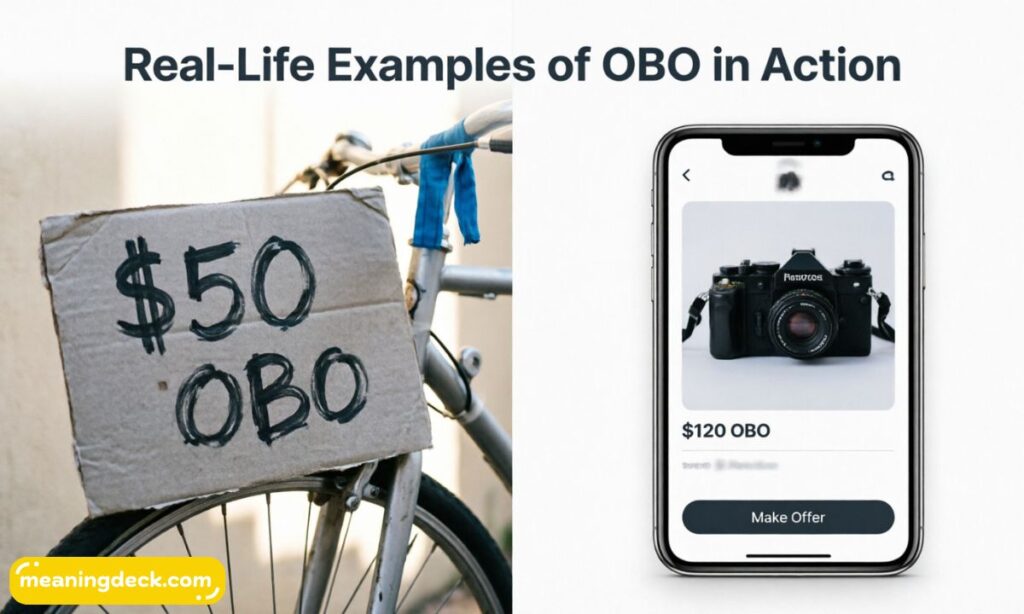
Let’s make this concrete, because the best way to understand a term is to see it working in real sentences.
In a marketplace listing: “Selling my mountain bike, barely used. Asking $400 OBO. DM me.” Translation: The seller wants $400 but will consider lower offers.
In a counteroffer: “You listed it at $400 OBO. Would you take $300?” This is exactly the kind of message OBO is designed to invite.
In a formal email: “This message is sent OBO of the Director of Operations.” Translation: Someone is writing on the director’s behalf.
In a sports broadcast or report: “The transaction was completed OBO of the team’s ownership group.” Translation: The ownership group authorized the transaction, and someone else executed it.
In casual texting: “Can you RSVP OBO of me? I’ll be driving.” Translation: “Can you respond for me since I cannot do it myself right now?”
Each of these feels natural in its setting because OBO bends to fit the context it is placed in.
How to Respond When You See OBO in a Listing
This is the practical part most people actually want to know. Seeing OBO is not a signal to lowball someone into an awkward situation. It is an opening for a respectful negotiation.
Here is how to handle it well:
Do this: Offer a price that is genuinely reasonable. If something is listed at $500 OBO, offering $400 or $450 is fair game. The seller might say yes, counter, or decline.
Do not do this: Do not offer 20% of the asking price and act surprised when the seller goes cold. OBO means flexible, not desperate.
A good opening message looks like this: “Hi, I saw your listing for the sofa at $300 OBO. Would you consider $250? I can pick it up this weekend.”
You are making an offer, giving a reason to say yes (quick pickup), and being polite. That combination works better than just sending a number with no context.
Common Mistakes People Make With OBO
A few things trip people up regularly when OBO is involved.
Mistake 1: Assuming OBO means the price is already low. Some sellers price high specifically because they added OBO. The listing price is not a bargain just because the term is there.
Mistake 2: Not offering anything at all. Seeing OBO and then asking “what’s your lowest price?” puts all the work on the seller. Make an actual offer. That is what OBO is there for.
Mistake 3: Confusing “Or Best Offer” with “On Behalf Of” in the wrong setting. Getting this backward can make a message confusing or even unprofessional. A business email saying “sent OBO” should mean “on behalf of,” not “or best offer.” Context matters enormously.
Mistake 4: Thinking OBO obligates the seller. The seller can decline any offer they receive. OBO means they are open, not that they are committed to selling below their asking price.
OBO vs. Firm Price: What Is the Difference?
Understanding the opposite of OBO helps you read listings faster. When a seller writes “firm” or “price is firm,” they mean exactly what it says. No negotiation. The price is the price.
Here is a quick breakdown:
| Listing Says | What It Means | Should You Negotiate? |
| $300 OBO | Open to offers | Yes, make a reasonable offer |
| $300 Firm | Not negotiating | No, pay asking price or move on |
| $300 or nearest offer | Same as OBO | Yes, similar flexibility |
| $300 (no lowballers) | Very little flexibility | Be very careful with offers |
Knowing this saves you time and the seller’s patience.
Which Should You Use: OBO, Firm, or Negotiable?
If you are the one selling something and wondering which term fits, here is a simple guide.
Use OBO when: You have a target price but would rather sell than hold out. You are okay with accepting a little less for a quick, smooth sale.
Use “Firm” when: You know exactly what the item is worth and you are not in a rush. You would rather wait for the right buyer than take less.
Use “Negotiable” when: You are genuinely unsure of the price and open to being guided by what buyers offer. This signals even more flexibility than OBO.
The honest truth: OBO gets more responses than “firm.” Buyers feel like they have a shot, so they reach out. If you want faster sales, OBO is your friend.
Read This: TYSM Meaning: What It Is, How to Use It, and When Not To
A Short Historical Note: Negotiation Is as Old as Trade Itself
Humans have been negotiating prices since the first markets appeared. Ancient bazaars in Mesopotamia, Egypt, and Rome operated almost entirely on negotiation. There was no fixed pricing. You offered what you thought something was worth, the seller countered, and eventually both parties landed somewhere in the middle.
Fixed pricing is actually a relatively modern invention. Department stores in the 19th century introduced the concept of tagged, non-negotiable prices partly to simplify transactions and reduce the time spent haggling.
OBO, in a sense, brings us back to something very old and very human. It says: “Let’s talk. Let’s find a number that works for both of us.” That instinct has never really gone away, and OBO keeps it alive in every marketplace listing it appears in.
FrequentlyAsked Questions
Is OBO only used in the United States?
OBO is most common in American and Canadian online marketplaces, but the concept and the abbreviation appear on English-language platforms globally. In the UK, you might see “ONO” (or nearest offer) used instead, which means essentially the same thing.
Can a seller reject all OBO offers and still sell at asking price?
Absolutely. OBO means the seller is open to offers. It does not mean they are required to accept any of them. If no offer meets their expectations, they can wait for a buyer who pays full price.
Is OBO used in professional or business settings?
Not in the “or best offer” sense. In professional communication, OBO almost always means “on behalf of.” Using it to mean “or best offer” in a business email would confuse most readers and come across as unprofessional.
Final Thought
OBO means “Or Best Offer” in commerce, and “On Behalf Of” in formal communication. Once you know which setting you are in, the meaning is never confusing again.
It is a tiny abbreviation with a lot of practical use behind it. Whether you are browsing a marketplace listing, writing a formal email, or sending a quick text, OBO carries a clear signal: someone is either open to negotiation or acting for another person.
Now you know both meanings, you know when to use each one, and you know how to make an offer without accidentally insulting the seller.

Welcome to MeaningDeck! I’m Alex, an AI-Powered SEO, and Content Writer with 2 years of experience.
I help websites rank higher, grow traffic, and look amazing. My goal is to make SEO and web design simple and effective for everyone.
Let’s achieve more together!