

You saw the letters PTSO somewhere and did a double take. Maybe it was on a school flyer, a work document, or a random online post. You searched for the meaning and got either a vague answer or five different answers that all contradicted each other. That is frustrating, and you deserve better. PTSO stands for Parent Teacher Student Organization, a community group that connects parents, teachers, and students to support and improve a school together. Now let us go deeper.
What Does PTSO Mean in Simple Terms?
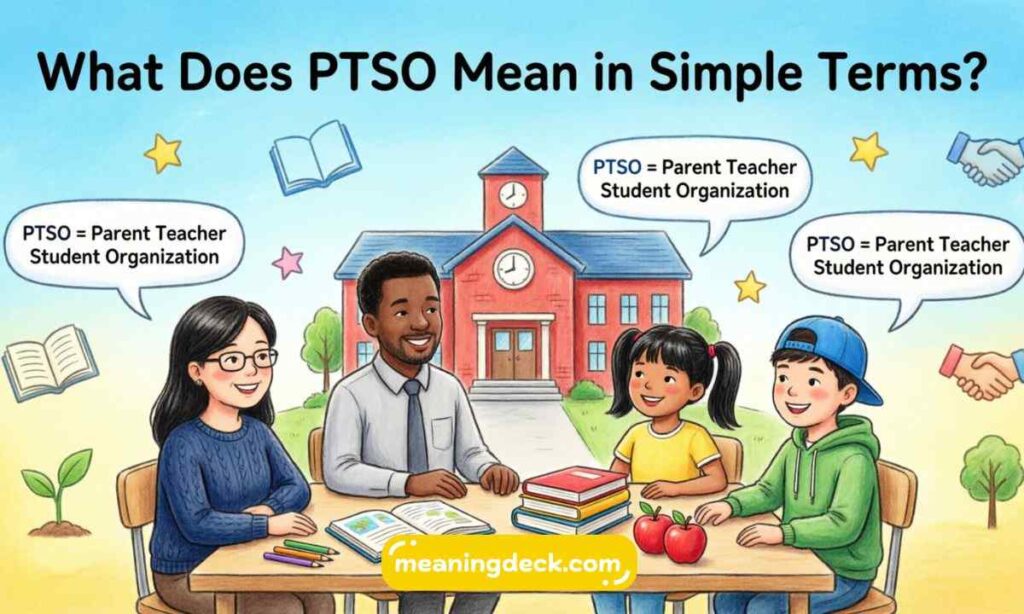
PTSO means Parent Teacher Student Organization. It is a school-based group where parents, teachers, and students work together to create a better learning environment.
The key difference from similar organizations is right there in the name: the S. Students are officially included. This is not just a group of adults meeting in a school library after hours. Students have a real seat at the table, an actual voice in decisions, and a genuine role in shaping their own school experience.
Think of it as the school’s community management team, except nobody gets paid and everyone brings homemade cookies to the meetings.
PTSO vs. PTO vs. PTA: What Is Actually the Difference?
This is where most people get confused, and honestly, most articles do not explain it clearly enough. Let us fix that right now.
All three organizations serve a similar purpose. They exist to connect families and educators. But the structure and membership tell very different stories.
Here is a clean comparison:
| Organization | Full Name | Students Included? | National Affiliation? | Structure |
| PTSO | Parent Teacher Student Organization | Yes | No | Independent |
| PTO | Parent Teacher Organization | No | No | Independent |
| PTA | Parent Teacher Association | No | Yes | National body |
The PTA is affiliated with the National PTA, a nonprofit organization with over a century of history. It follows a standardized structure and dues system.
The PTO and PTSO are both independent. They set their own rules, keep their own funds, and answer to nobody except their own school community.
The PTSO simply goes one step further by formally including students. That one letter changes the entire culture of the group.
Why Does the “S” in PTSO Matter So Much?
Including students in a school organization is not just a feel-good gesture. It has real, practical impact on how decisions get made.
When only adults plan school events, fundraisers, and programs, they sometimes miss what students actually want or need. A PTSO changes that dynamic completely.
Students who participate in their school’s PTSO learn leadership skills, practice public speaking, and understand how community organizations function. Some of the most effective young advocates got their start by speaking up in a PTSO meeting before they were old enough to vote in an election.
The “S” is small but it carries serious weight.
You Also Like This: RS Meaning in Text: Shocking Truth You Must Know
Where Did the Idea of a PTSO Come From?

The broader concept behind the PTSO goes back further than most people realize. The idea of parents and educators working together formally began in the late 19th century.
The National Congress of Mothers, which later became the National PTA, was founded in 1897 in Washington D.C. Its founders, Alice McLellan Birney and Phoebe Apperson Hearst, believed that the connection between home and school was essential to a child’s success. That belief became the foundation for every parent-teacher organization that followed.
The PTSO, as a student-inclusive variation, grew naturally as educational philosophy shifted. Educators began recognizing that students were not just subjects of education but participants in it. Including them in organizational decisions was the next logical step.
It is worth noting that the idea of community gathering for shared purpose has ancient and even biblical roots. In Proverbs 11:14, the text reads: “Where there is no guidance, a people falls, but in an abundance of counselors there is safety.” A PTSO is essentially that principle applied to a school community. Many voices, one shared goal.
What Does a PTSO Actually Do Day to Day?
Understanding the meaning of PTSO is one thing. Seeing what it does in practice is where it becomes genuinely useful to know.
A typical PTSO handles a wide range of activities across the school year:
- Fundraising for school supplies, technology, and extracurricular programs that the budget does not cover
- Organizing school events like carnivals, science fairs, talent shows, and cultural nights
- Communicating between school administration and families, especially on policy changes or school improvements
- Supporting teachers with classroom resources, volunteer coordination, and appreciation efforts
- Giving students a platform to propose ideas, lead initiatives, and represent their peers
Some PTSOs also get involved in bigger conversations, like school board discussions, curriculum feedback, and safety policy reviews. The scope depends entirely on the school and how active its members are.
How Is a PTSO Structured?
A PTSO typically runs like a small nonprofit organization. It has elected officers, regular meetings, a budget, and a set of bylaws that guide how decisions get made.
Common officer positions include:
- President (leads meetings and represents the group)
- Vice President (supports the president and steps in when needed)
- Secretary (keeps records of meetings and communications)
- Treasurer (manages the budget and financial records)
- Student Representative (the voice of the student body, unique to the PTSO structure)
Meetings usually happen monthly and are open to all members. Anyone who wants to participate can show up, contribute ideas, and vote on decisions.
The student representative role is what separates a PTSO from other parent-teacher groups in a structural, not just symbolic, way.
Real-Life Examples of PTSO in Sentences
Seeing a word used in context always makes its meaning click faster. Here is how PTSO appears in real-life communication:
In a school newsletter: “The PTSO will host its annual fall fundraiser on October 14th. All families are encouraged to attend and participate.”
In a parent email: “I joined the PTSO this year and I am genuinely impressed by how much the student representatives contributed to planning the spring event.”
In a student council speech: “As your student representative to the PTSO, I will make sure your ideas actually reach the adults making decisions.”
In a job application (for education-related roles): “I served as treasurer of my school’s PTSO for two years, managing a budget of over $15,000 annually.”
Notice how versatile the term is across different audiences and contexts.
Other Meanings of PTSO You Should Know
Here is something most articles skip entirely. PTSO does not always mean Parent Teacher Student Organization. Context matters enormously.
In some professional and technical fields, PTSO carries completely different meanings:
- PTSO in logistics and supply chain can refer to Purchase to Ship Order, describing the workflow from a purchase order to the physical shipment of goods.
- PTSO in some military or government documents may refer to specific operational designations that vary by branch and country.
- PTSO in medical or clinical records can sometimes appear as a status or procedural abbreviation, though this is far less standardized.
If you saw PTSO in a non-school context, the Parent Teacher Student Organization interpretation probably does not apply. Always read the surrounding context before assuming a single meaning.
Common Mistakes People Make About PTSO
A few persistent misunderstandings follow this term around the internet. Worth clearing them up once and for all.
Mistake 1: Assuming PTSO and PTA are the same thing. They are not. A PTA is nationally affiliated and follows a standardized structure. A PTSO is independent and locally governed. They share a purpose but operate very differently.
Mistake 2: Thinking students in a PTSO are just there for show. In a well-run PTSO, student representatives have genuine voting power and real influence. Their involvement is structural, not decorative.
Mistake 3: Believing only large or wealthy schools have PTSOs. Any school can form a PTSO regardless of size or funding. The organization itself costs nothing to start and depends entirely on community participation.
Mistake 4: Spelling or writing it as “PTSA” and meaning the same thing. PTSA stands for Parent Teacher Student Association and is specifically affiliated with the National PTA. A PTSO is independent. Same student-inclusive spirit, different organizational structure.
You Also Like This: Mhm Meaning in Text: Complete Chat Guide (2026)
PTSO vs. PTSA: Which One Should You Use or Join?
Since both include students, this comparison deserves its own space.
Choose a PTSO if your school values local independence and wants full control over its own budget, bylaws, and decision-making. You will not pay national dues and you will not follow a standardized structure. That freedom is its biggest advantage.
Choose a PTSA if your school wants the backing of the National PTA, access to national resources, advocacy support at the legislative level, and a structured framework that is already proven and widely recognized.
Neither is objectively better. It depends entirely on what your school community needs and how much organizational independence it wants.
If you are starting a new group from scratch, the PTSO model is often simpler and faster to get running.
Why Schools Are Moving Toward the PTSO Model
There is a quiet but clear trend in education. More schools are choosing the student-inclusive model over the traditional parent-teacher-only structure.
The reason is simple. Students are the reason the school exists. Leaving them out of organizational decisions creates a gap between what adults plan and what students actually experience.
Schools that operate with a PTSO report higher student engagement, more creative fundraising ideas, and stronger connections between the administration and the student body. When students feel heard, they also feel more invested in their school community.
It turns out that respecting young people’s ideas produces better outcomes. Revolutionary concept, right?
Frequently Asked Questions
Is a PTSO the same as a student council?
No. A student council is made up exclusively of students and focuses on student-led initiatives. A PTSO includes parents, teachers, and students working together. They can collaborate but they are separate organizations with different scopes.
Does every school have a PTSO?
No. A school must actively form and maintain a PTSO. Many schools operate with a PTO or PTA instead, and some smaller schools have no formal parent-teacher organization at all. It depends entirely on the school community and leadership.
Can a parent join a PTSO even if their child does not attend that school?
Technically, membership rules are set by each individual PTSO. Most require a direct connection to the school, either as a parent, guardian, teacher, or student. However, some community-based PTSOs allow broader membership. Check your school’s specific bylaws for the exact rules.
Conclusion
At its core, PTSO stands for Parent Teacher Student Organization. But what it really represents is the belief that a school works best when everyone involved in it has a voice.
Parents bring resources and family perspective. Teachers bring professional expertise and classroom insight. Students bring the lived experience of actually being there every single day. When all three groups work together, schools become more responsive, more creative, and more human.So the next time you see PTSO on a flyer, a form, or a meeting invitation, you know exactly what it means and why the “S” in the middle is the most important letter of all.

Welcome to MeaningDeck! I’m Alex, an AI-Powered SEO, and Content Writer with 2 years of experience.
I help websites rank higher, grow traffic, and look amazing. My goal is to make SEO and web design simple and effective for everyone.
Let’s achieve more together!