

Ever stared at your screen wondering what “ISTG” actually means? You’re not alone. Whether it showed up in a DM, a TikTok comment, or a Snapchat story, this four-letter abbreviation carries more emotional weight than most people realize.
In this complete guide, you’ll learn the ISTG meaning in text, how it’s used across platforms, what it signals emotionally, who uses it most, and why it exploded in 2026. No filler — just everything you need to know.
What Does ISTG Mean in Text?
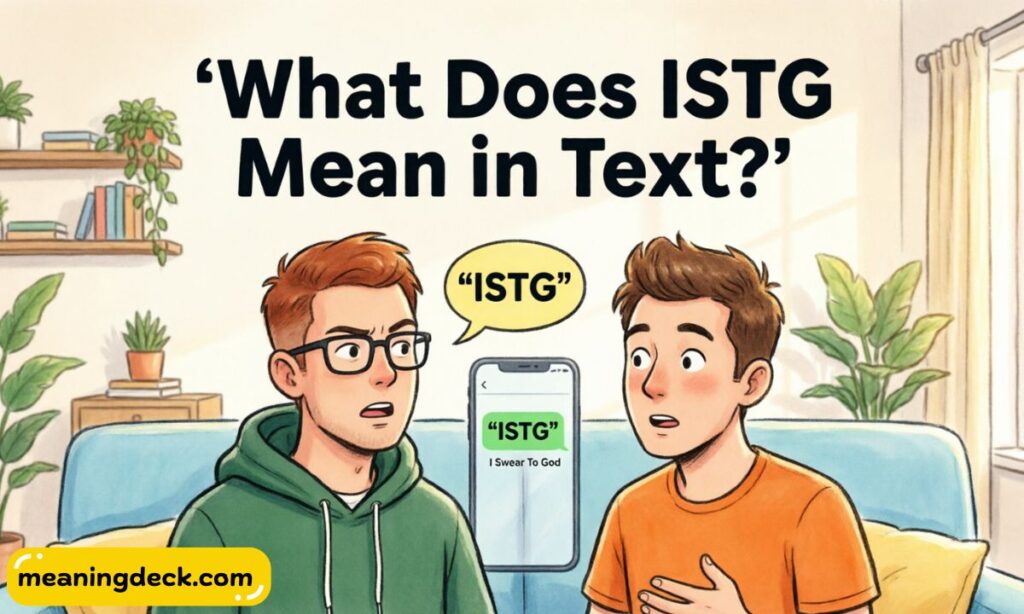
ISTG stands for “I Swear To God.”
It’s one of the most widely recognized slang abbreviations in modern digital communication. When someone types ISTG in a message, they’re using it as an emotional intensifier — a way to add honesty, urgency, frustration, or dramatic flair to whatever they’re saying.
Think of ISTG as a verbal exclamation point. It turns a flat sentence into something that feels something.
Plain: “My alarm didn’t go off.” With ISTG: “ISTG my alarm didn’t go off.”
The second version instantly feels more believable and relatable. That’s the whole power of this abbreviation.
Core Meanings of ISTG in Texting
ISTG isn’t locked into one meaning. Its tone shifts depending on the conversation. Here are the four most common ways people use it:
| Usage Type | What It Signals | Example |
| Sincerity | “I’m telling the truth” | “ISTG I didn’t eat your food.” |
| Frustration | “I’ve hit my limit” | “ISTG if this Wi-Fi drops again 😤” |
| Emphasis | “I mean this strongly” | “ISTG you’re the funniest person ever.” |
| Dramatic exaggeration | Humor or venting | “ISTG I’m moving countries if it rains again 😭” |
The meaning is always shaped by context — specifically, the tone, emoji, and punctuation surrounding it.
Origin of ISTG
The phrase “I swear to God” has existed in spoken English for centuries as a way to prove honesty or stress intensity. But the abbreviation ISTG is a product of internet culture.
It first appeared in early online forums and instant messaging platforms like AOL Instant Messenger in the mid-2000s. As character limits tightened and typing speed became crucial, long phrases got shortened. ISTG followed the same path as OMG, LOL, and BRB.
By the early 2010s, ISTG was gaining traction on Tumblr and Twitter. After 2020, TikTok turbocharged its spread — today it appears in millions of posts monthly and is a staple of Gen Z digital vocabulary.
ISTG Meaning in Text vs. Real-Life Speech
There’s a noticeable gap between how ISTG works in texting and how “I swear to God” functions in real life.
- In speech, “I swear to God” carries genuine weight. It can feel confrontational or solemn depending on delivery.
- In texts, ISTG is casual and breezy. Most people who type it aren’t making any kind of religious or solemn declaration — they’re just adding emotional intensity to a message.
If someone says it in person with a serious face, pay attention. If someone types “istg 😂” in a group chat, they’re probably laughing at something absurd. Context is everything.
ISTG Meaning in Chat
In chat environments — WhatsApp, iMessage, Discord, Messenger — ISTG behaves as an emotional shortcut. Digital text lacks the tone of voice that makes meaning obvious in person. ISTG fills that gap.
It tells the reader: feel this. Without it, messages can read as flat or ambiguous. With it, the emotion becomes unmistakable — whether that’s frustration, honesty, humor, or genuine sincerity.
Also Read This: LWK Meaning in Text – Must-Know Chat Slang in 2026!
How ISTG Is Commonly Used in Messages
ISTG is incredibly flexible. Here’s how it shows up in everyday digital conversations:
- At the start of a sentence: “ISTG, if you’re late again I’m leaving without you.”
- Mid-sentence: “She told me — ISTG — that she never even saw the message.”
- As a standalone reaction: Friend sends a chaotic video → “ISTG 💀😭”
- To reinforce a promise: “ISTG I’ll be there by 7.”
- Combined with other slang: “ISTG fr fr this is the best show I’ve ever seen.”
Lowercase “istg” is also common and intentional — it usually softens the tone, signaling humor or casual venting rather than serious emotion.
Real-Life Examples of ISTG in Text
Here are realistic conversation examples showing ISTG in action:
Frustration:
Alex: Did you finish the group project slides? Jordan: ISTG I was up until 3am doing everything myself 😩
Sincerity:
Sam: Did you really forget my birthday? Taylor: ISTG I didn’t forget, I just had the date wrong.
Humor:
“ISTG this cat video has me crying at work 😭😭”
Emphasis:
“ISTG you’re the best friend I’ve ever had.”
ISTG Meaning From a Girl
When a girl uses ISTG in a text, the emotional range can be wide. It might mean she’s being completely sincere and wants to be believed. It could be playful venting among friends. Or it might signal genuine frustration — especially if it shows up without any emoji.
A message like “ISTG if he texts me one more time…” from a girl typically signals exasperation or setting a personal boundary. Meanwhile, “ISTG you look amazing 😍” is enthusiastic, affectionate emphasis. Read the emoji and tone, not just the letters.
ISTG Meaning From a Boy
When a boy sends ISTG, it most commonly signals either sincerity or frustration. Boys tend to use it in two main scenarios:
- To prove they’re being honest: “ISTG I didn’t say that about you.”
- To express irritation: “ISTG this game is broken, that was not my fault 😤”
Occasionally it shows up as genuine affection or excitement — “ISTG that match was insane 🔥” — especially in gaming or sports contexts. As always, tone and context determine which meaning applies.
Emotional Tones of ISTG
ISTG operates on a wide emotional spectrum. Here’s a quick breakdown:
| Tone | Cue to Look For | Feeling Conveyed |
| Playful | 😂 😭 🤣 emojis, casual phrasing | Humor, light venting |
| Sincere | No emoji, short sentence | Wants to be believed |
| Frustrated | 😤 😠 multiple exclamation marks | Annoyance or anger |
| Affectionate | 💛 🥺 🫶 emojis | Warmth, emphasis on care |
| Sarcastic | Exaggerated claim + tone mismatch | Irony, dry humor |
The letters never change. The emotion absolutely can. Always read what’s around ISTG, not just the abbreviation itself.
ISTG vs. Similar Slang Terms
Wondering how ISTG compares to other popular internet slang? Here’s a side-by-side breakdown:
| Slang | Stands For | Key Difference |
| ISTG | I Swear To God | Strong emphasis, sincerity or frustration |
| ONG | On God | Similar meaning, TikTok-native, slightly softer |
| FR / FRFR | For Real / For Real For Real | Confirms honesty, less dramatic |
| NGL | Not Gonna Lie | Softens an honest opinion |
| OMG | Oh My God | Expresses surprise, not necessarily honesty |
| SMH | Shaking My Head | Frustration or disbelief, no sincerity element |
| No Cap | No Lie | Confirms truth, hip-hop origins |
ISTG carries more emotional urgency than most of its alternatives. It’s the go-to when you really want someone to feel that you mean it.
Is ISTG Offensive?
Generally, no. ISTG is considered casual internet slang with no inherently offensive meaning. Most people who use it aren’t making a religious statement at all — it functions more like an exclamation than an oath.
That said, context matters:
- In deeply religious settings, using “I swear to God” casually can feel dismissive or disrespectful to some people. Be mindful of your audience.
- In professional environments — work emails, client messages, formal conversations — ISTG is completely inappropriate. Stick to “I assure you” or “I promise.”
- In tense conversations, even a half-joking ISTG can escalate things. High-emotion moments aren’t the right setting for a phrase that already carries intensity.
Bottom line: ISTG is harmless among friends in casual digital spaces. Outside those spaces, read the room.
How to Respond When Someone Says ISTG
The best response to ISTG depends entirely on the tone of the message. Here’s a simple guide:
- If they sound sincere: “Okay, I believe you.” or “For real?”
- If they sound frustrated: “I hear you, that’s annoying.” or match their energy with “Same honestly 😩”
- If they’re being playful: Laugh along — “ISTG same 💀” or just “😭😭”
- If it’s affectionate: Respond warmly — “That genuinely made my day 🥺”
- If you’re unsure: Ask — “Are you actually upset or just venting?” It’s always okay to clarify tone in text.
Never assume ISTG means anger. It can just as easily mean joy, humor, or genuine affection.
ISTG in Social Media Captions
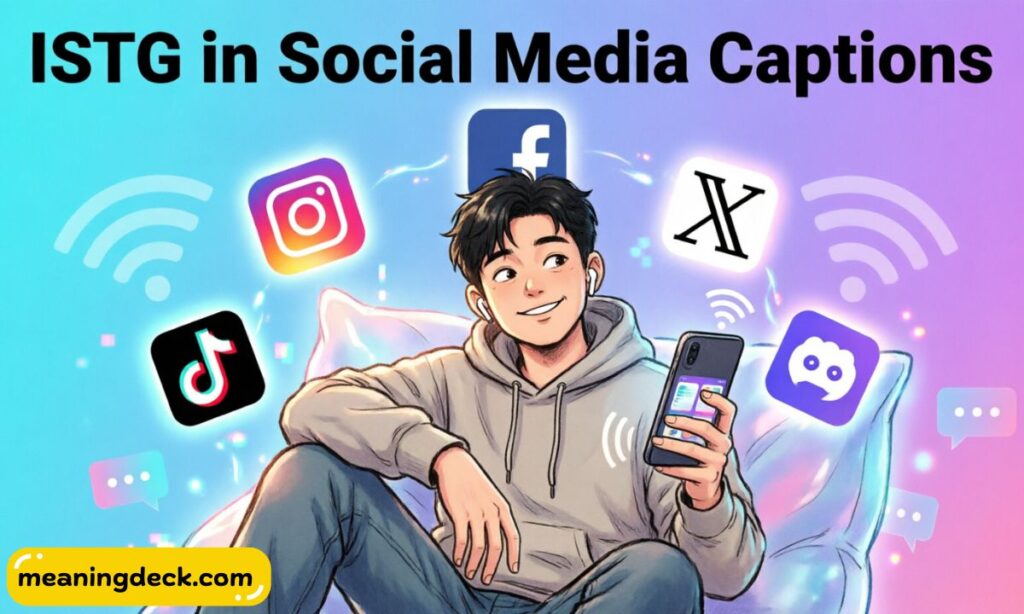
On social media, ISTG appears in captions across every major platform — and it works differently on each:
- Instagram: Adds aesthetic drama or humor. “ISTG this sunset had me crying 🌅”
- TikTok: Often used for storytelling intensity or reaction content. “ISTG this life hack actually changed my morning routine.”
- Snapchat: Fast, personal, reactive. “ISTG that snap made my whole day.”
- Twitter/X: Rants, opinions, and emotional hot-takes. “ISTG if this show gets cancelled I’m done with streaming services.”
- WhatsApp Group Chats: Shared frustration or collective enthusiasm. “ISTG we need to plan this trip ASAP.”
In social media captions, ISTG functions as an engagement hook — it invites people in with an emotional cue that feels immediate and real.
ISTG Meaning: Gen Z
For Gen Z, ISTG isn’t just slang — it’s part of the native digital language. This generation grew up expressing emotion through text, and ISTG slots perfectly into that toolkit.
Gen Z uses it to:
- Add authenticity to reactions without lengthy explanations
- Layer emotion into memes, captions, and comment threads
- Signal in-group fluency — knowing the slang means you’re part of the conversation
- Dramatize everyday moments for comedic effect
By 2026, “istg” (often lowercase) has become as automatic for Gen Z as “lol” was for millennials. It’s reflexive, expressive, and deeply embedded in how this generation communicates digitally.
ISTG Meaning: Bridgerton
In early 2026, ISTG went unexpectedly viral thanks to Bridgerton actor Luke Thompson. During a promotional interview, Thompson read a fan comment aloud — one that included “ISTG” — and pronounced it phonetically as “is-ta-ga” instead of spelling out the letters.
His co-star Yerin Ha immediately dissolved into laughter. When pushed to explain what it meant, Thompson confidently declared it stood for “Instagram.”
The clip spread instantly across TikTok, Twitter, and Instagram. Fans found the moment absolutely endearing — a beloved actor from a period drama completely offline and oblivious to basic internet slang. The meme practically wrote itself.
This moment didn’t just go viral. It reintroduced ISTG to audiences who hadn’t encountered it before, sparking a massive wave of searches and cementing it further in 2026 pop culture.
Who Uses ISTG the Most?
ISTG is primarily used by:
- Gen Z (ages 13–27): The core user base, especially on TikTok, Instagram, and Discord
- Millennials (late 20s–early 40s): Familiar with the term, increasingly common in casual chats
- Gamers: Used frequently in gaming chat rooms and Discord servers during live play
- Content creators: Used in captions and comments to drive relatable engagement
- Students and young professionals: In informal group chats and personal messages
It’s rare in older demographics and virtually absent in formal or professional communication.
Do’s and Don’ts of Using ISTG
✅ Do:
- Use it with friends, peers, and people you know well
- Pair it with emojis to clarify your emotional tone
- Use lowercase “istg” for a lighter, more humorous effect
- Use it to express genuine frustration, excitement, or sincerity
❌ Don’t:
- Use it in work emails, professional messages, or formal settings
- Use it around people who take religious language seriously
- Drop it in heated arguments where it could escalate tension
- Assume the other person knows what it means — not everyone does
Why ISTG Became Popular
Several forces drove ISTG into mainstream usage:
- Speed of texting — Typing “I swear to God” in full takes time. ISTG takes seconds.
- Character limits — Early platforms rewarded concise expression.
- Emotional flatness of text — Digital communication lacks vocal tone. ISTG injects emotion where punctuation can’t.
- Meme culture — Phrases that pack intensity into few letters spread naturally through memes.
- TikTok — Short-form video culture demanded equally short, punchy captions.
- The Bridgerton viral moment (2026) — Luke Thompson’s confusion introduced it to an entirely new audience.
Also Read This: What Does “MB” Mean in Text? A Comprehensive Guide to Its Usage in Different Contexts
Psychology Behind ISTG Usage
Why do people reach for ISTG specifically? The psychology is fascinating.
At its core, ISTG is about the need to be believed. When something wild happens and you need someone to trust you right now — not after follow-up questions — ISTG delivers instant credibility. It’s a linguistic shortcut to the credibility you’d otherwise have to build over several sentences.
Beyond that, ISTG serves as an emotional amplifier for people who feel things intensely but communicate in short bursts. In a world of shrinking attention spans, four letters can convey what a paragraph struggles to — frustration, sincerity, warmth, disbelief — depending entirely on context.
Psychologically, using abbreviated oaths like ISTG also mimics in-group bonding behavior. Shared slang creates a sense of belonging. Knowing and using ISTG signals: I’m fluent in this language. I’m part of this space.
It’s not just slang. It’s emotional shorthand, social glue, and a credibility marker — all in four letters.
Frequently Asked Questions
What does ISTG stand for?
ISTG stands for “I Swear To God.”
Is ISTG rude or offensive?
No, not generally — but avoid it in religious or professional settings.
Can ISTG be positive?
Yes, it works for excitement and affection too, not just frustration.
Is ISTG still used in 2026?
Absolutely — it’s more popular than ever, especially after the Bridgerton meme.
What’s the difference between ISTG and ONG?
Both mean the same thing; ONG is slightly newer and softer, ISTG is more dramatic.
Is lowercase “istg” different from “ISTG”?
Same meaning, but lowercase usually signals a lighter, more humorous tone.
Can ISTG be used sarcastically?
Yes — “ISTG that was the best day of my life 🙄” is clearly sarcastic from context.
Is ISTG appropriate for kids?
It’s informal but not harmful; still better suited for teens and adults.
Does ISTG have a religious meaning?
Technically yes, but in modern usage it’s an emotional intensifier, not a religious oath.
Who made ISTG famous in 2026?
Bridgerton actor Luke Thompson accidentally went viral for not knowing what ISTG meant.
Conclusion
ISTG is far more than a four-letter abbreviation. It’s an emotional shorthand that helps people communicate sincerity, frustration, humor, and intensity in a digital world where tone is hard to read. Whether you’ve seen it in a friend’s text, a TikTok caption, or a viral Bridgerton interview clip, now you know exactly what it means — and more importantly, how to read it.The next time someone sends you “ISTG 😭” in a message, you won’t pause to wonder. You’ll read the emoji, feel the vibe, and respond like a pro.

Welcome to MeaningDeck! I’m Alex, an AI-Powered SEO, and Content Writer with 2 years of experience.
I help websites rank higher, grow traffic, and look amazing. My goal is to make SEO and web design simple and effective for everyone.
Let’s achieve more together!