

You just saw IDM somewhere and now you are not sure if someone is talking about a music genre, a download manager, or just brushing you off in a conversation. Completely valid confusion. IDM is one of those abbreviations that wears multiple hats depending on where you find it. The good news is that once you understand all three of its main meanings, you will never be confused again. Let us sort this out right now.
IDM most commonly means “I Don’t Mind” in texting and casual conversation. It signals that the person is flexible, easygoing, or simply has no strong preference about something.
IDM Meaning in Texting: The Most Common Use
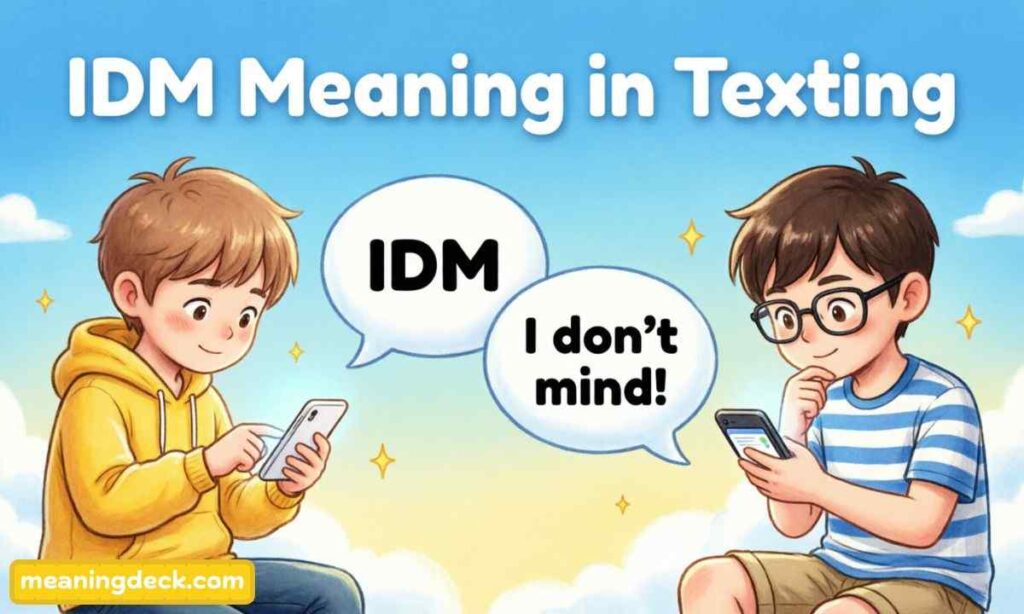
When someone sends you IDM in a text message or chat, they almost always mean “I Don’t Mind.” It is a polite and relaxed way of saying “whatever works for me” or “I have no objection to that.”
Think of it as the texting version of a friendly shrug. Not negative, not dismissive. Just genuinely flexible.
Here is a quick example to make it click immediately:
You: “Is it okay if we meet at 7 instead of 6?” Them: “IDM, works either way”
That is it. Short, friendly, no drama. IDM in texting is all about showing zero resistance to a suggestion.
Where Did IDM Come From? A Brief Origin Story
IDM as a texting abbreviation grew alongside the broader culture of shorthand digital communication that exploded in the late 1990s and early 2000s. As SMS texting became standard, people started shrinking phrases into initials to save time and characters.
Phrases like “I don’t mind” were common in everyday British and American English long before smartphones existed. The phrase itself carries roots in classic polite speech, the kind of language you would have heard in formal conversation a century ago when someone wanted to express graceful agreement without enthusiasm.
Over time, as casual digital communication took over, “I don’t mind” became IDM, just like “talk to you later” became TTYL and “by the way” became BTW. The abbreviation stuck because the phrase itself is so universally useful.
IDM Also Means Something Completely Different in Music
Here is where things get genuinely interesting. IDM in the music world stands for Intelligent Dance Music, and it is a full blown genre with a fascinating history.
Intelligent Dance Music is an experimental electronic music genre that emerged in the United Kingdom in the early 1990s. Unlike mainstream dance music built for clubs and parties, IDM was designed for focused listening. Think of it as electronic music that wants you to sit down, put on headphones, and actually pay attention.
Artists like Aphex Twin, Boards of Canada, and Autechre are considered pioneers of the genre. The music often features complex rhythms, unusual sound textures, and an overall feeling that resists easy categorization. It challenges the listener rather than just entertaining them.
The term itself was controversial from the start. Many artists in the genre disliked the word “intelligent” in the name because it implied that other dance music was unintelligent, which was a bit of an arrogant assumption. But the label stuck regardless, and today IDM remains an established term in electronic music culture.
Read This: SB Meaning in Text — Secrets Only Gen Z Understand in 2026
And Yes, IDM Is Also a Download Software
Beyond texting and music, IDM is the abbreviation for Internet Download Manager, a popular software tool used primarily on Windows computers.
Internet Download Manager accelerates download speeds by splitting files into segments and downloading them simultaneously. People who download large files frequently, like video editors, researchers, or anyone with a passion for digital hoarding, tend to love this tool.
If you ever land on a tech forum and see someone asking about IDM, there is a strong chance they are talking about the software and not the music genre or the texting phrase. Context, as always, is everything.
IDM Meaning Across Three Different Worlds: A Quick Comparison
Here is a clean side by side view so you always know which IDM you are dealing with:
| Context | IDM Stands For | What It Means |
| Texting and Chat | I Don’t Mind | Expressing flexibility or easygoing agreement |
| Music | Intelligent Dance Music | Experimental electronic music genre from the UK |
| Technology | Internet Download Manager | Software that speeds up file downloads |
| Formal Writing | Infectious Disease Medicine | A medical specialty field |
As you can see, the same three letters carry completely different weight depending on where you encounter them. The context of the sentence is your best guide every single time.
Real Life Examples of IDM Used in Conversation
Seeing slang in action always makes it easier to understand than any definition alone. Here are natural, real world examples of IDM in texting:
Example 1 (Making plans): Friend: “Should we get pizza or burgers tonight?” You: “IDM, you choose, I am happy either way”
Example 2 (Scheduling): Colleague: “Can we push the call to 3pm?” You: “IDM at all, 3pm works fine”
Example 3 (Expressing no preference): Partner: “Do you want to watch a movie or just talk?” You: “IDM honestly, whatever you feel like”
Notice the pattern. IDM always signals openness and zero resistance. It never carries a negative tone. It is the polite middle ground between “yes” and “whatever.”
IDM vs Similar Texting Abbreviations: Know the Difference
Since IDM sits in a family of similar sounding responses, it helps to see how it compares to its closest relatives:
| Abbreviation | Full Form | Tone and Use |
| IDM | I Don’t Mind | Easygoing agreement, no strong preference |
| IDC | I Don’t Care | More indifferent, can sound cold if not careful |
| IDK | I Don’t Know | Expressing uncertainty, not a yes or no |
| NVM | Never Mind | Withdrawing a question or point |
| IDGAF | I Don’t Give A… | Strong indifference, quite blunt and informal |
IDM is the warmest of this group. While IDC can come across as dismissive, IDM sounds genuinely polite. It says “I trust your judgment” rather than “I could not care less.”
This distinction actually matters in real conversations. Choosing IDM over IDC can be the difference between sounding flexible and sounding rude, so it is worth knowing when each one fits.
Which One Should You Use: IDM, IDC, or IDK?
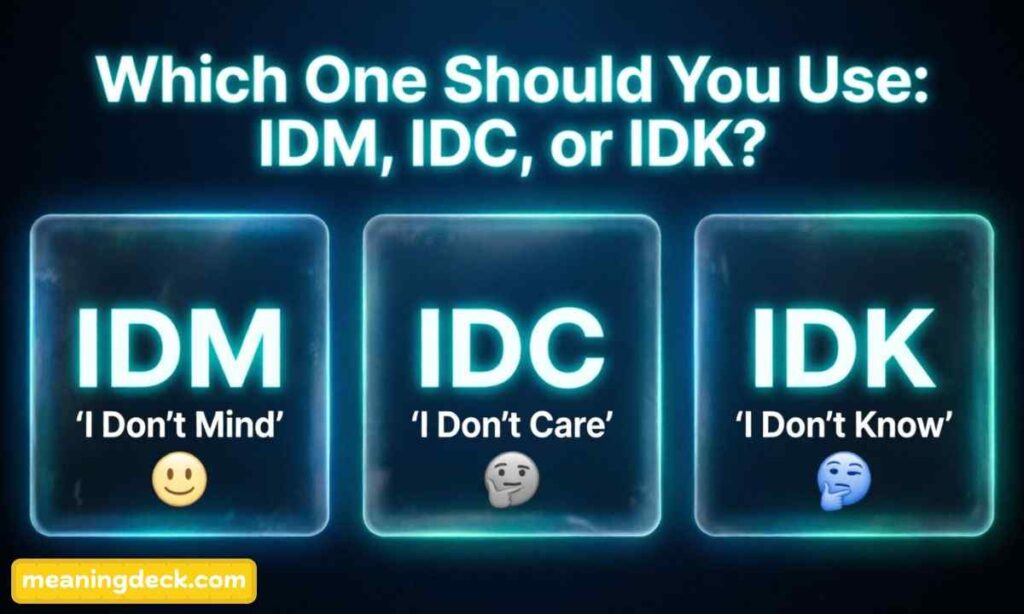
This is the practical question most people never think to ask, and the answer is simpler than it seems.
Use IDM when you genuinely have no preference but you are still engaged and happy to go along. It keeps the conversation warm and cooperative.
Use IDC when you truly are indifferent and you do not mind if the other person notices that. Fair enough in the right friendship, but use it carefully with anyone you want to impress.
Use IDK when you are actually uncertain, not indifferent. If someone asks you a question and you simply do not have the answer, that is IDK territory.
The core rule is this: IDM keeps relationships smooth. IDC can create friction if misread. IDK admits a gap in knowledge. Pick based on what you actually mean, not just what is quickest to type.
Common Mistakes People Make With IDM
Even simple abbreviations attract misuse. Here are the mistakes worth avoiding:
Mistake 1: Using IDM when you actually do have a preference If you secretly want Italian food but you say IDM when asked, do not be surprised when you end up at a sushi place. IDM is only useful when you genuinely mean it.
Mistake 2: Confusing IDM with IDC in tone They look similar and feel similar, but IDM is noticeably warmer. Sending IDC to someone who is genuinely trying to include you can come across as dismissive even if you did not mean it that way.
Mistake 3: Using texting IDM in professional or formal writing IDM belongs in casual conversations only. In a work email, in an official message, or in any setting that requires professionalism, write out “I don’t mind” in full. Abbreviations in formal contexts make you look careless rather than efficient.
Mistake 4: Assuming IDM always means texting slang If you are on a music platform or a tech forum and someone mentions IDM, they are almost certainly not talking about their personal preferences. Read the room, or in this case, read the thread.
A Small Historical Note: “I Don’t Mind” Through the Ages
The phrase “I don’t mind” has been part of polite English speech for well over two centuries. In classic British literature and formal correspondence, saying “I don’t mind” was considered an elegant and gracious way to show accommodation without appearing indifferent.
Jane Austen era characters used similar phrasing to signal social grace. The idea was that a well mannered person expressed flexibility rather than demanding their own way. The underlying value behind IDM is actually centuries old, even if the abbreviation is brand new.
There is something quietly charming about the fact that a three letter texting shortcut carries the spirit of centuries old good manners inside it. IDM might be modern in form, but its heart is thoroughly old fashioned.
How to Respond When Someone Sends You IDM
Read This: SMD Meaning in Text
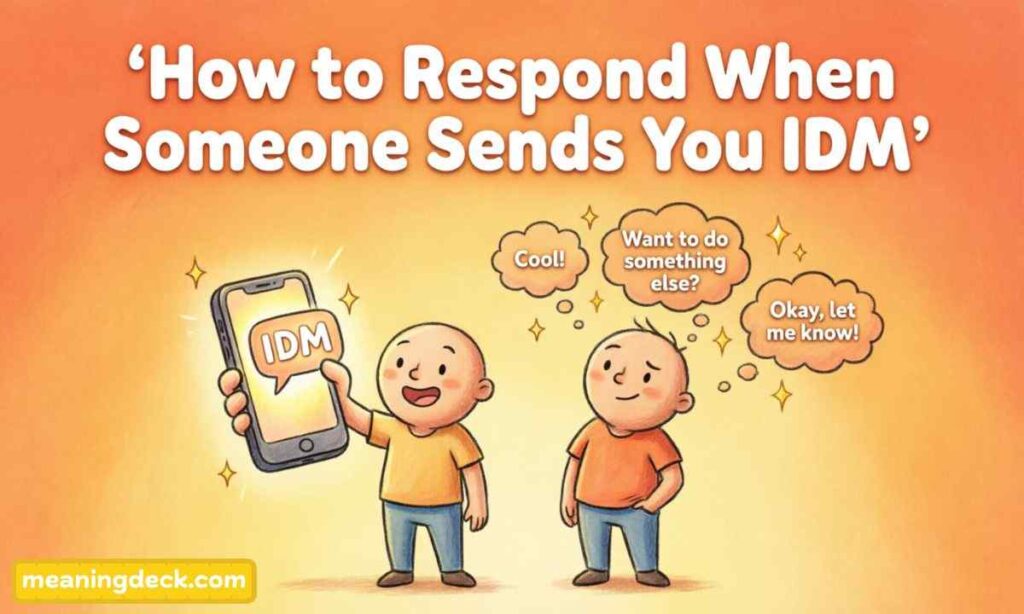
This is a detail most articles skip entirely, and it is genuinely useful. When someone texts you IDM, it means the decision is now yours to make. They have handed over the choice to you politely.
The right response is simply to make the decision. Do not text back “okay but what do you actually want?” because that defeats the whole purpose. The person said IDM because they genuinely do not have a strong preference.
Respond with a clear decision. “Okay, let us do 7pm then” or “Great, I will pick the place” is exactly what the conversation needs next. Take the wheel. They gave you permission.
Frequently Asked Questions
Can IDM ever sound rude in a conversation?
In most contexts, IDM is warm and polite. However, if someone is clearly looking for enthusiasm or validation and you reply with IDM, it can feel flat. When someone shares exciting news and asks “Is that okay?” they probably want more than “IDM.” Read the emotional tone of the conversation before using it.
Is IDM used more in British or American English?
The phrase “I don’t mind” is more common in British English, where it is a standard polite expression. In American English, people more often say “I don’t care” or “whatever works.” So you will see IDM used more frequently in British texting culture, though it is fully understood everywhere.
Does IDM have any meaning in medical fields?
Yes. In formal medical contexts, IDM can stand for Infant of a Diabetic Mother, referring to babies born to mothers with diabetes during pregnancy. It is a clinical term used in neonatal and obstetric medicine. This meaning never appears in casual texting and is strictly professional and medical in use.
Final Thoughts
IDM means “I Don’t Mind” in texting, “Intelligent Dance Music” in music culture, and “Internet Download Manager” in tech. Three completely different worlds, one shared abbreviation.
The texting meaning is the one you will encounter most often in daily life. It is polite, casual, warm, and genuinely useful for keeping conversations smooth and cooperative. The music meaning opens a door to one of the most creative and intellectually rich genres in electronic music history. And the software meaning is exactly what millions of people rely on every time they download something large.
Context is the only decoder you need. Once you know all three meanings, you will always know which IDM you are looking at, no matter where you find it. And now you do.

Welcome to MeaningDeck! I’m Alex, an AI-Powered SEO, and Content Writer with 2 years of experience.
I help websites rank higher, grow traffic, and look amazing. My goal is to make SEO and web design simple and effective for everyone.
Let’s achieve more together!