

You type the word, pause, and stare at it. Is it modelling vs modeling? Does the extra “l” matter? Are you making an error, or is the version you learned growing up actually the right one?
Here is the straightforward truth: both spellings are correct. The one you should use depends entirely on which variety of English you are writing in. Modelling vs modeling is not a right versus wrong situation. It is a British versus American situation, and once you understand that distinction, the confusion disappears completely. The modelling vs modeling debate is one of the most searched spelling questions in 2026, and this guide gives you the full answer.
This guide breaks down the full picture: the grammar rules, regional usage, industry preferences, real examples, and a simple decision framework so you always know which form to reach for when facing modelling vs modeling.
British and American English Spelling Rules
English is not one uniform language. It evolved differently in different parts of the world, and nowhere is that more visible than in spelling conventions. Words like “colour” and “color,” “travelling” and “traveling,” and yes, modelling vs modeling, all reflect the same underlying split.
The United Kingdom developed its spelling system over centuries of formal grammar tradition. The United States, during the 18th and 19th centuries, simplified many of those conventions, partly through the influence of lexicographer Noah Webster, who believed that American spelling should be more logical and streamlined.
The result is two valid, recognized spelling systems that coexist today. Writers, students, and professionals in every field deal with modelling vs modeling depending on their location and audience. Knowing the rule behind modelling vs modeling once is enough to handle it correctly forever.
Quick Answer: Modelling vs Modeling
| Spelling | English Variant | Where Used |
| Modeling | American English | United States |
| Modelling | British English | UK, Australia, Canada, New Zealand, India |
Both words carry the exact same meaning. Neither is incorrect in its own context.
Key Insight
If your audience is in the United States, use modeling. If your audience is in the UK, Australia, or any Commonwealth country, use modelling. If your audience is global, pick one and stay consistent throughout your document.
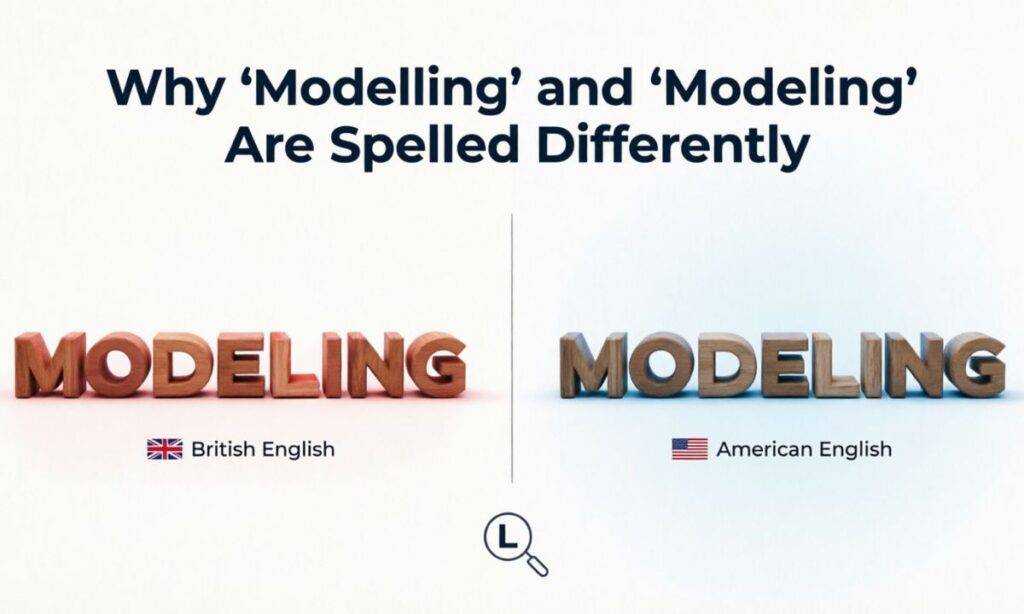
Why “Modelling” and “Modeling” Are Spelled Differently
Read This: Atleast or At Least: Which One Is Correct in 2026?
The root word is “model,” which comes from the Latin modulus, meaning a small measure or pattern. When English speakers began adding the suffix “ing” to form the present participle, the two regional spelling systems diverged.
British English Tendency
British English follows a rule that requires doubling the final consonant of a verb before adding a vowel suffix like “ing” or “ed,” whenever the verb ends in a single vowel followed by a single consonant. “Model” ends in a vowel (“e”) followed by a consonant (“l”), so British English doubles the “l” to produce modelling and modelled.
This same logic explains why British English gives us “travelling,” “labelling,” “cancelled,” and “signalling.”
American English Simplification
American English applies a different rule. It only doubles the final consonant when the last syllable of the verb carries the stress. In the word “model,” the stress falls on the first syllable (“MOD-el”), not the last. Because the final syllable is unstressed, American English does not double the “l,” giving us modeling and modeled.
This is not carelessness on the part of American writers. It is a deliberate, rule-based simplification that applies consistently across hundreds of words.
Modelling vs Modeling Grammar
From a grammatical standpoint, modelling vs modeling is not a debate at all. Both forms function identically in sentences.
- A present participle (verb form): “She is modeling for the agency.”
- A gerund (noun form): “Modeling requires patience and discipline.”
- A modifier: “The modeling agency signed three new clients.”
The grammar does not change. The structure does not change. The only thing that changes is the number of “l” letters in the middle of the word. When you see modelling vs modeling side by side, you are looking at two versions of the same grammatical unit.
Modelling vs Modeling Spelling
The spelling difference is simple and consistent:
- Modeling: one “l” before the suffix “ing”
- Modelling: two “l” letters before the suffix “ing”
This same pattern applies to the past tense forms:
- Modeled (American) vs Modelled (British)
And to the noun form for a person who models:
- Modeler (American) vs Modeller (British)
When you understand that modelling vs modeling follows the same pattern as “traveling vs travelling” and “labeled vs labelled,” the rule becomes easy to remember and apply.
The Core Meaning of Modeling or Modelling
Regardless of which spelling you use, the word covers a wide range of activities across very different industries. Understanding these meanings helps you use the word with confidence in any professional or academic context.
Fashion and Runway Modeling
This is the most widely recognized meaning. A fashion model displays clothing, accessories, or products by wearing or presenting them in front of an audience, camera, or photographer. Whether someone is modeling in New York or modelling in London, the job description is identical.
3D Modeling in Technology
In the technology and design industries, modeling refers to creating three-dimensional digital representations of objects. Game designers, architects, animators, and product designers all rely on 3D modeling software to bring concepts to life before they are built or produced.
Mathematical and Scientific Modeling
Scientists use modeling to create abstract representations of real-world systems. Climate researchers build climate models to simulate the effects of greenhouse gases. Epidemiologists use disease models to predict the spread of infections. Engineers use structural models to test whether bridges and buildings will hold under stress.
Behavioral Modeling in Psychology
In psychology and education, modeling refers to demonstrating a behavior so that others can observe and replicate it. Parents model language for young children. Teachers model problem-solving strategies for students. Therapists use behavioral modeling to help clients develop healthier patterns of thinking and action.
Modeling or Modelling in Machine Learning
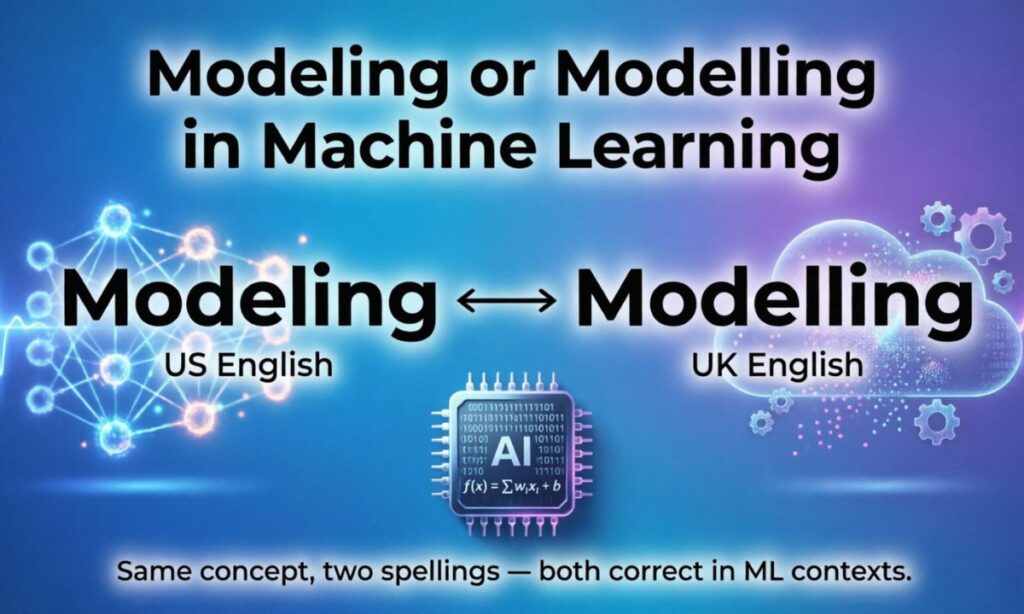
This is one of the most searched variations of modelling vs modeling in 2026, and for good reason. The fields of artificial intelligence, data science, and machine learning have expanded massively, and the modelling vs modeling terminology question comes up constantly in research papers, tools, and documentation.
In machine learning, modeling (or modelling) refers to the process of building algorithms and statistical structures that learn from data to make predictions or decisions. The spelling used depends on the origin of the publication or tool:
- American platforms and papers such as those published by Google, OpenAI, and most US-based universities tend to use modeling.
- British and European journals, institutions, and publications tend to use modelling.
Both forms are fully accepted in the field. When writing for an international technical audience, the safest approach is to choose one form and apply it uniformly throughout your paper, report, or documentation.
Modeling vs Modelling by Region
American English (Modeling)
In the United States, “modeling” with a single “l” is the universal standard. It appears in:
- All major American style guides including APA and Chicago
- US academic journals and university publications
- American media, fashion publications, and advertising
- US-based technology companies and software documentation
British English (Modelling)
In the United Kingdom and most Commonwealth countries, “modelling” with a double “l” is the standard form. It appears in:
- UK academic journals and research papers
- British fashion, television, and media
- Australian, Canadian, New Zealand, and Indian English publications
- European Union documents written in English
Global Usage Comparison
| Region | Preferred Spelling |
| United States | Modeling |
| United Kingdom | Modelling |
| Canada | Modelling (with some American influence) |
| Australia | Modelling |
| New Zealand | Modelling |
| India | Modelling |
| South Africa | Modelling |
| International/Mixed Audience | Either (be consistent) |
Is “Modelling” Wrong in the United States?
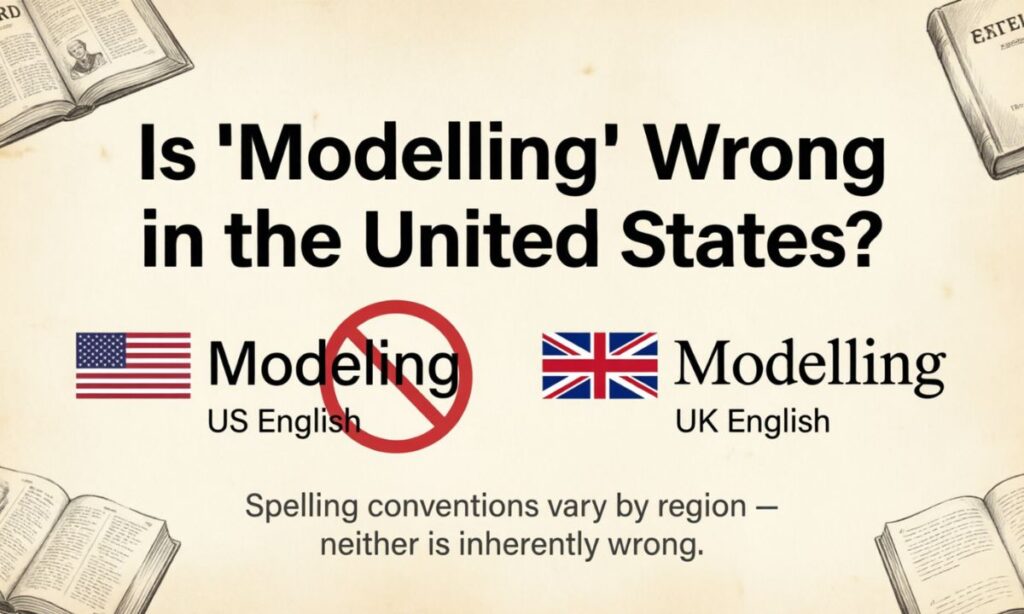
This is a fair question. If you are an American writer and you type “modelling,” is that an error?
Technically, no. Most American dictionaries and style guides acknowledge “modelling” as an alternate spelling. It will not be flagged as a spelling error in most professional contexts. However, it is non-standard for American audiences and may appear unusual to American readers who are accustomed to seeing “modeling.”
What Actually Happens
American editors will often flag “modelling” as a deviation from house style. Academic papers submitted to American journals will typically be corrected to “modeling” during the editing process. In casual writing, it is unlikely to cause any real confusion or concern.
Simple Rule
If you are writing for an American audience, use modeling. If you are writing for a British or Commonwealth audience, use modelling. If your audience is global, pick one at the start and do not switch between them within the same piece of work.
Industry Breakdown: Where Each Spelling Dominates
Understanding where modelling vs modeling is most commonly used across industries can help you make faster decisions in your own writing., and both spellings appear freely depending on the geographic origin of the publication. American Vogue, WWD, and US-based agencies use modeling. British Vogue, Harper’s Bazaar UK, and London-based agencies use modelling. Neither is considered incorrect in a global fashion context.
Technology and Software
Most major technology companies are headquartered in the United States, so modeling dominates in software documentation, API references, and technical writing. Tools like those from Google, Amazon, and Microsoft use modeling as the default. However, European tech companies and open-source projects with global contributor bases often use modelling.
Academic Writing
Academic usage follows the institutional location. American universities and their publications use modeling. British and Commonwealth universities use modelling. If you are submitting a paper, check the journal’s author guidelines. Most journals specify which English variant they require.
Engineering and Data Science
This is where modelling vs modeling becomes especially important. Engineers writing for international standards bodies, including ISO and IEC, often use modelling because these organizations follow British English conventions. Data scientists writing for US-based platforms and publications use modeling. Again, consistency within a document is more important than the choice itself.
Grammar Rules Behind the Difference
British Rule: Double Consonants
British English doubles the final consonant of a verb before adding a vowel suffix, regardless of where the stress falls in the word. This applies when the verb ends in a single vowel and a single consonant.
Examples:
- model + ing = modelling
- travel + ing = travelling
- label + ing = labelling
- signal + ing = signalling
- cancel + ed = cancelled
American Rule: Simplified Spelling
American English only doubles the final consonant when the stress falls on the last syllable of the verb. When stress falls on an earlier syllable, the consonant stays single.
Examples:
- model + ing = modeling (stress on MOD, not el)
- travel + ing = traveling (stress on TRAV, not el)
- label + ing = labeling (stress on LA, not bel)
- signal + ing = signaling (stress on SIG, not nal)
“MOdel” has stress on the first syllable. American English therefore keeps the single “l.”
Simple Comparison Table
| Form | British Spelling | American Spelling |
| Present participle | Modelling | Modeling |
| Past tense | Modelled | Modeled |
| Person who models | Modeller | Modeler |
| Noun (process) | Modelling | Modeling |
How Pronunciation Works?
This is one area where modelling vs modeling creates zero confusion. Both words are pronounced exactly the same way in every English dialect. The modelling vs modeling spelling difference is purely visual and has no effect on sound.
MOD-el-ing
Three syllables. Stress on the first. The number of “l” letters on the page does not affect how the word sounds out loud. A British speaker saying “modelling” and an American speaker saying “modeling” are producing the same sounds. The difference is purely visual and textual.
Which One Should You Use?
Use “Modeling” if:
- You are writing for an American audience
- You are submitting work to a US-based publication or institution
- You are following American style guides such as APA, Chicago, or AP
- Your company or organization operates primarily in the United States
- Your software, platform, or tool is US-based
Use “Modelling” if:
- You are writing for a British, Australian, Canadian, or Commonwealth audience
- You are submitting work to a UK or European publication or institution
- You are following British style conventions
- Your organization operates in the UK or another Commonwealth country
- The document will be published under British English standards
Golden Rule
Choose one spelling at the start of your project and use it every single time. The biggest mistake writers make is not picking the wrong version. It is switching between both versions within the same document. That inconsistency looks unprofessional regardless of your audience.
Real-World Examples in Sentences
American English Examples
- “She has been modeling for the same agency for six years.”
- “The engineering team spent weeks modeling the structural load of the new bridge.”
- “Financial modeling is a core skill for any investment analyst.”
- “The AI system uses predictive modeling to detect fraud in real time.”
- “3D modeling software has transformed the way architects present their designs.”
British English Examples
- “She has been modelling for the same agency for six years.”
- “The engineering team spent weeks modelling the structural load of the new bridge.”
- “Financial modelling is a core skill for any investment analyst.”
- “The AI system uses predictive modelling to detect fraud in real time.”
- “3D modelling software has transformed the way architects present their designs.”
Notice that every sentence above is identical except for the presence or absence of the second “l.” This is the entire practical difference between modelling vs modeling in everyday writing.
Common Mistakes People Make
Mixing Both Spellings
The most common error writers make when dealing with modelling vs modeling is not using the wrong regional form. It is using both forms in the same document. A writer might start with “modeling” in the introduction and accidentally type “modelling” three paragraphs later. This inconsistency signals a lack of attention to detail and can confuse readers who are sensitive to language conventions.
Fix: Do a simple search for both spellings once you finish writing. Pick the appropriate form and change all instances to match.
Assuming One Is Incorrect
Many writers, particularly those who learned one form in school, assume the other form is simply wrong. This is a common misconception about modelling vs modeling. American writers sometimes think “modelling” is a typo. British writers sometimes think “modeling” looks incomplete. In reality, both forms of modelling vs modeling are correct within their own systems.
Fix: Accept that both spellings are valid. Adjust your choice based on your audience, not personal habit.
Ignoring Audience
Some writers choose a spelling based on what they were taught rather than considering who will read their work. A British writer contributing to an American publication should use “modeling” even if “modelling” feels more natural to them.
Fix: Always identify your audience before you begin writing. Make the spelling decision early and treat it as part of your style choices for that particular document.
Read This: Girlie or Girly: Which One Is Correct in 2026?
Conclusion
The debate around modelling vs modeling is one of the clearest examples of how English adapts to geography. Two forms of the same word, both correct, both widely used, each reflecting a distinct and legitimate spelling tradition. Writers who understand modelling vs modeling at this level never second-guess themselves again.
Modeling belongs to American English. Modelling belongs to British English and the Commonwealth. Both carry identical meanings across fashion, technology, science, psychology, data science, and every other field where the word appears.
The real takeaway from understanding modelling vs modeling is this: the spelling is not about correctness in absolute terms. It is about appropriateness for your audience and consistency within your writing. Get those two things right, and you will never need to second-guess this word again.
Whether you are building a career in fashion, writing a machine learning paper, designing 3D environments, or crafting a business report, the answer to modelling vs modeling is simply: know your audience, choose one, and stick to it. Every major style guide, dictionary, and grammar authority agrees that modelling vs modeling is purely a regional choice and not a question of one being superior to the other.
Frequently Asked Questions
Is “modelling” or “modeling” correct?
Both are correct. “Modeling” is the American English spelling. “Modelling” is the British English spelling.
Which spelling do most countries use?
Most countries outside the United States, including the UK, Australia, Canada, and New Zealand, use “modelling” with a double “l.”
Can I use “modelling” in an American document?
It will not be flagged as a formal error, but American style guides prefer “modeling,” so it is best to match your audience’s expectations.
Do “modeling” and “modelling” mean the same thing?
Yes, completely. The meaning is identical. The only difference is spelling based on regional English conventions.
Which spelling is used in machine learning?
American publications and platforms use “modeling.” British and European sources use “modelling.” Both are accepted in the global tech community.
Which form should I use for academic writing?
Follow the style guide of your target journal or institution. American institutions use “modeling.” British and Commonwealth institutions use “modelling.”
Why does British English double the “l”?
British English doubles the final consonant before adding a vowel suffix, regardless of where stress falls in the word. American English only doubles the consonant when the final syllable is stressed.

Welcome to MeaningDeck! I’m Alex, an AI-Powered SEO, and Content Writer with 2 years of experience.
I help websites rank higher, grow traffic, and look amazing. My goal is to make SEO and web design simple and effective for everyone.
Let’s achieve more together!