
If you have ever typed boney or bony and then stopped to second guess yourself, you are not alone. Both spellings look reasonable, both sound identical when spoken aloud, and both show up across the internet, which makes the confusion completely understandable.
This guide settles the boney or bony question once and for all. You will learn the correct spelling, the meaning behind the word, where it comes from, how it is used in real sentences, and the small rule that explains why one form became standard while the other faded into informal use.
Boney
Boney is a variant spelling that occasionally appears in older texts, casual writing, and proper nouns such as surnames or place names. It is not the standard form used in modern dictionaries or professional writing.
Bony
Bony is the standard, dictionary approved spelling used in formal writing, journalism, academic work, and everyday communication. It describes something thin, full of visible bones, or skeletal in appearance.
Boney or bony meaning
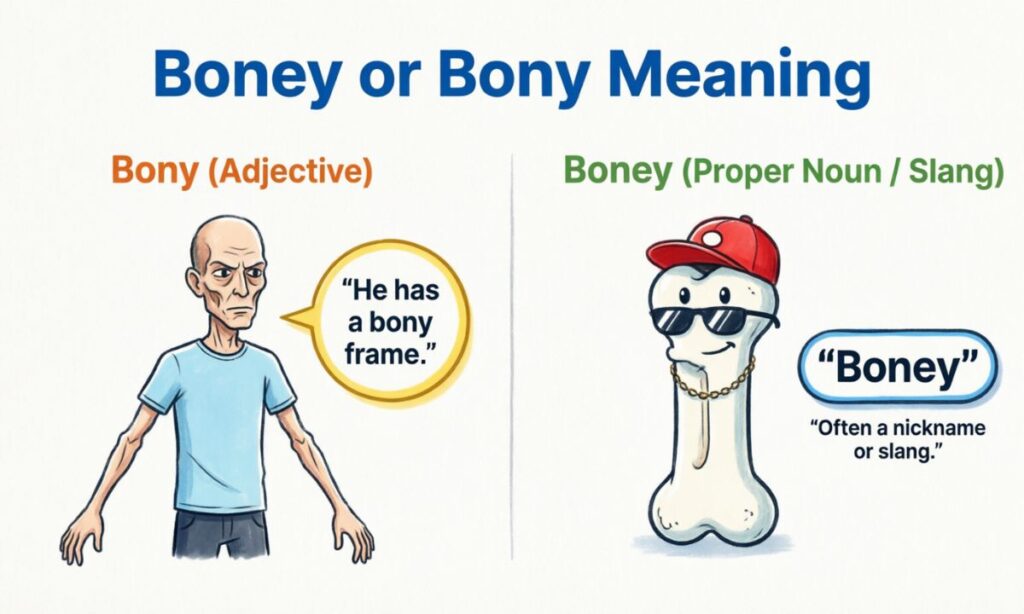
Both spellings carry the same basic meaning: having prominent bones, looking very thin, or containing many bones, such as a fish. The meaning does not change between the two forms. Only the level of acceptance changes, since bony is recognized everywhere while boney is treated as an occasional variant.
Typical meanings include:
- Describing a person with a thin, angular body
- Describing a fish or piece of meat with many bones
- Describing fingers, knees, or shoulders that appear sharp or prominent
- Used figuratively to describe something stripped down or lacking substance
Boney or bony synonym
Since both words share the same meaning, they also share the same list of synonyms. Useful alternatives include:
- Skinny
- Gaunt
- Skeletal
- Angular
- Lean
- Emaciated
- Spindly
Choosing a synonym depends on tone. Skinny feels casual, gaunt feels more serious or even concerning, and angular feels descriptive rather than judgmental.
Bony slang meaning
In informal slang, bony is sometimes used as a lighthearted or affectionate way to describe someone who is very thin, often without any negative intent. It can also appear in casual nicknames or playful teasing among friends. This slang usage stays close to the dictionary meaning, just delivered in a more relaxed tone. Boney rarely appears in slang contexts, since bony is the spelling most casual writers default to as well.
Read This: Griefing vs Grieving: What’s the Real Difference?
Boney or Bony: Quick Answer
Bony is correct. Boney is considered a nonstandard or outdated variant. When you are unsure which form to use in any sentence, bony is always the safer and more professional choice.
| Question | Answer |
| Which spelling is correct? | Bony |
| Is boney wrong? | It is a variant, not the standard form |
| Used in formal writing? | Bony only |
| Same meaning? | Yes, identical meaning |
The Origin of Boney vs Bony
The word traces back to the Old English term bān, meaning bone. As English developed, the noun bone gained a descriptive suffix to form an adjective. Bony follows the common English pattern where a silent e is dropped before adding the suffix y, similar to how stone becomes stony and shine becomes shiny.
Boney developed later as an alternate spelling, likely influenced by pronunciation rather than spelling logic. Since English allows both ey and y endings to create adjectives in some cases, boney persisted in scattered usage even though it never became the standard.
Here is the simple rule that explains the correct spelling:
- Start with the base noun: bone
- Drop the silent e at the end
- Add the suffix y
- Result: bony
This pattern matches dozens of similar English words, which is exactly why bony, not boney, became the form taught in schools and used in dictionaries.
British English vs American English Spelling
Many spelling debates exist because British and American English disagree, similar to colour versus color. That is not the case here.
| Spelling Aspect | British English | American English |
| Standard word | bony | bony |
| Variant seen occasionally | boney | boney |
| Use in formal writing | bony only | bony only |
| Pronunciation | identical | identical |
Both versions of English treat bony as the correct and expected spelling, with boney remaining a rare variant in either region.
Bony in a sentence
Seeing the word in context makes correct usage easier to remember.
- Her bony fingers gripped the railing tightly.
- The cat looked thin and bony after weeks outdoors.
- This fish is delicious but very bony.
- His bony shoulders were visible through the thin shirt.
- The horse had grown bony from lack of proper feeding.
- She joked about her bony knees during the photoshoot.
Which Spelling Should You Use?
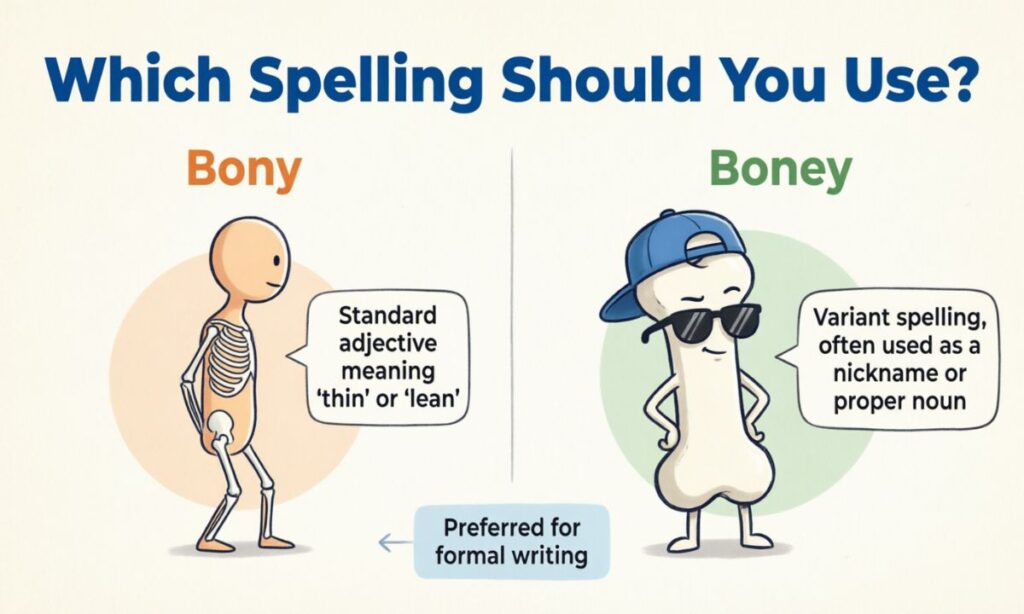
Always choose bony for the following situations:
- Academic essays and research papers
- Business emails and professional documents
- News articles and journalism
- Blog posts and website content
- Social media captions meant for a wide audience
Boney may appear acceptable only in very specific contexts, such as quoting historical text, referencing a surname, or recreating a deliberately old fashioned tone in creative writing. Outside those narrow cases, bony remains the better and safer option.
Common Mistakes with Bony or Boney
❌ Frequent Errors
- Writing boney because it visually resembles words like money or honey
- Assuming both spellings are equally accepted in professional writing
- Using boney in essays or resumes without realizing it looks nonstandard
- Mixing up boney with bonny, a completely different word meaning attractive or healthy looking
- Believing British English prefers boney, which is not accurate
✅ Correct Usage
- Always default to bony unless quoting older text
- Remember the rule: drop the e, add y
- Double check spelling in formal documents before submitting
- Use bony consistently throughout a single piece of writing
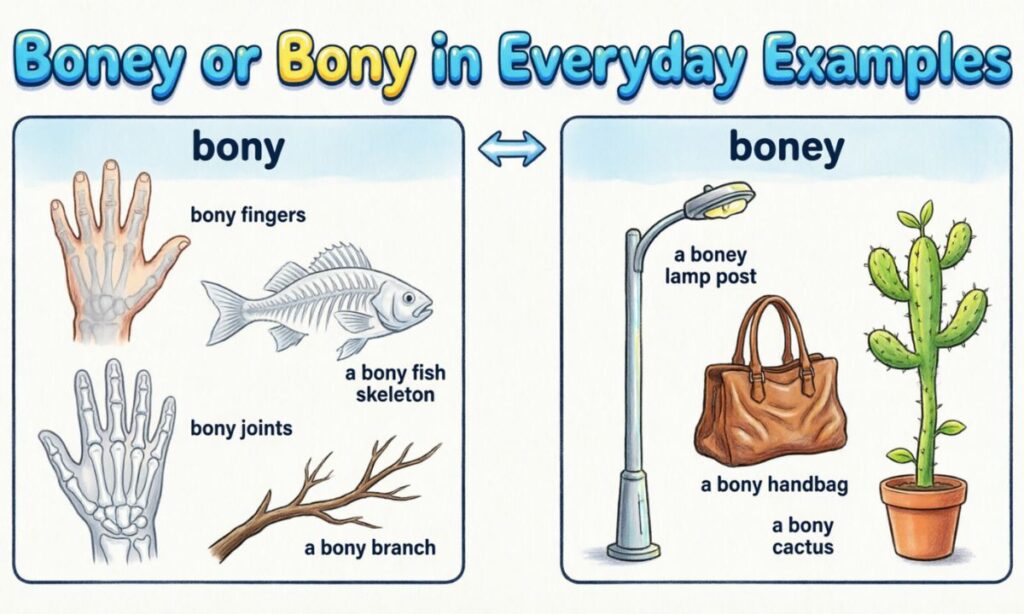
Boney or Bony in Everyday Examples
📧 Emails
A professional email referencing health, fitness, or food should always use bony. Example: The fish you ordered was excellent but slightly bony.
📰 News
Journalists consistently choose bony when describing physical appearance or skeletal structure in articles, interviews, or feature stories.
📱 Social Media
Casual posts often default to bony as well, even in quick captions or comments, since it remains the more familiar spelling to most readers.
📄 Formal Writing
Academic papers, reports, and official documents should never use boney. Bony is the only acceptable choice in formal contexts.
Boney or Bony: Google Trends and Usage Data
Search and usage data consistently show bony receiving far higher search volume and far more appearances in published writing than boney. Most queries involving boney come from people trying to confirm whether the spelling is correct, rather than people intentionally choosing it. This pattern holds steady across the United States, the United Kingdom, India, Pakistan, and Australia, confirming that bony is the globally recognized standard while boney remains a minor variant.
Comparison Table: Boney vs Bony
| Feature | Boney | Bony |
| Dictionary standard | No | Yes |
| Formal writing | Avoid | Use |
| Common in modern usage | Rare | Very common |
| Found in proper nouns | Sometimes | Rarely |
| Pronunciation | Same | Same |
| Recommended choice | No | Yes |
Read This: 12th or 12nd? Which Ordinal Number Is Correct? (2026)
Final Thoughts
The boney or bony debate has a clear winner. Bony is the correct, standard, and widely accepted spelling across British and American English alike, while boney remains a rare variant best reserved for proper nouns or deliberately old fashioned writing. The rule behind the correct spelling is simple: drop the silent e from bone, then add y, just like stone becomes stony.
Whether you are writing a business email, a school assignment, a news article, or a casual social media post, choosing bony will always keep your writing clear, professional, and easy to trust. The next time the boney or bony question comes up, you can answer with confidence: bony is correct.
Frequently Asked Questions
Is boney a real word?
It exists as a rare variant spelling, but it is not the standard form.
Which spelling is correct, boney or bony?
Bony is the correct and widely accepted spelling.
Do boney and bony mean the same thing?
Yes, both describe something thin or full of visible bones.
Is boney used in British English?
Rarely, since British English also prefers bony.
Why do people write boney by mistake?
It visually resembles words like honey and money, leading to confusion.
Can boney be used in formal writing?
No, formal writing should always use bony.
Is bony only used to describe people?
No, it also describes fish, meat, and other objects with prominent bones.
Does pronunciation differ between the two spellings?
No, both are pronounced exactly the same way.
Is boney sometimes correct in names?
Yes, it can appear correctly in surnames or place names.
Should I use bony in a resume or report?
Yes, bony is the appropriate and professional spelling to use.

Welcome to MeaningDeck! I’m Alex, an AI-Powered SEO, and Content Writer with 2 years of experience.
I help websites rank higher, grow traffic, and look amazing. My goal is to make SEO and web design simple and effective for everyone.
Let’s achieve more together!