

You get a buzz on your phone. The screen says “New SMS.” Most people tap it without thinking about what the word stands for. If you want the full SMS meaning with simple examples, a bit of history, and safety tips, this guide covers it in plain words.
Quick Answer:
SMS stands for Short Message Service. It is the standard text message that travels through your mobile carrier’s network, not the internet. One SMS holds up to 160 characters of plain text. That is the SMS meaning in one line.
What Does SMS Mean in Text?
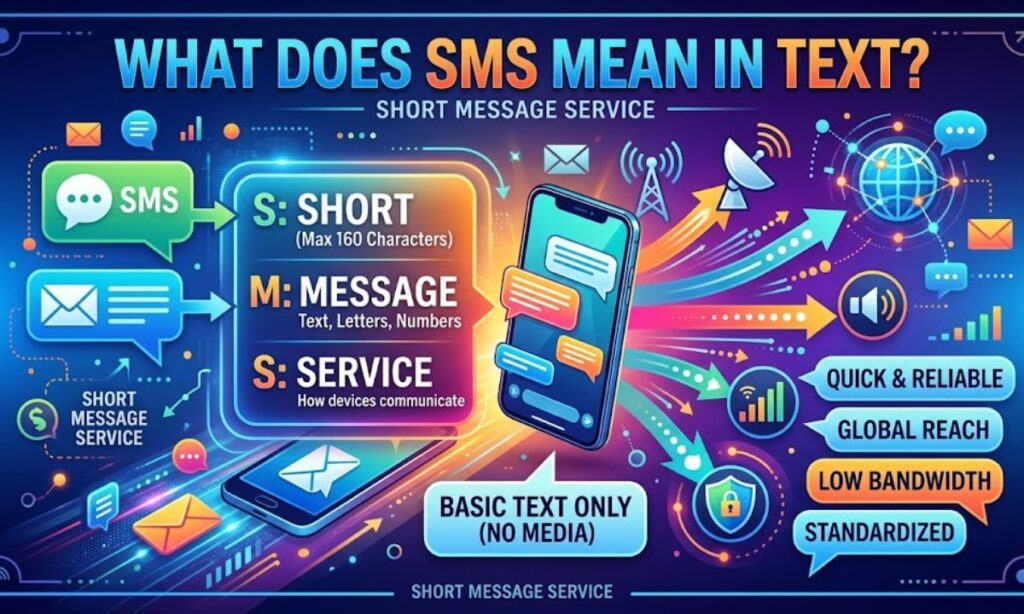
In text, SMS means Short Message Service. It is the basic texting system built into every mobile phone. When you type a message, enter a phone number, and send it without a chat app, you are sending an SMS.
The SMS meaning stays the same on iPhone, Android, and old keypad phones. It also works without mobile data, because your carrier handles delivery through its regular signal.
What makes SMS different from chat apps:
- It uses your phone number, not a username
- It needs only a cellular signal
- It carries plain text with a 160 character limit
- The other person does not need to install anything
sms meaning in text slang
In slang, people use “SMS” as a casual word for “text.” If someone says “SMS me later,” they want a text, not a call.
| Slang Use | Meaning | Tone |
|---|---|---|
| SMS me | Text me | Neutral |
| SMS | Send Me Something | Joking |
| SMS | Send My Shooters | Violent, avoid |
The second one shows up when friends joke about getting snacks. The third has dark roots in internet culture, so do not use it casually. Check the full chat before you reply to it.
What Is the SMS Full Form?
The SMS full form is Short Message Service. Phone companies, dictionaries, and tech writers all use this name. In daily talk, people say an SMS, a text, or a text message.
What Does SMS Stand For?
SMS stands for three simple words:
- S for Short, because messages are brief
- M for Message, because it carries written information
- S for Service, because carriers provide it as a built in feature
Is SMS Rude, Offensive, or Neutral?
SMS is neutral. It is a technical term, like “email” or “call.” Nobody takes offense when you say it.
The only exception is the slang “Send My Shooters,” which is tied to violence. In normal use, like “I will send you an SMS,” the tone is safe even at work or school.
SMS meaning in text from a girl
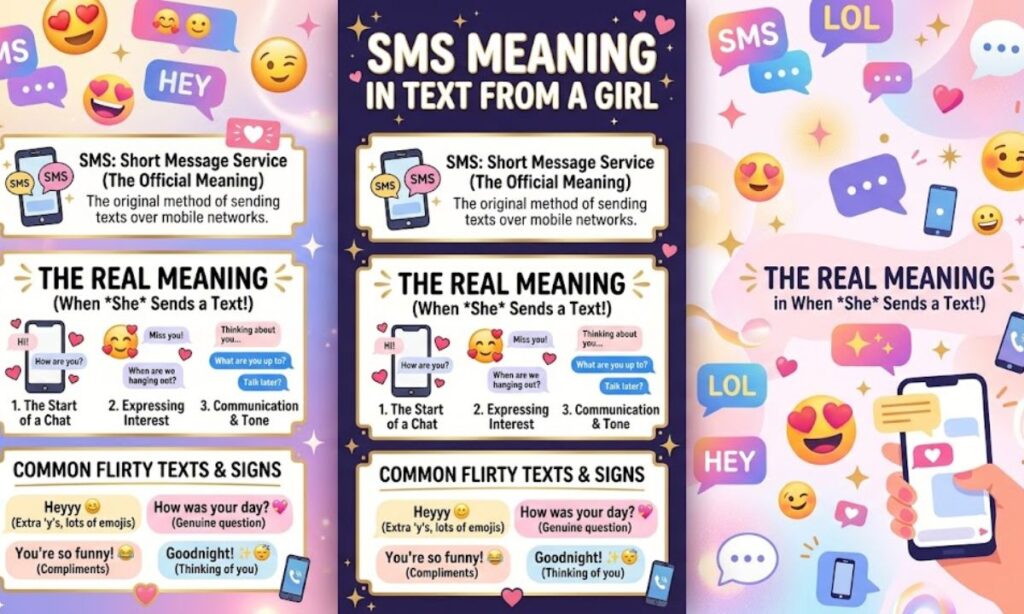
If a girl writes “SMS me” or “drop me an SMS,” she is asking for a text message. It is usually a polite and casual request, not a secret code.
- If she says it after a call, she wants the details in writing
- If she says it at night, she may prefer texting to talking
- If it comes with a smiley, the tone is friendly
The SMS meaning here depends on the mood, not the letters. When unsure, send a quick text and ask.
Where Is SMS Commonly Used?
Banks, shops, schools, and friends still depend on SMS because it reaches almost every phone. The SMS meaning is simple, but its uses are wide.
Personal Communication
Friends and family send SMS when they do not share the same chat app. It works with any phone number.
Verification Codes
Many apps send a one time passcode by SMS to confirm your login. These codes expire within minutes.
Banking Alerts
Banks send SMS for card spending, balance updates, and suspicious activity. It is fast, even with weak internet.
Appointment Reminders
Clinics and salons send short reminders so you do not miss your slot. Many let you reply with one word to confirm.
Delivery Notifications
Couriers send tracking updates and delivery windows by SMS. They are short and useful.
Marketing Messages
Brands send offers and discount codes. This works because most people open a text within minutes.
Real-Life Examples of SMS Usage
Examples make the SMS meaning easier to see.
Friendly Example
“Hey, running ten minutes late. Save me a seat!”
Casual Example
“SMS me the address and I will find it.”
Here SMS works as a verb meaning “text me.”
Business Example
“Your appointment is confirmed for Friday at 4 PM. Reply YES to confirm.”
Security Example
“Your verification code is 482913. Do not share this code with anyone.”
Never share these codes, even if the sender claims to be support.
Social Media Example
“Check your SMS to finish signing in.”
Platforms often use SMS to confirm accounts or reset passwords.
Origin and Background of SMS
The SMS meaning goes back to a very small moment. The first SMS was sent on December 3, 1992. Engineer Neil Papworth sent the words “Merry Christmas” to a Vodafone director in the United Kingdom. The idea grew from the GSM standard built for European mobile networks.
The 160 character limit came from Friedhelm Hillebrand, who studied postcards and short notes and found most fit inside that length. This limit shaped texting habits, and it is why shortcuts like “gr8” and “brb” became popular.
SMS vs Text Message
In daily life, they mean the same thing. Anyone searching for the SMS meaning will find both words used for one idea.
| Feature | SMS | Text Message |
|---|---|---|
| Style | Technical term | Casual term |
| Delivery | Carrier network | Usually carrier network |
| Common use | Business, tech writing | Daily chats |
One detail: on a smartphone, a “text message” may travel through iMessage or RCS. A true SMS always uses the carrier’s basic system.
SMS vs MMS
MMS stands for Multimedia Messaging Service. The SMS meaning covers plain text only, while MMS carries more.
| Feature | SMS | MMS |
|---|---|---|
| Content | Plain text | Text, images, video, audio |
| Length | 160 characters | Much longer |
| Data needed | No | Often yes |
If your message has only words, it is an SMS. Add a photo and it usually becomes an MMS.
SMS vs iMessage and Other Chat Services
iMessage, WhatsApp, Telegram, and Signal use the internet. SMS uses your carrier network.
| Feature | SMS | Chat Apps |
|---|---|---|
| Needs internet | No | Yes |
| Needs same app | No | Yes |
| Encryption | Limited | Often strong |
On an iPhone, SMS shows in green bubbles and iMessage in blue. Chat apps offer more features, but SMS wins on reach.
When Should You Use SMS?
Once you know the SMS meaning, the best use cases are clear:
- The other person does not use your chat app
- Your internet is weak
- You need a short alert or reminder
- You are sending a verification code or official notice
When Should You Avoid SMS?
- Private details, because SMS is not strongly encrypted
- Large files or photos, where chat apps work better
- Long group conversations
- International messages, which may cost extra on some plans
Why Do People Use the Term SMS?
It is short, easy to say, and used in official language by carriers and businesses. It also separates a carrier text from a chat app message. In countries like Pakistan, India, and the UK, many people still say “SMS” more than “text,” which keeps the SMS meaning in daily use.
Impact of SMS on Communication
SMS made quick, low cost messaging possible for everyone, even people without smartphones. It pushed people toward short, direct sentences, and that style carried into every chat app. For businesses, it opened a direct line to customers for alerts, receipts, and offers.
Check out: What Does IMK Mean in Text? (Full Guide & Examples)
Is SMS Safe for Social Media?
The SMS meaning is harmless, but safety needs care. SMS is fine for simple tasks like account verification, but it has limits. Texts can be targeted by SIM swap scams.
- Never share your verification code
- Do not click unknown links
- Use an authenticator app when offered
- Report any message that asks for money or passwords
SMS Meaning in Different Contexts
| Context | What SMS Means |
|---|---|
| Phones and carriers | Short Message Service |
| Business | Customer text messaging |
| Banking | Alert and security notices |
| Online slang | Text me, or Send Me Something |
Nearly every time, the SMS meaning points to a plain text message.
Common Mistakes About SMS
- Thinking SMS needs internet. It runs on the cellular network.
- Mixing up SMS and iMessage. They are different services.
- Believing SMS is fully private. It is not strongly encrypted.
- Calling every picture text an SMS. Pictures make it an MMS.
- Sharing OTP codes. No real company asks for them.
FAQs:
What does SMS stand for?
Short Message Service, the standard text message sent over a mobile network.
Is SMS the same as a text message?
Yes, in daily use. SMS is just the technical name.
How many characters can one SMS hold?
Up to 160 characters of plain text. Longer texts are split into parts.
Does SMS need internet?
No. It works on your carrier’s cellular signal.
What is the difference between SMS and MMS?
SMS carries plain text only, while MMS can include images, video, and audio.
What is the SMS meaning in simple words?
It is a short text sent through your phone carrier.
What does SMS me mean?
It means “text me,” a casual request for a text message.
Conclusion
The SMS meaning is easy once you break it down. It stands for Short Message Service, and it is the simple text message that works on every mobile phone. It is neutral, widely used, and still key for banking alerts, verification codes, reminders, and daily chats.
Now you know where SMS came from, how it differs from MMS and iMessage, and when to use it or skip it. Use it for short, reliable messages and keep private details for safer apps. With the SMS meaning clear, you can read any notification with confidence.

Welcome to MeaningDeck! I’m Alex, an AI-Powered SEO, and Content Writer with 2 years of experience.
I help websites rank higher, grow traffic, and look amazing. My goal is to make SEO and web design simple and effective for everyone.
Let’s achieve more together!