
Zionist meaning is simple on paper. A Zionist is a person who supports Zionism, the movement for a Jewish national homeland in the land of Israel.
In real life, the word carries much more weight. People use it as a label, a political position, a religious belief, and sometimes as an insult.
This guide explains what the word means, where it came from, and how to read it in different situations. It stays factual, so you can understand the term whatever your own view is.
What Does Zionist Mean?
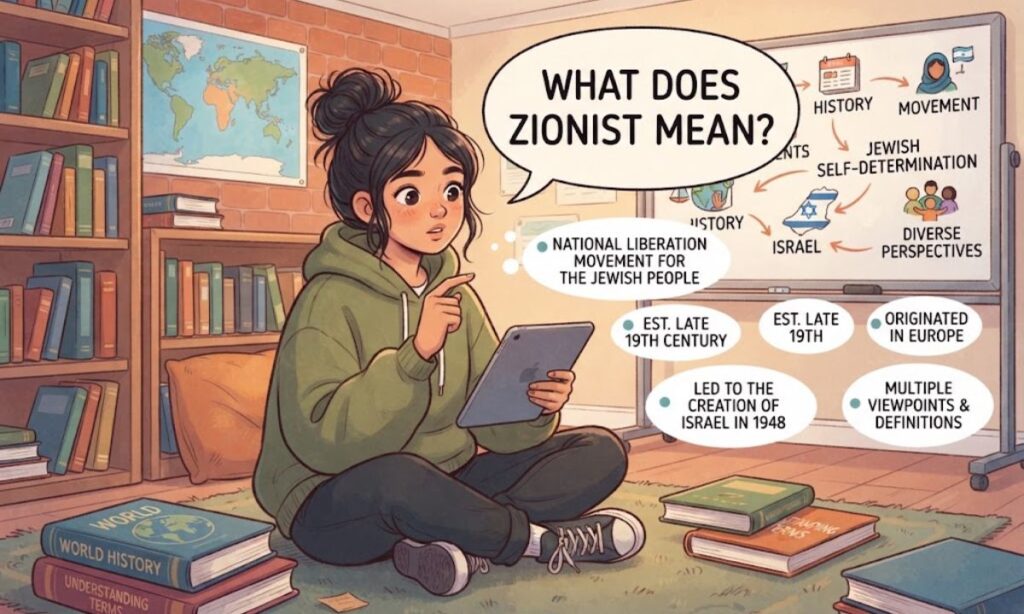
A Zionist is someone who believes in Zionism. As an adjective, “Zionist” describes anything related to that movement, such as a Zionist leader or the Zionist movement.
Major dictionaries agree on the core idea. Collins defines a Zionist as a believer in Zionism. Cambridge adds that the movement began with the aim of creating a country for Jewish people and now supports the state of Israel.
| Form | Meaning | Example |
| Noun | A person who supports Zionism | She is a lifelong Zionist. |
| Adjective | Related to the Zionist movement | The Zionist congress met in 1897. |
The dictionary meaning is neutral. How people feel about the word is not.
zionist meaning in slang
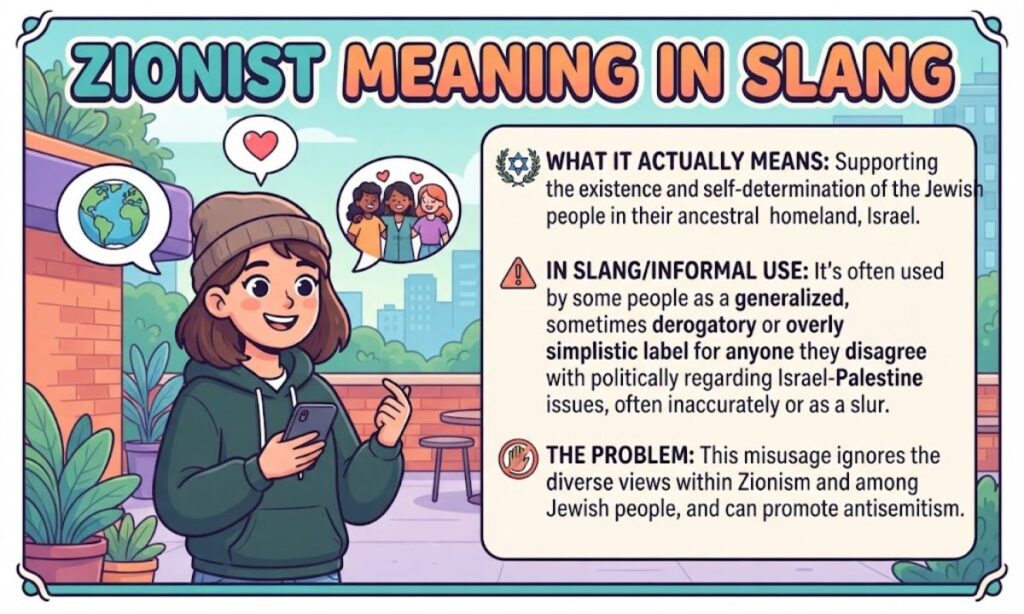
Zionist meaning in slang depends heavily on the speaker. Online, the word often appears in heated arguments, and its tone can change from one post to the next.
Some people use it as a plain label for supporters of Israel. Others use it as an insult or as shorthand for Israeli government policy. You may also see the short form “Zio”, which many Jewish organizations flag as derogatory.
There is a bigger concern too. Groups such as the American Jewish Committee and the Anne Frank House note that some people use “Zionist” as a coded replacement for “Jewish”. That is where the word crosses into antisemitism.
What Is the Zionist Meaning in Simple Terms?
Here is the Zionist meaning in simple terms:
- A Zionist supports a Jewish homeland in Israel.
- The word comes from “Zion”, a hill in Jerusalem.
- It describes a belief, not an ethnicity or a passport.
- People of many views can fit the label, from left to right.
Think of it like the word “nationalist”. The base meaning is clear, but the feelings attached to it vary a lot.
What Is Zionism?
Zionism is a national movement that grew in Europe in the late 1800s. It rose from centuries of persecution of Jews and from the wave of nationalism across Europe at that time.
Theodor Herzl helped turn the idea into an organized political movement. He led the First Zionist Congress in Basel in 1897. The state of Israel was declared in 1948.
Zionism is not one single doctrine. Its followers include secular, religious, socialist, and conservative Jews, plus many people who are not Jewish. They often disagree about borders, settlements, and peace with Palestinians.
Critics see it differently. Many Palestinians connect the creation of Israel with the loss of their homes in 1948, and they view the movement through that history.
Zionist Meaning in Different Contexts
The same word can land very differently depending on where you hear it. This is why the Zionist meaning confuses so many people.
| Context | What “Zionist” usually points to |
| Historical | A person building or backing a Jewish homeland |
| Political | A stance on Israel’s existence and policies |
| Social media | A label, a debate tag, or sometimes an insult |
| Religious | A belief tied to land, scripture, or prophecy |
Historical Context
In the early 1900s, a Zionist was someone working to create a Jewish homeland. The word was a proud political identity for many Jews, not a slur.
Later, in the Soviet Union, officials often used the word as an accusation. That shows how fast its tone can shift when politics changes.
Political Context
Today, supporters use the word to mean backing Israel’s right to exist as a Jewish state. Many add that they support debate on borders and a peaceful settlement.
Critics often use it to point at Israeli policy, settlements, or the occupation of Palestinian land.
Social Media Context
On social platforms, the word is short, loaded, and easy to throw into a quarrel. It can be a label people wear, a charge they make, or a coded jab.
Posts lack tone, so readers often assume the worst. Check who is talking and what they are aiming at.
Religious Context
For many religious Jews, the connection to the land is part of faith and history. Religious Zionism links the modern state with biblical promises.
Not every religious Jew agrees. Some ultra Orthodox groups have historically opposed Zionism on religious grounds.
How Context Changes the Meaning
Three questions help you decode the word:
- Who is speaking? A supporter, a critic, and a hateful troll all use it differently.
- What is the tone? Calm description, pride, anger, or mockery all point to different meanings.
- Who is the target? A movement is one thing. A whole group of people is another.
If the word is aimed at all Jews, it is no longer about the movement. It is a stereotype.
Zionist meaning in Chinese
In Chinese, a Zionist is called 犹太复国主义者 (Yóutài fùguó zhǔyì zhě) in Simplified Chinese and 猶太復國主義者 in Traditional Chinese. Cambridge lists both forms as translations.
An older, shorter term, 锡安主义 (Xī’ān zhǔyì), borrows directly from “Zion”.
| Term | Pronunciation | Meaning |
| 犹太复国主义者 | Yóutài fùguó zhǔyì zhě | Zionist (person) |
| 犹太复国主义 | Yóutài fùguó zhǔyì | Zionism |
| 锡安主义 | Xī’ān zhǔyì | Zionism (shorter form) |
The Chinese Zionist meaning mirrors the English one. It names the belief, and tone depends on context.
Christian Zionist meaning
Christian Zionist meaning refers to Christians who support the Jewish return to Israel and the state of Israel. Their reasons are usually religious, based on God’s covenant with Abraham in the Bible.
Many link this return to end times prophecy. The movement is strongest among evangelical Protestants, especially in the United States, and it has no single headquarters.
It also has critics. Churches in Jerusalem have called it a damaging ideology. Views inside the movement differ too, from friendship with Jewish people to prophecy focused politics.
Is Zionist the Same as Jewish or Israeli?
No. These three words overlap, but they are different things.
| Term | What it describes | Key point |
| Jewish | A religion, culture, or ethnic identity | Not every Jewish person is a Zionist |
| Israeli | A citizen of the state of Israel | About one in five citizens is Palestinian Arab |
| Zionist | A supporter of Zionism | Can be Jewish, Christian, or neither |
Using “Zionist” as a replacement for “Jewish” is a common mistake, and it is often seen as antisemitic.
Real Conversation Examples
1: Historical Discussion
Student: Was Herzl a Zionist?
Teacher: Yes. He is considered the founder of political Zionism and organized the first Zionist Congress in 1897.
Here the word is a neutral historical label.
2: Political Conversation
Person A: I am a Zionist, but I oppose the settlements.
Person B: Can you be both?
Person A: Yes. Zionism means support for a Jewish state. People inside the movement disagree about policy.
3: Social Media Argument
User 1: Zionists control everything.
User 2: Which Zionists? Whom do you mean?
The first comment is a red flag. It uses the word for a vague, powerful group, which matches an old antisemitic conspiracy pattern. The reply asks for clarity, which is the right move.
Is Zionist a Neutral or Offensive Word?
It can be either. Dictionary.com notes that the term can be neutral, positive, or offensive depending on use.
Quick test:
- Describing a political belief? Likely neutral.
- Aimed at all Jews or Israelis? Likely offensive.
- Paired with conspiracy claims? Very likely offensive.
Many people also use the word with pride, so check the intent behind it.
Is Zionist the Same as Supporting the Israeli Government?
No. Zionism is a belief about a Jewish homeland. A government is a temporary group of officials that voters can replace.
Scholars note that a person can be a Zionist without backing a particular government’s policies. Criticizing Israeli policy is not automatically antisemitic either. It becomes a problem when it uses stereotypes or targets Jewish people as a whole.
How to Respond When Someone Uses “Zionist”
Stay calm first. Then decide whether the person is describing, asking, or attacking. The Zionist meaning behind the word is only clear once you know which one it is.
Polite Clarification
“When you say Zionist, what do you mean exactly? I want to be sure I understand.”
If You Agree With the Label
“Yes, I am a Zionist. To me it means supporting a Jewish homeland, and I also care about fairness for everyone there.”
If You Disagree
“I do not use that label for myself. I see it differently, but I am happy to talk about why.”
You can reject a label without attacking the person. If the word is used as a slur, say so plainly and step away.
When to Use the Term
Use the word when it adds clarity. Knowing the Zionist meaning well helps in these cases:
- Teaching or writing history about the movement
- Describing a person who calls themselves a Zionist
- Discussing positions on Israel with precise language
When to Avoid the Term
Skip the word when it adds heat and no clarity:
- You mean “Jewish” or “Israeli”
- You are insulting someone
- You are talking about a group in a vague, sweeping way
- You are tempted to use “Zio”
If you mean a government or a policy, name it. “The Israeli government” is more accurate than “the Zionists”.
Common Mistakes About the Word Zionist
- Treating it as a synonym for Jewish. They are different words.
- Assuming every Israeli is a Zionist. Citizens hold many views.
- Assuming every Zionist backs the current government.
- Thinking it is always a slur. It is also a self chosen label.
- Thinking it is always harmless. In some posts it is a coded insult.
Similar Terms and Their Differences
| Term | Meaning |
| Zionism | The movement for a Jewish homeland in Israel |
| Christian Zionist | A Christian who supports Israel for religious reasons |
| Zio | A short, often derogatory form of Zionist |
| Critic of Zionism | Someone who opposes or questions the movement |
| Antisemitism | Hostility toward Jewish people as a group |
A critic of Zionism and an antisemite are not the same. Some critics are sincere, while others use criticism as cover for hatred. Context decides.
Origin and Historical Background
“Zion” is a Hebrew name tied to a hill in Jerusalem. It stands for the Jewish homeland in religion and history.
The words Zionism and Zionist are credited to Nathan Birnbaum in the early 1890s. Herzl published his case for a Jewish state in 1896, and the First Zionist Congress followed in 1897.
The Balfour Declaration of 1917 expressed British support for a Jewish national home in Palestine. The United Nations proposed partition in 1947, and Israel declared independence in 1948.
Quick Recap
- A Zionist supports Zionism, the movement for a Jewish homeland in Israel.
- The Zionist meaning shifts with speaker, tone, and target.
- Zionist is not the same as Jewish, Israeli, or pro government.
- The word can be neutral, proud, or offensive.
Frequently Asked Questions
What does Zionist mean in one line?
A Zionist is a person who supports a Jewish national homeland in Israel.
Is Zionist a bad word?
Not by definition. It becomes offensive when used as a slur or as code for Jews.
Can a person who is not Jewish be a Zionist?
Yes. Many Christians and others support Zionism.
Are all Jews Zionists?
No. Jewish people hold many views, and some do not identify as Zionists.
How do you say Zionist in Chinese?
It is 犹太复国主义者 (Yóutài fùguó zhǔyì zhě).
Final Thoughts
Zionist meaning looks small, but it carries history, faith, politics, and strong emotion. The safest habit is to ask what a speaker means before reacting.
Use the word with care, define it when needed, and never treat it as a stand in for Jewish people.
Did this clear things up? Share your questions in the comments, and pass the guide to someone who needs a calm explanation.

Welcome to MeaningDeck! I’m Alex, an AI-Powered SEO, and Content Writer with 2 years of experience.
I help websites rank higher, grow traffic, and look amazing. My goal is to make SEO and web design simple and effective for everyone.
Let’s achieve more together!