

If you have ever typed an email at work and stopped mid-sentence to wonder whether you wrote Manuel vs. Manual correctly, you already understand how genuinely confusing this pair can be. These two words look almost identical. One tiny letter at the end changes everything, from the meaning to the entire context of your sentence. Writers, students, bloggers, and professionals make this mistake regularly, and it happens across both British and American English.
This guide will break down the Manuel vs. Manual difference in plain, simple language. You will learn the exact definition of each word, see real sentence examples, understand the origins of both, and walk away able to use each one correctly without hesitation. Whether you are creating a user guide, writing a report, or simply trying to address someone properly in an email, this article gives you everything you need.
Definitions Of Manuel And Manual
Before diving into usage rules, it helps to understand exactly what each word means.
Manuel is a proper noun. It is a masculine given name used primarily in Spanish, Portuguese, and other Romance language cultures. It functions the same way any name does in English: it identifies a specific person and is always capitalized. Manuel does not have a definition in English dictionaries as a common vocabulary word because it is not one.
Manual, on the other hand, is a standard English word recognized in every major dictionary including Merriam-Webster, Oxford, and Collins. It serves as both a noun and an adjective. As a noun, it refers to a handbook, guide, or instructional document. As an adjective, it describes any task, process, or object operated or performed by hand rather than by machine.
The Manuel vs. Manual confusion arises because both words are spelled almost identically. One ends in “el” and one ends in “al,” but when read quickly, the difference is easy to miss.
Manual meaning
The word manual carries two core meanings depending on how it is used in a sentence.
As a noun: A manual is a document that explains how to operate, assemble, or use something. Think of the instruction booklet that comes with a new appliance, a vehicle owner’s guide, or a company policy handbook. All of these are manuals.
As an adjective: When manual describes something, it means that a human hand or physical effort is involved rather than automation. Manual labor, manual entry, and manual transmission all carry this meaning.
The word traces directly back to the Latin word “manus,” which means “hand.” That root connection explains both meanings perfectly: a manual (noun) is a handbook, something meant to be held in or referenced by hand, and manual (adjective) describes work done by hand.
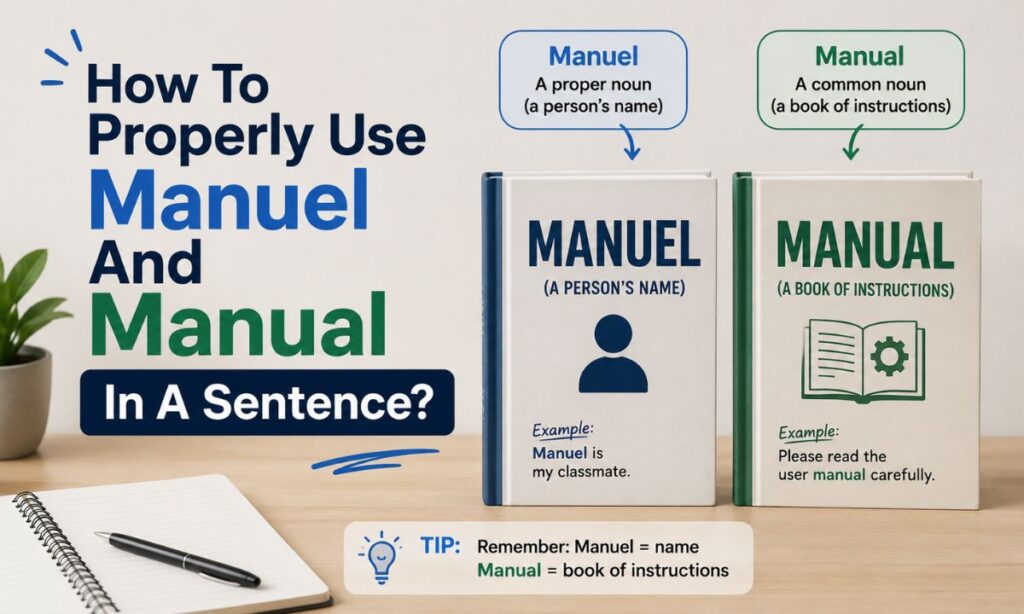
How To Properly Use Manuel And Manual In A Sentence?
Read This: Treck or Trek – Clear Up the Confusion Once and for All
Knowing the Manuel vs. Manual rule comes down to one simple question: are you referring to a person or to a document or hand-operated process?
Use Manuel when:
- You are addressing or referring to a specific person with that name.
- The name appears in a story, article, email, or caption.
- Always capitalize it since it is a proper noun.
Use Manual when:
- You are discussing an instruction guide, handbook, or user document.
- You are describing a task performed by hand rather than by machine.
- You are talking about a car with a manual transmission.
- The word is not capitalized unless it starts a sentence.
A helpful trick: if you can replace the word with “handbook” or “by hand” and the sentence still makes sense, you need manual. If you are talking about a person, you need Manuel.
Examples Of Manuel And Manual Use In Sentences
Reading words used in context is one of the most powerful ways to cement correct usage. Below are clear examples for both words in the Manuel vs. Manual pair.
Sentences using Manuel (the name):
- Manuel arrived early to set up the conference room.
- The project was assigned to Manuel because of his technical background.
- Our new team member is named Manuel, and he starts on Monday.
- Have you spoken to Manuel about the delivery schedule yet?
Sentences using Manual (the word):
- Please read the manual before attempting to install the software.
- The car comes with a six-speed manual transmission.
- All manual data entry should be completed before the system update.
- She found the instruction manual in the box along with the parts.
- The job requires significant manual labor and physical stamina.
Each of these examples shows how the Manuel vs. Manual distinction works naturally in everyday writing. The context makes the correct choice obvious every time.
Manuel or Manual: What’s the Real Difference 2026
In 2026, clear written communication matters more than ever. Whether you are crafting SEO content, sending professional emails, or writing technical documentation, one misplaced letter can shift your meaning entirely. The Manuel vs. Manual confusion belongs in the same category as other commonly confused word pairs like “your vs. you’re” or “their vs. there.”
The core difference is this: Manuel is a name, and Manual is a word. One refers to a human being. The other refers to an action, process, or document. There is no overlap in meaning, and there is no context where they can be swapped without creating an error or making the sentence confusing.
Manual as a Noun
When manual functions as a noun, it refers to any instructional guide or reference document designed to help a person understand, operate, or troubleshoot something. The word in this form is incredibly common across many industries.
Common examples of manual as a noun include:
- User manual: A guide that explains how to operate a device or product.
- Instruction manual: Step-by-step directions for assembling or using something.
- Training manual: A document used to teach employees policies, procedures, or skills.
- Owner’s manual: Typically found in vehicles, explaining car features and maintenance.
- Policy manual: A business document outlining rules and procedures.
- Reference manual: A comprehensive guide used for looking up specific information.
In all of these cases, the noun “manual” describes a physical or digital document meant to be used as a reference resource.
Manual as an Adjective
When manual functions as an adjective, it modifies a noun by describing it as operated by human hands, requiring physical effort, or working without automation. This form appears constantly in professional, technical, and everyday writing.
Common adjective uses:
- Manual transmission (a car gearbox shifted by the driver’s hand)
- Manual labor (physical work done by people, not machines)
- Manual input (data or information entered by a person, not software)
- Manual process (a workflow that requires human involvement at each step)
- Manual override (switching a system to human control from automatic operation)
Understanding both forms of the word is important for anyone working through Manuel vs. Manual in writing. The adjective use is just as common as the noun form.
Common Uses of “Manual”
The word manual appears constantly across a wide range of professional, technical, and everyday contexts. Here are the most frequent situations where you will encounter it.
| Context | Example Usage |
| Technology | “Download the user manual from the website.” |
| Automotive | “She prefers driving a manual over an automatic.” |
| Workplace | “The employee manual outlines company expectations.” |
| Manufacturing | “This step requires manual inspection.” |
| Education | “The teacher’s manual includes lesson plans for the semester.” |
| Software | “Manual testing is still required for edge cases.” |
In all of these situations, using “Manuel” instead of “manual” would immediately read as a spelling error, reducing the credibility of the writer or the document.
Manuel vs manual meme
The Manuel vs. Manual confusion has taken on a life of its own in internet culture. A well-known running joke involves the fictional scenario where someone asks for a copy of a manual and receives a confused response because a coworker named Manuel shows up instead. The comedic misunderstanding plays directly on the spelling similarity.
This kind of humor actually reinforces how meaningful the Manuel vs. Manual distinction is. The fact that the confusion is funny online is proof that real people genuinely mix up these two words in real writing situations. Autocorrect on phones and tablets sometimes switches “manual” to “Manuel” if that name appears frequently in a person’s contacts, turning professional documents into unintentionally amusing text.
The lesson from the meme culture around Manuel vs. Manual is simple: the words look harmless when confused, but they can create real misunderstandings in formal or technical writing contexts.
Manuel as a Rare Noun (Advanced Usage)
In some very specific historical and archaic contexts, “Manuel” has appeared as a word referring to a type of early prayer book or church service text in medieval European tradition. This usage is extremely rare and almost never encountered in modern writing.
For all practical purposes in 2026, you can treat “Manuel” as a proper noun only. It is a person’s name. Attempting to use it as a common noun in modern English writing would confuse readers and read as a clear mistake. When discussing instruction guides, handbooks, or hand-operated equipment, the only correct choice in the Manuel vs. Manual debate is always “manual.”
Comparison Table: Manuel vs Manual
| Feature | Manuel | Manual |
| Word type | Proper noun (name) | Common noun and adjective |
| Meaning | A person’s first name | A guide, handbook, or hand-operated task |
| Capitalized? | Always | Only at the start of a sentence |
| In dictionaries | Not as English vocabulary | Yes, in all major dictionaries |
| Origin | Hebrew via Spanish/Portuguese | Latin “manus” (hand) |
| Use in writing | Only when referring to a named person | Everywhere else |
| Example | Manuel is the team leader. | Please check the user manual. |
Common Mistakes People Make
The Manuel vs. Manual mix-up is one of the more common spelling errors in professional and casual writing. Here is why it keeps happening and what triggers it.
1. Autocorrect errors: If a person named Manuel is saved in your phone contacts, autocorrect will sometimes change the word “manual” to “Manuel” in your messages and emails.
2. Visual similarity: The two words differ by just one final letter. When reading or typing quickly, the eye and the fingers both miss the difference.
3. Phonetic similarity: Both words sound nearly identical in normal spoken English, especially in casual or fast conversation.
4. Spanish or Portuguese speakers: For people whose first language includes “Manuel” as a very common name, the word comes to mind quickly and can accidentally replace the English term.
5. Limited exposure to technical writing: People who do not work frequently with instruction manuals or technical documents may not have the correct spelling deeply reinforced.
Spelling Tips to Remember the Difference
Getting the Manuel vs. Manual difference right every time is easy once you have a reliable memory trick.
Tip 1: The ending tells the story. “ManueL” ends in “L” like a name (think of names like Daniel, Michael, or Joel, all of which end in “l”). “ManuaL” ends in “al” like the word “hand” (manual comes from “manus,” meaning hand). If it is a hand or a handbook, use the “al” ending.
Tip 2: The person test. Before you write the word, ask: am I talking about a human being? If yes, use Manuel. If no, use manual.
Tip 3: The substitution test. Replace the word with “handbook” in your sentence. If the sentence makes sense, write manual. If it sounds odd, you are probably talking about a person named Manuel.
Tip 4: Capital letters. If the word is capitalized in the middle of a sentence, it is a name: Manuel. If it is lowercase and not starting the sentence, it is the English word: manual.
Manuel or Manual in British and American English
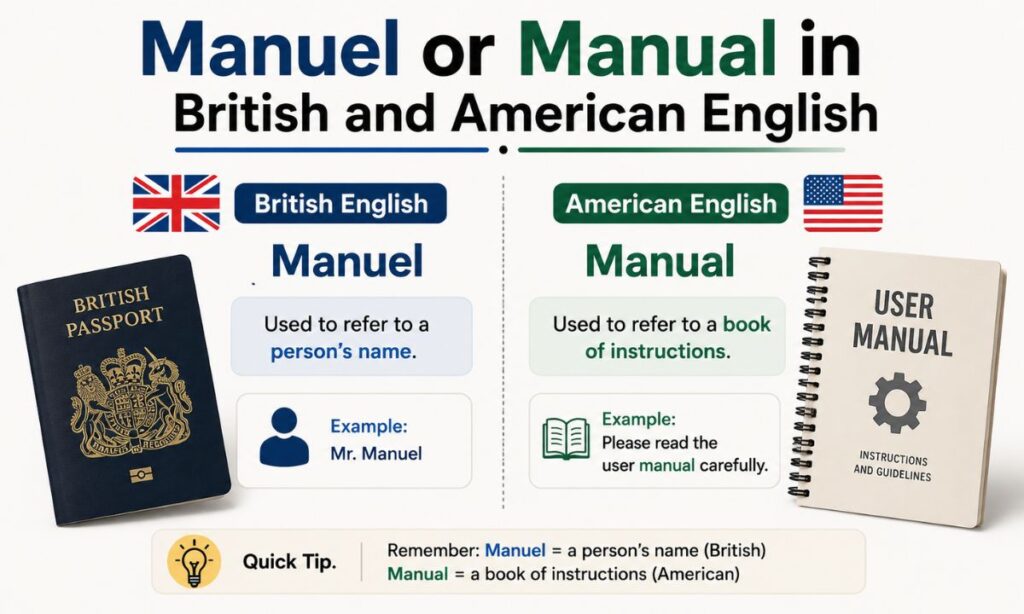
One of the clearest aspects of the Manuel vs. Manual question is that there is absolutely no regional variation to worry about. The spelling does not change between British English and American English.
Both varieties of English:
- Spell the instruction guide and adjective as manual
- Recognize Manuel only as a proper name
- Use the same definitions, grammar rules, and capitalization conventions
This makes the rule genuinely universal. Whether you are writing content for a UK audience, an American publication, an Australian website, or an international audience, manual is correct for the English word and Manuel is a person’s name. No exceptions.
Why “Manual” Is So Important in SEO and Writing
In the context of digital content and SEO, the word manual carries significant weight. It is used across a massive range of high-value search queries, including:
- User manual downloads
- Instruction manual templates
- Manual vs. automatic transmission
- Manual testing in software QA
- Manual labor job listings
- Employee manual examples
Using Manuel instead of manual in any of these contexts would not just confuse readers. It would also signal to search engines that the content contains errors, potentially reducing its authority and ranking potential. Google’s natural language processing tools are sophisticated enough to detect incorrect word usage, and consistent spelling errors can hurt a page’s credibility score.
For anyone creating web content, technical documentation, or professional writing, understanding the Manuel vs. Manual difference is genuinely important for both readability and SEO performance.
Manuel or Manual – Google Trends & Usage Data
Search data from Google Trends confirms what grammar guides already know: the term “manual” is searched at extraordinarily high volumes across English-speaking countries. Queries involving user manuals, instruction manuals, and manual transmission dominate search results constantly.
The query “Manuel vs. Manual” itself is searched thousands of times per month, indicating that a significant portion of the writing public wants confirmation about which spelling is correct before committing to it in their work. This is actually a good sign: it means people are checking rather than assuming.
Importantly, “Manuel” as a name is primarily searched in Spanish-speaking countries and in name-related queries (baby names, notable people named Manuel, etc.) rather than in English language or grammar contexts. This further confirms that in standard English writing, manual is always the correct form for anything that is not a person’s name.
The Origin of Manuel or Manual
The two words in the Manuel vs. Manual pair come from completely different linguistic traditions, which is part of what makes them so easy to mix up visually despite being so different in meaning.
Origin of Manual: The word “manual” entered English around 1400 CE. It came from the Latin word “manualis,” which is derived from “manus,” the Latin word for “hand.” The earliest English uses referred to small books designed to be carried in the hand or easily referenced one-handed. By the 1530s, the meaning had expanded to include any concise handbook or guide. The connection to hand-operated tasks followed naturally from the same root.
Origin of Manuel: “Manuel” is a proper name with a rich and layered history. It is the Spanish and Portuguese form of “Emmanuel,” which comes from the Hebrew name “Immanuel” (עִמָּנוּאֵל), meaning “God is with us.” The name appears in the Old Testament and was widely used in Christian tradition. It traveled from Hebrew into Greek as “Emmanouēl,” then into Latin as “Emmanuel,” and eventually shortened to “Manuel” in the Iberian Peninsula during the 13th century. Two kings of Portugal bore this name, and it remains one of the most enduring traditional names across Spanish and Portuguese-speaking cultures worldwide.
Despite the very different roads each word traveled to reach modern English, they arrived sounding almost identical, and that is the source of the Manuel vs. Manual confusion that continues in 2026.
Read This: NTR Meaning: Definition and Simple Guide 2026
Last Words
The Manuel vs. Manual question has a definitive answer that never changes: use manual when you mean an instruction guide, a handbook, or something operated by hand, and use Manuel only when you are referring to a person with that name.
This is not a matter of style or dialect. It is a clear distinction between a proper noun and a common English word. The two terms come from entirely different origins, serve entirely different purposes, and should never be used interchangeably.
In professional writing, technical documentation, SEO content, school essays, and everyday emails, correct spelling builds credibility. Mixing up Manuel vs. Manual in a user manual, an employee handbook, or a product description signals carelessness. The good news is that once you know the rule and the memory tricks, this is one of the easiest spelling challenges in English to permanently solve.
Bookmark this guide, share it with colleagues who hesitate over Manuel vs. Manual, and write with complete confidence going forward.

Welcome to MeaningDeck! I’m Alex, an AI-Powered SEO, and Content Writer with 2 years of experience.
I help websites rank higher, grow traffic, and look amazing. My goal is to make SEO and web design simple and effective for everyone.
Let’s achieve more together!