

You see it everywhere. Someone tweets something wild, and the replies are full of “ONG.” Your friend sends it in a text. A comment section is drowning in it. And you’re sitting there thinking, “Is this a typo? A new religion? A secret code?” You are not alone.
ONG is one of those internet slang terms that spread faster than an explanation could follow. So let’s fix that right now.
What Does ONG Mean?
ONG means “On God.” It is a slang expression used to swear that something is completely true. When someone says ONG, they are saying, “I am telling you the absolute truth” or “I promise, no lies.” Think of it as the internet’s version of placing your hand on a Bible and saying, “I swear.”
If someone says “ONG that pizza was the best thing I’ve ever eaten,” they are not exaggerating for fun. They genuinely mean it, and they want you to believe them.
Simple, right? Now let’s go deeper.
Where Did ONG Come From?

ONG grew out of African American Vernacular English (AAVE), specifically from the phrase “On God,” which itself comes from a long tradition of swearing by God as the highest form of truth-telling.
People have been saying “I swear to God” or “On God” in spoken conversation for decades. When that phrase moved into text messaging and social media, people shortened it. “On God” became ONG because nobody has time to type full words when emotions are running high.
The term picked up serious momentum around 2019 and 2020 on TikTok and Twitter, where short, punchy expressions travel at the speed of light. Once Gen Z adopted it, it spread into mainstream online culture almost overnight.
Read This: HMU Meaning: What It Really Means and How to Use It Right
Is ONG the Same as OMG?
This is the big one. People mix these up constantly, and honestly, it makes sense because they look almost identical.
Here is the difference:
| Term | Stands For | Used To Express |
| ONG | On God | Truth, sincerity, a sworn statement |
| OMG | Oh My God | Surprise, shock, disbelief, excitement |
OMG is a reaction. You say OMG when something surprises you.
ONG is a confirmation. You say ONG when you want someone to believe you.
So if someone texts you “OMG did that really happen?” and you reply “ONG it did,” you have used both correctly. That is a full conversation in six letters. The internet is efficient.
How to Use ONG in Real Life
ONG works best when you want to add emphasis and sincerity to a statement. It fits naturally in casual, informal settings like texting, social media captions, comments, and group chats.
Here are some real examples of how people actually use it:
In a text message: “ONG I waited 45 minutes for this coffee. Worth it though.”
In a comment: “This song is ONG the best thing released this year.”
As a standalone response: Someone says: “You ate that whole pizza by yourself?” You say: “ONG.”
On TikTok or Twitter: “ONG why did no one tell me about this life hack earlier?”
Notice that ONG can go at the beginning, middle, or end of a sentence. It is flexible like that.
The Biblical and Cultural Roots of “On God”
This part is worth understanding because it adds real depth to a seemingly casual term.
Swearing by God has ancient roots. In the Bible, taking oaths in God’s name was a serious act of commitment. Deuteronomy, Matthew, and James all reference the practice of swearing oaths and the weight those oaths carry. To say something “on God” meant you were invoking the highest possible witness to your truth.
That gravity carried into modern spoken language, especially in Black American communities, where “On God” became a culturally significant way to assert honesty and sincerity. It was not just casual slang. It had weight.
When it became ONG online, some of that weight traveled with it. Yes, people use it casually, but the underlying meaning is still: “I am telling you the truth, and I am putting everything on the line to say so.”
ONG in Different Contexts: Does the Meaning Change?
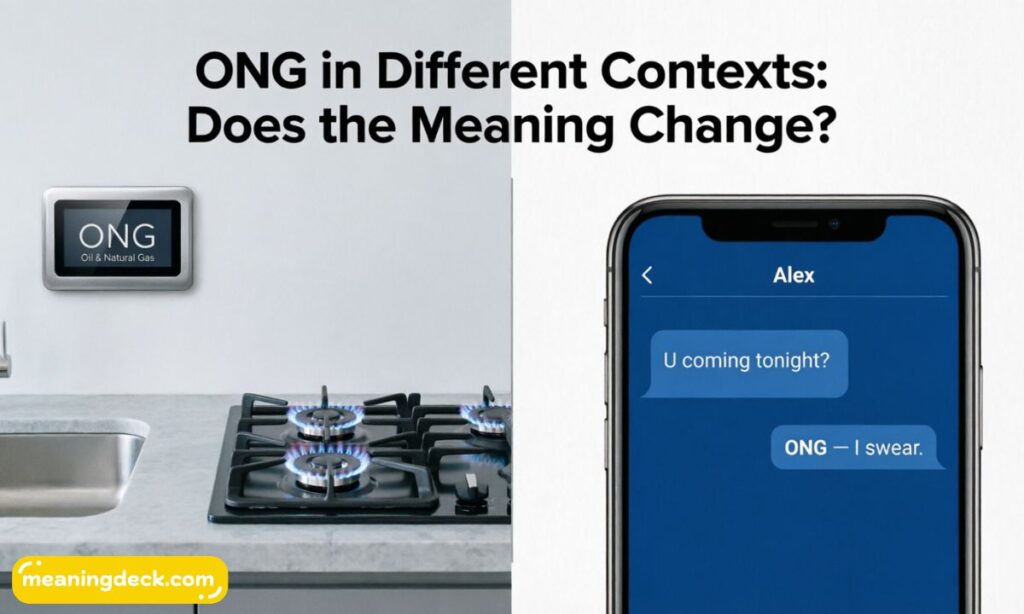
Mostly no, but the tone can shift depending on how it is used.
Serious context: “ONG I have never felt this exhausted in my life.” Here, it signals genuine honesty.
Humorous context: “ONG this cat just knocked over my entire dinner.” Here, it adds emphasis with a light dramatic flair.
Validation context: Someone shares a frustrating experience, and you reply “ONG same.” Here, it means “I relate completely and I am not exaggerating.”
The core meaning stays the same: truthfulness and emphasis. The energy around it shifts based on what you are talking about.
Common Mistakes People Make With ONG
A few things people get wrong when using ONG:
Mistake 1: Thinking it means OMG. These are not interchangeable. ONG is about truth. OMG is about surprise. Using them backwards makes your message confusing.
Mistake 2: Using it in formal settings. ONG belongs in casual conversations. Do not end a work email with “ONG this report took forever.” Your boss will have questions.
Mistake 3: Overusing it. Like any emphasis word, ONG loses its punch if you drop it into every single sentence. Use it when something genuinely needs that extra sincerity.
Mistake 4: Confusing it with “ong” the musical term. In some music and cultural discussions, “ong” refers to a tone or sound. Context will usually make it obvious which one someone means.
Which One Should You Use: ONG, FR, or No Cap?
If you are navigating the crowded world of internet slang truth-tellers, here is a quick guide:
ONG (On God): Use when you want to swear something is true with maximum sincerity.
FR (For Real): Use when you want to agree with something or confirm it casually. Lower intensity than ONG.
No Cap: Use when you want to say you are not lying or exaggerating. Very similar to ONG but slightly more playful in tone.
The rule of thumb: The more unbelievable your statement sounds, the stronger the emphasis you need. “FR this was good” is fine for mild praise. “ONG this changed my life” carries more emotional weight.
Is ONG Appropriate for Everyone to Use?
Here is where it gets a little nuanced. ONG comes from AAVE, which means it carries cultural roots that deserve acknowledgment.
Using it respectfully means understanding where it comes from. Using it naturally in casual digital conversation is generally accepted. Using it to mock or mimic a culture is not.
For most people, ONG is simply a part of internet language that has been widely adopted across communities. But being aware of its origins makes you a more thoughtful communicator, and honestly, a cooler one.
Read This: What Does BMF Mean?
Related Terms You Will See Alongside ONG
Once you know ONG, these related terms will start making total sense:
On sight (ONS): Meaning immediate action or immediate agreement.
Deadass: Another word for being completely serious, similar to ONG.
Frfr (For real for real): An even stronger version of FR, used when something is especially true.
Bet: Means agreement or confirmation. Similar energy to ONG but used as a response rather than a statement.
These terms often appear together in conversations, and now you will understand all of them.
Frequently Asked Questions
Is ONG always religious?
Not in everyday use. While it comes from “On God,” most people use it simply to emphasize sincerity. It functions more like a truth marker than a religious statement in casual conversation.
Can ONG be used sarcastically?
Yes, and when it is, context carries all the weight. “ONG best day of my life” after describing something clearly terrible reads as sarcastic humor. Tone in text depends on what surrounds the word.
Is ONG only used by Gen Z?
It originated with younger internet users, but language does not stay in one age group for long. You will find it used across generations online today, especially on platforms like TikTok, X (formerly Twitter), and Instagram.
Final Thought
ONG means “On God,” and it is one of the most direct, sincere things you can say in digital conversation. It is a sworn statement wrapped in three letters, born from a long tradition of truth-telling that stretches back centuries.
Now that you know what it means, where it came from, and how to use it without making the classic OMG mixup, you are fully equipped. Go forth and use your internet slang with confidence.ONG, this was the most helpful explanation you have read today.

Welcome to MeaningDeck! I’m Alex, an AI-Powered SEO, and Content Writer with 2 years of experience.
I help websites rank higher, grow traffic, and look amazing. My goal is to make SEO and web design simple and effective for everyone.
Let’s achieve more together!