

Someone just sent you NTY and now you are sitting there wondering if you should be offended or not. Or maybe you want to use it yourself but you are not sure if it lands the way you intend. Either way, the confusion stops here. NTY means “No Thank You.” It is a short, direct, and polite way to decline something in a text message, online chat, or social media conversation. Three letters. One clear message. Zero drama. Usually.
What Does NTY Mean in Plain Language?
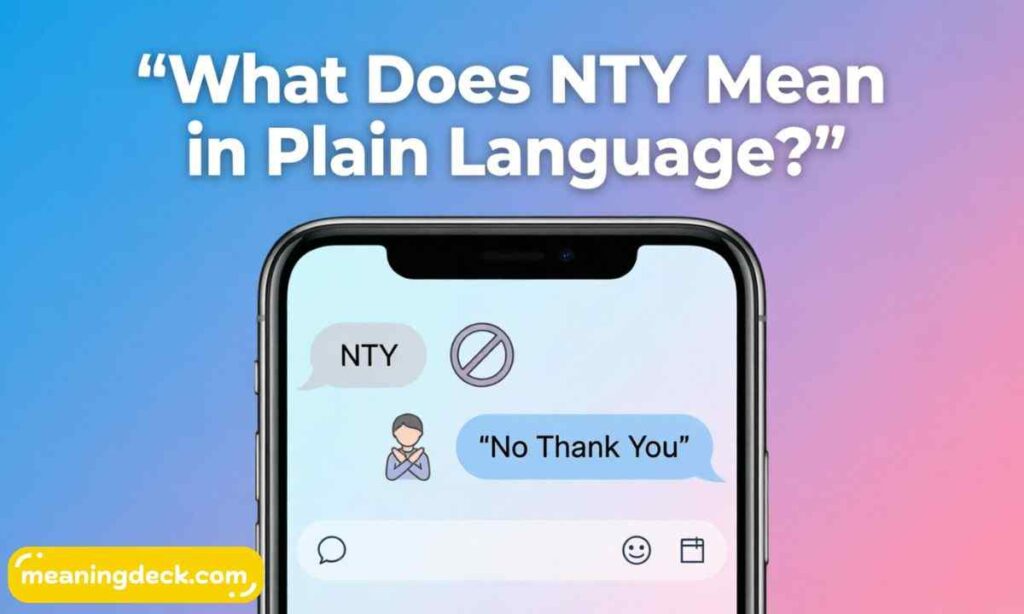
NTY stands for “No Thank You.” It is used to politely decline an offer, suggestion, invitation, or request in digital communication.
It carries the same meaning as saying “no thank you” out loud, just compressed for the pace of online conversation. When someone offers you something and you do not want it, NTY is the fast, clean, socially acceptable way to say so without writing a full sentence.
The tone is generally polite rather than rude. It is a soft no, not a hard rejection. Think of it as the digital equivalent of shaking your head with a small, courteous smile.
Where Did NTY Come From?
NTY grew out of the same internet culture that produced most modern text abbreviations. The late 1990s and early 2000s were the golden era of chat shortcuts. Platforms like AOL Instant Messenger and early SMS texting created environments where speed mattered and character counts were limited.
People were already using TY for “thank you” and TYS for “thank you sir.” The natural counterpart to TY was NTY, a way to decline with the same brevity and social grace.
It spread gradually through gaming communities, chat forums, and eventually mainstream texting culture. In online gaming particularly, NTY became extremely common. When another player offers to trade an item or help with a quest and you do not need it, typing NTY is faster and kinder than typing out a full refusal.
From gaming lobbies to group chats to Instagram comments, NTY made its way into everyday digital language one polite decline at a time.
Has the Idea of Polite Refusal Always Mattered This Much?
The abbreviation is modern but the social art of declining gracefully is ancient. Every major culture throughout history has understood that how you say no matters just as much as the fact that you said it.
In the Bible, the concept of a respectful refusal appears in multiple places. When Ruth’s kinsman redeemer was given the right of first refusal over land and later over Ruth herself, he declined respectfully and removed his sandal as a public acknowledgment of his decision, as described in Ruth 4:6. The refusal was handled with dignity and ceremony, not dismissal.
The ancient Greeks valued the concept of sophrosyne, a word meaning self-restraint and measured response. Saying no thoughtfully was considered a sign of wisdom, not weakness.
In many Eastern cultures, the manner of refusal carries as much social significance as the refusal itself. A blunt “no” could damage relationships, while a soft, gracious decline preserved them.
NTY is essentially a digital echo of this ancient social wisdom. It lets you say no while still keeping the “thank you” in the sentence.
You Also Like This: RLS Meaning in Text: Shocking Truth Revealed (2026 Guide)
NTY vs. No vs. Nah vs. Nope: What Is the Real Difference?
Refusing something digitally has a surprisingly wide vocabulary. Here is a clear comparison so you know exactly what each option communicates:
| Expression | Full Meaning | Tone | Best Used When |
| NTY | No Thank You | Polite, soft | Declining offers kindly |
| No | No | Neutral, direct | Clear refusal with no extra warmth |
| Nah | No (informal) | Casual, relaxed | Among close friends |
| Nope | No (light) | Playful, breezy | Informal low-stakes situations |
| Hard pass | Definitely no | Emphatic, humorous | Strong rejection with personality |
| I’m good | No thanks | Gentle, indirect | Soft decline without using “no” directly |
| Pass | No interest | Brief, neutral | Quick refusal in casual settings |
The key advantage of NTY over all the others is that it keeps gratitude attached to the refusal. You are not just saying no. You are saying no while still acknowledging the offer was appreciated.
That combination of declining and appreciating at the same time is what makes NTY socially smooth.
How Do You Actually Say NTY Out Loud?
Like most abbreviations, NTY is primarily a written term. You type it, you do not typically speak it in conversation.
When speaking, you would simply say the full phrase: “No thank you.”
That said, in casual video calls, voice chats on gaming platforms, or recorded content online, some people do spell it out as N-T-Y when they want to be playful or reference internet culture. It can get a laugh in the right context.
The practical rule is straightforward: NTY lives in text. In speech, use the full phrase. Nobody at a dinner table wants to hear “N-T-Y to the mashed potatoes, please.”
Real-Life Examples of NTY Used Correctly

Seeing NTY in actual context removes any remaining uncertainty about how and when to use it. Here are examples across different digital settings:
In a text between friends: “Hey, want to come to the gym with me at 6am tomorrow?” “NTY. I value my sleep more than my abs.”
In an online gaming chat: “I can carry you through this level if you want.” “NTY, I want to try it myself first.”
In a group chat: “Anyone want the leftover pizza from the meeting?” “NTY, just ate. Someone else grab it.”
In a social media comment: “You should try this new detox tea, it changed my life!” “NTY, but thanks for sharing!”
In a marketplace or resale app: “Would you take $10 less for it?” “NTY, the price is firm.”
Each example shows NTY doing the same job: declining clearly, quickly, and without being rude about it.
When Is NTY Appropriate and When Does It Miss the Mark?
NTY works well in most casual digital settings, but like every abbreviation, it has situations where it fits perfectly and situations where it creates the wrong impression.
NTY works well in these contexts:
- Texting friends or family in a casual conversation
- Online gaming when declining trades, help offers, or group invitations
- Social media replies to suggestions or offers
- Group chats where everyone knows each other and the tone is informal
- Marketplace or buy-sell apps when declining a counteroffer
NTY does not work well in these contexts:
- Professional emails or workplace communication
- Declining a formal job offer or business proposal
- Responding to a client or someone you have never met before
- Any situation where the other person is being genuinely generous or vulnerable
In formal situations, writing “No, thank you” in full shows more respect and intentionality. An abbreviation in those moments can feel dismissive even when you do not mean it that way.
NTY in Gaming Culture: Why It Became So Popular There
It is worth giving gaming culture its own spotlight here because that is genuinely where NTY found its largest and most enthusiastic audience.
Online multiplayer games create constant social situations where players offer each other things: items, help, trades, team spots, and strategies. These interactions happen fast, often mid-game, and require quick responses.
Typing “No thank you, I appreciate the offer but I would like to handle this myself” is not realistic when you are in the middle of a raid. NTY solved that problem perfectly.
It became so embedded in gaming communication that many players now use it naturally in non-gaming conversations too, carrying the habit from the keyboard to the text thread.
This cross-pollination from gaming into mainstream digital culture is exactly how many of the most recognized internet abbreviations spread. Gaming communities have quietly shaped how millions of people communicate online.
Other Meanings of NTY You Might Not Expect
Most of the time, NTY means “No Thank You” and that interpretation fits almost every digital context you will encounter. However, there are a few alternate uses worth knowing.
In some professional and corporate environments, NTY can appear as an abbreviation for “Not This Year”, used in budget planning, performance reviews, or project scheduling when a request or proposal is deferred rather than rejected permanently.
In certain regional slang and niche online communities, NTY occasionally appears as shorthand for other phrases, though these uses are far less common and often specific to very small groups.
Unless you are in a highly specific professional context or a niche online community, assume NTY means “No Thank You.” That interpretation is correct the overwhelming majority of the time.
Common Mistakes People Make With NTY
A few misunderstandings follow NTY around consistently. Here is what to watch out for:
Mistake 1: Reading NTY as rude or cold. NTY is actually one of the more polite refusals in digital communication because it keeps “thank you” in the message. It is not aggressive or dismissive. If anything, it is the abbreviation version of a gracious decline.
Mistake 2: Confusing NTY with NYT. NYT is the abbreviation for The New York Times. NTY is “No Thank You.” Very different things. Mixing them up creates interesting sentences. “NYT to the dinner invite” will confuse people significantly.
Mistake 3: Using NTY in formal professional communication. An email to a business contact or potential partner that includes NTY will undermine your professional image. Write out “No, thank you” in full in any formal written context.
Mistake 4: Assuming NTY is passive aggressive. In text, tone is hard to read. Some people worry that NTY sounds sharp or cold. It does not, as long as the surrounding conversation is warm and normal. If you are worried about tone, add a brief explanation after it: “NTY on that one, already sorted it out though!”
NTY vs. “No Thank You”: Which One Should You Use?

The choice between NTY and the full phrase “No thank you” comes down entirely to context and relationship.
Use NTY when:
- You are texting someone you know well
- The conversation is fast, casual, and already using abbreviations
- You are in an online game or digital community setting
- Speed matters and the situation is low stakes
Use “No thank you” written in full when:
- You are communicating professionally or formally
- The person made a significant offer that deserves a thoughtful response
- You are writing an email rather than a quick message
- The decline involves something emotionally significant to the other person
Both communicate the same thing. The full phrase simply signals more care and formality. When the relationship or situation calls for that extra effort, write it out. When you are just declining a meme share in a group chat, NTY gets the job done just fine.
You Also Like This: TM Meaning in Text
Related Abbreviations That Live in the Same Space as NTY
Now that you know NTY thoroughly, here are a few abbreviations that appear in similar conversations and are worth recognizing:
TY means “Thank You” and is the positive counterpart to NTY. Where NTY declines with gratitude, TY accepts with gratitude.
YW means “You’re Welcome” and typically follows a TY. It completes the polite exchange in digital form.
IKR means “I Know Right” and often appears in conversations where someone agrees with a suggestion rather than declining it. Understanding IKR helps you see the full spectrum from agreement to polite refusal.
NBD means “No Big Deal” and sometimes follows an NTY to soften the decline and reassure the other person that no offense was taken.
These abbreviations form a kind of social grammar for digital conversations. Knowing them together makes you a much more fluent communicator online.
Frequently Asked Questions
Is NTY considered rude in online communication?
Not at all. NTY is widely recognized as a polite decline. It is warmer than a plain “no” because it still contains “thank you.” In most casual digital contexts, receiving NTY is not considered offensive. However, tone perception can vary by person, so if you are in a sensitive conversation, adding a short follow-up helps clarify your warmth.
Can NTY be used sarcastically?
In theory, yes. Any phrase can carry sarcasm depending on context. But NTY is not a naturally sarcastic expression. If used with a laughing emoji or in an obviously playful exchange, it can carry light humor. On its own, it is straightforwardly polite. Unlike phrases like “thanks so much” spoken with a certain inflection, NTY in text defaults to genuine courtesy.
Is NTY used more by a specific age group?
NTY is most commonly used by millennials and Gen Z, largely because these groups grew up with internet culture and online gaming where the abbreviation became popular. Older generations tend to write “No thank you” in full, while younger digital natives reach for NTY naturally. That said, anyone who spends significant time in digital communication eventually picks it up regardless of age.
Conclusion
NTY is three letters that do something quietly impressive. They let you say no while still being kind about it. That balance of honesty and courtesy is harder to achieve than it sounds, and NTY manages it every time.
Behind those three letters is a long human tradition of understanding that how you decline something matters just as much as declining it at all. From ancient philosophers to biblical stories to modern gaming lobbies, the gracious refusal has always been valued.
So the next time someone offers you something you do not want, whether it is an extra slice of cake, a questionable trade in a game, or a meeting that could have been an email, you know exactly what to type.

Welcome to MeaningDeck! I’m Alex, an AI-Powered SEO, and Content Writer with 2 years of experience.
I help websites rank higher, grow traffic, and look amazing. My goal is to make SEO and web design simple and effective for everyone.
Let’s achieve more together!